Enterprise AI & Automation Agency | Eplanet Soft
Top AI Tools for Marketing & Automation in 2026
Discover the best AI marketing tools of 2026 to boost lead generation, personalization, and automation. Learn how to choose, implement, and measure ROI. Get started today.
Key takeaways
- AI marketing tools in 2026 are essential for personalization, content velocity, and automation at scale.
- Map tools to business outcomes and evaluate via APIs, integrations, and governance capabilities.
- Start small with pilots, measure lift with controlled experiments, and then scale using cross-functional teams.
- Choose vendors that provide explainability, compliance, and strong integration ecosystems.
- Consider augmenting internal teams by hiring AI engineers or hiring digital marketers to accelerate adoption.
Introduction
The marketing landscape in 2026 is no longer just augmented by artificial intelligence — it’s being fundamentally re-architected by it. Across channels, AI marketing tools are automating repetitive tasks, surfacing actionable insights, and enabling hyper-personalization at scale. For companies that want to stay competitive, understanding the best AI marketing tools and AI marketing automation strategies is now a strategic imperative rather than an experimental luxury. This article dives deep into the top AI tools for marketing & automation in 2026 and explains how to select, implement, and measure them for real business outcomes.
Marketers face three simultaneous pressures: higher expectations for personalized experiences, the proliferation of channels and data sources, and the need to demonstrate measurable ROI. Modern AI tools tackle all three by leveraging models that can write, optimize, predict, and orchestrate marketing actions across platforms. From AI content marketing tools that create campaign-ready copy, to AI tools for lead generation that pre-qualify prospects, the right toolset can shorten campaign cycles and increase conversions.
This guide covers categories of AI tools, a curated list of the top platforms to evaluate in 2026, a comparison table, and practical frameworks for selection, implementation, and governance. We'll include real-world examples, case studies, and data-backed evidence so you can move beyond hype into measurable performance gains. Whether you’re a marketing leader evaluating a stack for the next year, a growth team focused on demand, or an engineering lead integrating AI into your martech ecosystem, you’ll find actionable guidance and links to related services to speed up execution.
Throughout the article you’ll see references to how teams can leverage AI and machine learning solutions from a partner perspective, and where automation and integration matter most. We’ll also point to where to hire AI talent and marketing experts to accelerate adoption. By the end of this post, you’ll have a prioritized playbook to adopt the best AI marketing tools 2026 has to offer and a risk-managed approach to scale them across your organization.
Why AI Marketing Tools Matter in 2026
AI marketing tools matter in 2026 because the volume, velocity, and variety of marketing data have outpaced what human teams can analyze and act on in real time. Machine learning models now analyze multi-touch attribution across channels, generate creative variations, and predict customer lifetime value with an accuracy that materially improves decision-making. According to industry analyses, organizations that embed AI into their marketing stack report faster lead-to-revenue cycles and improved campaign ROI. These tools reduce manual drudgery—like A/B test setups and template-based creative—freeing teams to focus on strategy and creative differentiation.
Another reason AI matters is personalization at scale. Today's consumers expect individualized experiences across email, web, app, and paid channels. AI-driven personalization engines can generate product recommendations, dynamic site experiences, and tailored email sequences that change with each user action. This capability converts interest into revenue more efficiently because it matches offers to intent. Advanced tools use contextual signals—like session behavior and historical purchases—to trigger messages that are not just segmented but individualized in real time.
AI marketing automation is also reshaping go-to-market models. Rather than manually orchestrating hundreds of rules, automation tools now learn from outcomes and propose or enact workflow changes automatically. This reduces time-to-optimization and scales best practices across multiple campaigns and markets. The result is a virtuous cycle where AI-driven experimentation informs strategy, and strategy feeds back into models that power future automation decisions.
Finally, governance and compliance are increasingly embedded in tool selection. Vendors are releasing explainable AI features, consent management hooks, and data lineage tools that help marketing teams stay compliant while using advanced models. For organizations concerned with privacy and risk, modern AI marketing tools include privacy-first capabilities that make it practical to deploy personalization without compromising customer trust.
Impact on ROI
When evaluating impact on ROI, consider both direct and indirect benefits. Direct benefits include higher conversion rates, increased average order value, and better-qualified leads. Indirect benefits include faster campaign iteration, reduced operational costs, and improved cross-team collaboration because AI automates repetitive tasks. Real-world examples show that brands using AI content and personalization tools can see conversion uplifts between 10-40% depending on channel and maturity.
Adoption Rates and Market Context
AI adoption in marketing is accelerating: according to insights from market analysts, more than half of leading marketers have implemented at least one AI-driven tool in their stack by 2025. For enterprise buyers, AI is no longer a checkbox but a requirement for modern stacks. The increased availability of pre-built integrations, SDKs, and APIs has lowered the technical barrier for mid-market and enterprise firms to deploy advanced capabilities.
Categories of AI Tools for Marketing & Automation
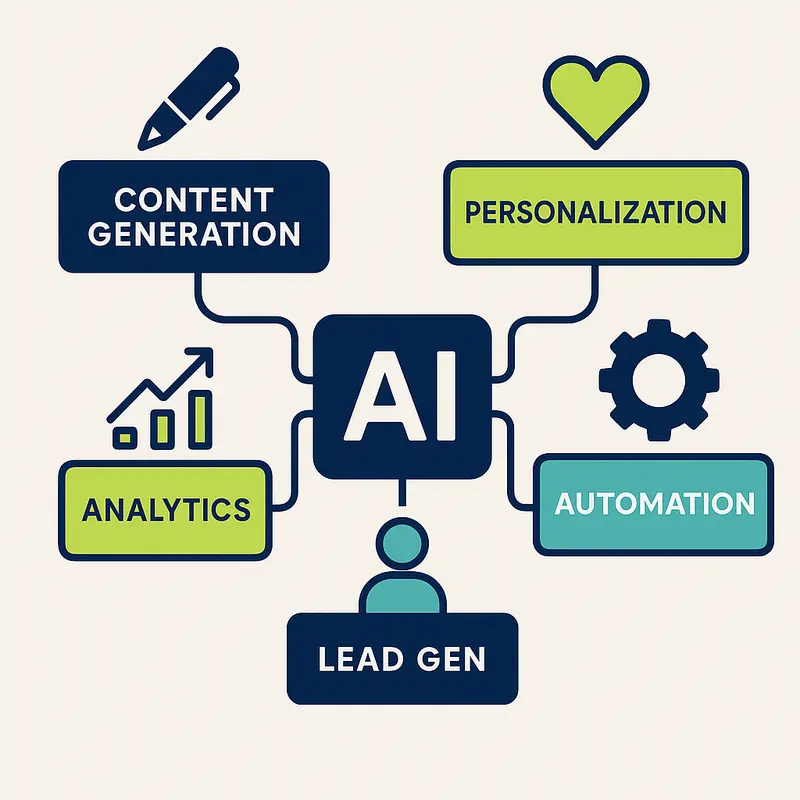
Understanding categories helps you design a balanced stack. AI marketing tools generally fall into six major categories: AI content marketing tools, AI-driven personalization engines, AI tools for lead generation and qualification, analytics and insights platforms, automation orchestration platforms, and creative/visual generation tools. Each category solves a distinct set of use cases and requires different evaluation criteria—some are creative-first, others are data-first. When you map tools to use cases, you avoid redundant spend and build a cleaner tech stack that delivers measurable outcomes.
AI content marketing tools are focused on ideation, copy generation, and content optimization. They reduce content production time and provide SEO-informed drafts that marketers can refine. Tools in this category often integrate with SEO platforms to generate content briefs and optimize on-page copy for target keywords. They are invaluable for teams with high content velocity needs such as blogs, product descriptions, and campaign landing pages.
Personalization engines power individualized experiences across web, email, mobile, and in-app messaging. These platforms rely on predictive models to score and serve recommendations, dynamic creative, and personalized landing pages. The most advanced solutions use reinforcement learning to iteratively improve content selection and user journeys. They are particularly effective for e-commerce, subscription, and high-touch B2B experiences where small improvements in CVR yield outsized revenue impact.
AI Content Marketing Tools
Tools in this category include modern language models and dedicated content platforms that create long-form articles, ad copy, social posts, and SEO content. The best platforms combine generative capabilities with guardrails—tone-of-voice controls, brand safety filters, and plagiarism checks. They often include integrations with editorial workflows and CMS systems so that content flows from draft to publish with version control and approvals.
AI Personalization & Recommendations
Personalization platforms ingest behavioral, transactional, and CRM data to power one-to-one experiences. They may provide product recommendation engines, on-site personalization layers, and email personalization tokens driven by predictive scoring. The evaluation focus should be on data connectors, latency (real-time vs batch), and the ability to run controlled experiments to measure lift.
AI Lead Generation & Qualification
Lead generation tools use AI to enrich profiles, predict propensity, and automate outreach sequences. They reduce time wasted by sales on low-quality prospects and automate lead scoring models that continuously learn from conversion signals. For B2B marketers, these platforms integrate with traditional CRMs and outreach tools to close the loop from initial interest to qualified opportunity.
Top AI Marketing Tools to Consider in 2026
The market for AI tools is crowded but maturing. Below is a curated list of platforms worth evaluating in 2026, grouped by primary capability. Each entry contains where the tool excels and a representative business use case. When possible, we include vendor strengths and any notable limitations so you can quickly match them to your needs.
| Tool | Primary Use | AI Capabilities | Best For | Estimated Price Range |
|---|---|---|---|---|
| OpenAI GPT (ChatGPT / API) | Content generation & chat | Large language models, few-shot tuning, embeddings | Content teams, chatbots, idea generation | Pay-as-you-go; enterprise plans |
| HubSpot (AI features) | CRM + Marketing Automation | Predictive scoring, content generation, workflow suggestions | SMB to mid-market inbound teams | Tiered SaaS pricing |
| Salesforce Einstein | Personalization & predictions | Predictive insights, personalization API | Enterprise CRM-integrated personalization | Enterprise pricing |
| Adobe Firefly / Adobe Sensei | Creative generation | Image generation, asset tagging, video assist | Creative teams, brand design | Adobe Creative Cloud bundles |
| Jasper / Writesonic | Marketing copy & SEO | Templates, SEO integrations, fine-tuning | Content marketers & agencies | Subscription tiers |
| Surfer / Semrush (AI SEO) | SEO optimization | Content briefs, SERP analysis, on-page suggestions | SEO teams & content ops | Subscription tiers |
| Klaviyo | Email & SMS personalization | Predictive targeting, dynamic flows | E-commerce brands | Volume-based pricing |
| Drift / Intercom | Conversational marketing | AI chatbots, routing, intent detection | B2B demand generation & support | Subscription + usage |
| ZoomInfo / Apollo (Enrichment) | Lead enrichment & intent | Data enrichment, intent signals | B2B SDR teams and account-based marketing | Enterprise / seat pricing |
| Zapier / Make (Automation) | Workflow automation | Event-driven triggers, AI-enabled actions | SMB integrations, cross-tool orchestration | Subscription tiers |
Note: Pricing estimates are indicative because many vendors vary by usage, seats, and enterprise deals. When shortlisting tools, request case studies from vendors that match your industry and ask for performance SLAs and integration references.
How these tools are typically used together
An effective stack usually combines generative LLMs for content creation (OpenAI, Jasper), an SEO platform for optimization (Surfer, Semrush), a personalization layer for web and app (Salesforce Einstein or a CDP), and an automation/orchestration layer (HubSpot or Zapier) that ties marketing actions to CRM and advertising platforms. For lead generation, combine enrichment services like ZoomInfo with conversational tools like Drift to qualify leads in real-time and push high-quality leads into the sales pipeline.
How to Evaluate and Select the Best AI Marketing Tools
Selecting the right tool requires a repeatable evaluation framework that aligns with business goals. Start with outcomes: are you optimizing for lead volume, conversion rate, time to close, or content velocity? Map each tool to the metric it most directly influences. Next, evaluate technical fit: data connectors, APIs, SDKs, latency, and deployment model (cloud vs on-prem). Consider vendor stability and model governance—ask about model refresh cadence, retraining practices, and the ability to export and validate predictions.
Consider cost not only as subscription fees but also integration, maintenance, and opportunity costs. A cheaper tool with poor integrations increases developer time and creates operational friction that offsets savings. Look for vendors with robust documentation, pre-built connectors for common CRMs and ad platforms, and active developer communities. Check references and request to see anonymized examples of outcomes achieved for businesses similar to yours.
Another critical axis is explainability and compliance. For enterprise deployments, choose platforms that provide model explainability, audit logs, and data governance features. If your business operates under strict data regulations (e.g., GDPR, CCPA), ensure the tool has consent management and data residency options. Evaluate the vendor’s security certifications such as SOC 2 and ISO 27001 to mitigate risk.
Integration and APIs
APIs determine how quickly you can realize value. Look for REST/GraphQL APIs, webhook support for event-driven architectures, and SDKs for popular languages. Integration speed matters when you want to link AI-powered insights to downstream systems like your CRM, ad platforms, and analytics. If you’re using a headless stack or a custom web application, the ability to embed the AI engine via API reduces time-to-production dramatically.
Data Privacy & Compliance
Ask vendors how they handle PII, model training data, and opt-out requests. Insist on contractual language that prevents model training on your private data unless explicitly approved. For global companies, confirm data residency options and any GDPR/CCPA compliance features. These clauses are increasingly standard and essential to prevent downstream legal and reputational risks.
Performance Measurement & ROI
Design experiments and measurement plans before full rollouts. Use holdout groups and A/B tests to measure lift attributable to AI interventions. Typical metrics include conversion rate uplift, cost-per-lead reduction, and increased average order value. For example, a personalized product recommendation engine might be measured by incremental revenue per user and repeat purchase rates over 90 days.
Implementation Best Practices and Change Management
Implementation success hinges as much on process as on technology. Start small with a pilot that targets a single high-value use case—like abandoned-cart recovery using AI-generated email copy—so you can measure impact before scaling. A phased approach reduces risk: pilot, validate, scale, and govern. Establish cross-functional teams that include marketing, data engineering, product, and legal to ensure all angles are covered. This also helps institutionalize learnings and create reusable playbooks for subsequent rollouts.
Training and enablement programs are crucial. Marketing teams need to understand how to prompt and refine generative outputs, how to interpret model predictions, and how to trust AI-driven recommendations. Build internal centers of excellence or partner with external vendors and agencies that specialize in deploying marketing automation tools and AI-driven workflows. Providing templates, standard operating procedures, and playbooks will reduce variance in execution and accelerate time-to-value.
Hiring and human capital are also essential components. Many organizations augment in-house teams with external talent to bridge skill gaps. You can source specialized talent via targeted hiring of AI engineers or digital marketers with AI experience. For example, hiring dedicated talent for model integration and MLOps is often necessary to maintain production systems reliably. If you prefer to extend your permanent team rapidly, consider channels to hire AI engineers or hire digital marketers with proven martech experience.
Build vs Buy
Deciding whether to build or buy depends on IP, timelines, and engineering capacity. Buy when the tool provides packaged value and ongoing model maintenance that would be costly to replicate. Build when you need highly specialized models or when data sensitivity prevents vendor-hosted training. A hybrid model often works: leverage vendor APIs for baseline capabilities while developing proprietary models for differentiating features.
Operationalizing & Monitoring
Operationalization includes model monitoring, data drift detection, and fallback logic. Create dashboards that track model performance metrics, such as prediction accuracy and business KPIs (e.g., revenue per recommendation). Establish an incident response plan if model outputs degrade or produce harmful content. Regular reviews and retraining cycles should be part of your SLA with vendors or internal teams.
Real-World Case Studies and Measurable Results
Below are three anonymized, representative case studies that show how companies achieved measurable results by adopting AI marketing tools. Each example highlights the tools used, the approach, and the outcomes to provide practical learning for your own programs.
Case Study 1: E-commerce Brand — Personalization & Email AI
Business challenge: A mid-market e-commerce retailer had a high cart abandonment rate and struggled with email engagement. Approach: The team implemented a personalization engine combined with an email AI platform to serve dynamic product recommendations and automatically generate subject lines and body copy tailored to browsing behavior. Tools: personalization layer + AI email platform + CRM integration. Outcome: Within 12 weeks, click-through rates rose by 32% and abandoned cart recovery revenue increased by 22%. The company attributed the improvement to real-time recommendations and automated subject-line optimization.
Case Study 2: B2B SaaS — Conversational Lead Qualification
Business challenge: A B2B SaaS vendor saw website visitors but low demo conversion rates. Approach: They deployed an AI-driven conversational marketing tool that qualified leads using a combination of enrichment data and intent signals, then routed high-quality leads to sales reps with priority tags. Tools: conversational AI + enrichment service + sales automation workflow. Outcome: Demo booking rates increased 45%, and sales qualified lead (SQL) conversion improved by 28% over six months. The automation reduced manual triage time, letting SDRs focus on closing.
Case Study 3: Media Company — Content Velocity & SEO
Business challenge: A digital publisher needed to scale topical coverage rapidly to capture seasonal demand. Approach: The editorial team used AI content marketing tools integrated with an SEO optimization platform to produce briefs, drafts, and on-page improvements. Tools: LLM-based content generator + SEO analysis tool + editorial CMS integration. Outcome: Organic traffic to targeted seasonal pages grew by 60% YoY, and content creation time per article dropped by 70%, enabling the team to publish 3x more articles during peak season.
Future Trends: What’s Next for AI Marketing After 2026
The pace of innovation will continue. Expect to see more autonomous marketing agents that can run entire campaigns end-to-end with minimal human intervention, while human marketers provide high-level strategy and oversight. Multimodal models that combine text, image, audio, and video will enable richer creative personalization, powering dynamic video ads and interactive content tailored to individual profiles. We’ll also see tighter integration between AI marketing tools and customer data platforms (CDPs) so that personalization decisions become more accurate and privacy-conscious.
Another trend is the commoditization of baseline AI capabilities, which will push vendors to differentiate on data, vertical expertise, and workflow integrations. Vendors that provide better data connectors, explainability, and purpose-built models for specific industries (e.g., healthcare marketing, regulated financial services) will outcompete generalized offerings. This shift increases the importance of vendor evaluation across domain expertise and not just model performance.
Finally, responsible AI and ethical advertising will become mainstream requirements. Regulators and consumer expectations will drive processes for transparency around automated decisions and use of personal data. Companies that proactively build consent-first architectures and invest in explainable AI will reduce legal risk and preserve brand trust in an era of intense scrutiny.
“AI accelerates marketing operations and personalization, but accountability and measurement determine whether it drives real business value.” — Industry analysis
Actionable Roadmap: 90-Day Plan to Adopt AI Marketing Tools
To convert strategy into action, here’s a pragmatic 90-day plan. Week 1-2: define objectives and KPIs, select one priority use case (e.g., email personalization or conversational lead qualification). Week 3-6: run vendor discovery and shortlisting based on the evaluation criteria we described (APIs, compliance, integrations). Week 7-10: configure a pilot, establish tracking and measurement frameworks, and train users. Week 11-12: run the pilot, collect results, and prepare a go/no-go decision for scale. This phased approach preserves capital, reduces risk, and yields learnings that you can codify into repeatable processes for other initiatives.
For teams that lack internal bandwidth, partnering with a solutions provider or hiring a dedicated team speeds execution. If you want to scale quickly across multiple programs, consider engaging with specialists in demand generation and martech implementation who can bring playbooks and pre-built integrations. Firms that have executed dozens of implementations can avoid common pitfalls and reduce time-to-value significantly.
Conclusion
AI marketing tools are no longer speculative investments; they are mission-critical components of modern marketing stacks. The right combination of generative AI, personalization engines, automation orchestration, and analytics can drastically improve lead generation, conversion rates, and campaign efficiency. But technology alone is not enough. Success requires clear objectives, rigorous vendor evaluation, governance structures, and a phased implementation roadmap that enables measurement and iteration.
If you’re evaluating AI tools for marketing or planning to scale automation across channels, begin with a focused pilot that targets a high-impact use case, measure lift with sound experimental design, and use those learnings to scale. When time is a constraint, consider partnering with experienced teams who specialize in integrating AI tools within existing martech ecosystems. Our team helps companies select and implement the best AI marketing automation and AI digital marketing tools to deliver measurable results — from strategic planning to production deployment.
Additional Resources & References
- Market and AI adoption trends: McKinsey: AI Adoption Advances
- Industry insights and strategic guidance: Gartner: Marketing Insights
- Market sizing and statistics: Statista (search for marketing automation and AI statistics)
Frequently Asked Questions
Top AI Tools for Marketing & Automation in 2026.
What are AI marketing tools and how do they differ from traditional marketing software?
AI marketing tools leverage machine learning and generative models to automate tasks, generate content, predict outcomes, and personalize experiences in real time. Unlike traditional marketing software that follows static rules, AI tools learn from data and continuously improve predictions and recommendations, enabling more adaptive campaigns and hyper-personalization.
Which AI tools are best for lead generation in 2026?
Best-in-class lead generation tools in 2026 combine enrichment services (like ZoomInfo or Apollo), conversational AI (like Drift), and predictive scoring engines within your CRM. These tools automate qualification, surface intent signals, and route high-value leads to sales reps — reducing manual triage and increasing conversion rates.
How should I measure ROI when implementing AI marketing automation?
Measure ROI by defining clear pre-launch KPIs such as conversion rate uplift, cost-per-lead reduction, and time-to-close. Use control groups, A/B tests, and holdouts to attribute lift to AI interventions. Track operational metrics too — like content production time saved and reduction in manual workflows — to account for both direct and indirect benefits.
What are common pitfalls when adopting AI tools for marketing?
Common pitfalls include choosing tools without proper integration capabilities, underestimating data quality needs, ignoring governance and privacy considerations, and failing to plan for change management and training. Starting with a clear pilot and measurable objectives helps mitigate these risks.
Do I need in-house AI expertise to deploy marketing AI tools?
Not always. Many vendors provide turnkey solutions with low-code/no-code interfaces that marketing teams can use. However, for production-grade deployments, custom integrations, or proprietary models, hiring AI engineers or partnering with specialists will help maintain reliability and scale. You can <a href=”/hire-ai-engineers”>hire AI engineers</a> or <a href=”/hire-digital-marketers”>hire digital marketers</a> to complement your team.
How do AI tools handle data privacy and compliance?
Leading AI marketing platforms provide features for consent management, data residency, PII protection, and audit logs. Ask vendors about their approach to not using your private data for model training unless consented, as well as certifications like SOC 2 or ISO 27001 to ensure compliance.
Ready to accelerate your AI marketing roadmap?
Contact our team to explore tailored solutions, or visit our services pages to learn more about how to integrate professional SEO services, adopt advanced marketing automation, or build custom platforms using custom platforms and integrations. When you’re prepared to scale staffing, we can help you hire a dedicated team to operationalize your AI initiatives quickly and securely. Reach out via our contact page to schedule a consultation.
- No commitment required
- Detailed technical roadmap
- Customized to your infrastructure
By submitting this form, you agree to our privacy policy. · 4,000+ businesses served · 24hr response · 98% satisfaction