Enterprise AI & Automation Agency | Eplanet Soft
AI Automation for Business 2026 — Where It Actually Works
AI automation for business 2026: practical guide for US enterprises—what workflows deliver true ROI, what to avoid, and how EPlanet Soft builds real solutions.
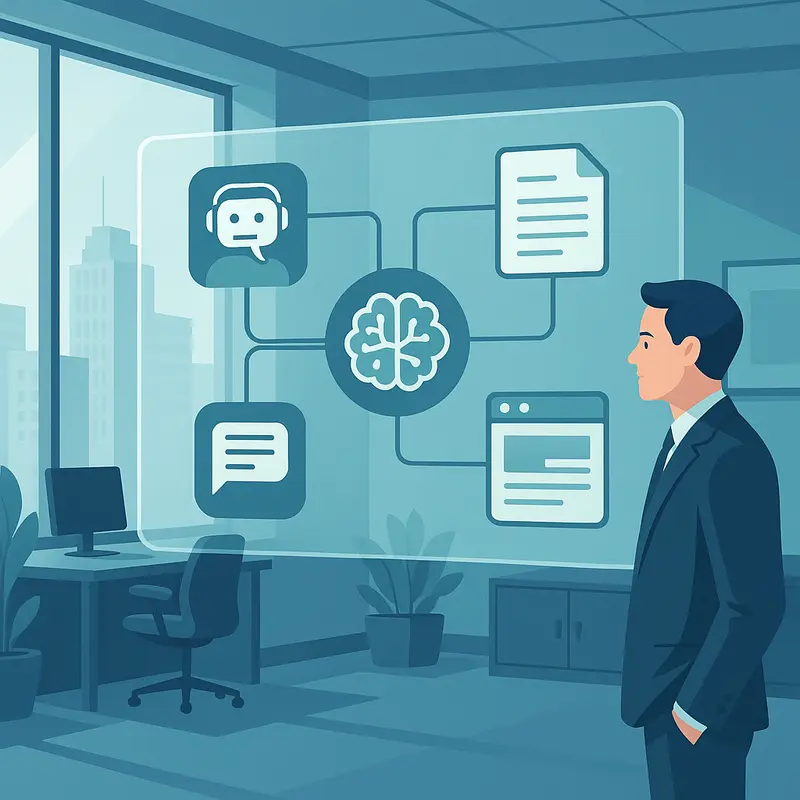
Key takeaways
- AI automation for business 2026 works best on high-volume, templated tasks where outputs are verifiable and reversible.
- AI agents for business are valuable when sandboxed and instrumented; don’t give agents broad, unchecked privileges.
- Production success depends on orchestration, observability, and human-in-the-loop controls—not just model quality.
- Use vibe coding (Cursor, Claude Code, Lovable) to validate ideas quickly, then harden with engineering practices and connectors to systems like CRM or web-applications.
- Measure everything and integrate automation outputs into analytics-and-reporting to track real ROI.
By Sanyam Singhal, Founder at EPlanet Soft
AI automation for business 2026 is now a board-level discussion in most US enterprises. The promise is huge; the reality is mixed. At EPlanet Soft we’ve built, tested and operated end-to-end automation systems for large clients, and our view is pragmatic: some workflows produce fast, measurable ROI; others create technical debt, governance headaches and wasted budget. This article lays out which projects are worth your time in 2026 and which you should steer clear of—based on hands-on deployments, both at scale and at the MVP level.
Why the fuss—and why context matters
After rapid model improvements in 2024–2026 and the rise of task-specialist AI agents, boards expect automation to be the next productivity lever. But vendor pitches often conflate proof-of-concept magic with repeatable production outcomes. I’ve seen the same: slick demos that fail when connected to real data, compliance, and edge cases. That’s the reason EPlanet Soft approaches automation pragmatically—combining AI & Automation Solutions with engineering patterns that emphasise observability, rollback, and human-in-the-loop controls. We also accelerate initial builds with vibe coding approaches (using tools such as Cursor, Claude Code and Lovable) to validate assumptions in weeks, not months.
Which workflows deliver ROI: business process automation AI in 2026
Start with repeatable, high-volume processes where human judgment is constrained by templates, rules, or well-defined form fields. The sweet spot in 2026 remains where an AI reduces manual effort without introducing high downstream compliance risk.
- Content generation at scale with structured outputs. Automated page creation, templated product descriptions, and localized landing pages are low-risk if you use deterministic templates plus an LLM to populate fields. We use this pattern heavily in web content automation and see consistent savings.
- Document ingestion + extraction for known schemas. Invoice OCR, contract clause tagging, and shipping manifests where the formats are predictable. Pair LLMs with dedicated parsers and a rules engine for validation.
- Ticket triage and routing with human escalation. Use AI agents for business to tag, prioritise and route tickets; keep humans in the loop for exceptions. This reduces backlog and improves SLA performance without handing decisions fully to the model.
- Data augmentation for analytics. Auto-enriching customer records, mapping product attributes, and generating metadata that feeds BI systems. Combined with good instrumentation this materially improves downstream reporting quality.
- Conversational assistants for discovery and navigation. Bots that help users find products, pages or company services deliver clear ROI when limited in scope (e.g., FAQ, account lookup) and backed by session logging and fallback to agents.
These use cases are dependable because the inputs, outputs and risk envelope are constrained. For enterprises, they translate into two kinds of measurable value: reduced manual hours and lower error rates. A 2025 study from McKinsey found automation pilots that focused on constrained workflows saw the fastest time-to-value (McKinsey, 2025). McKinsey has more on where structured automation delivers early ROI.
When you build these systems, combine the automation with analytics. We connect automation outputs to analytics and reporting pipelines so leaders can measure error rates, cycle time and cost per transaction. If you want to operationalise those outputs into dashboards, see our analytics-and-reporting work for reference.
AI agents for business: where to deploy autonomous assistants
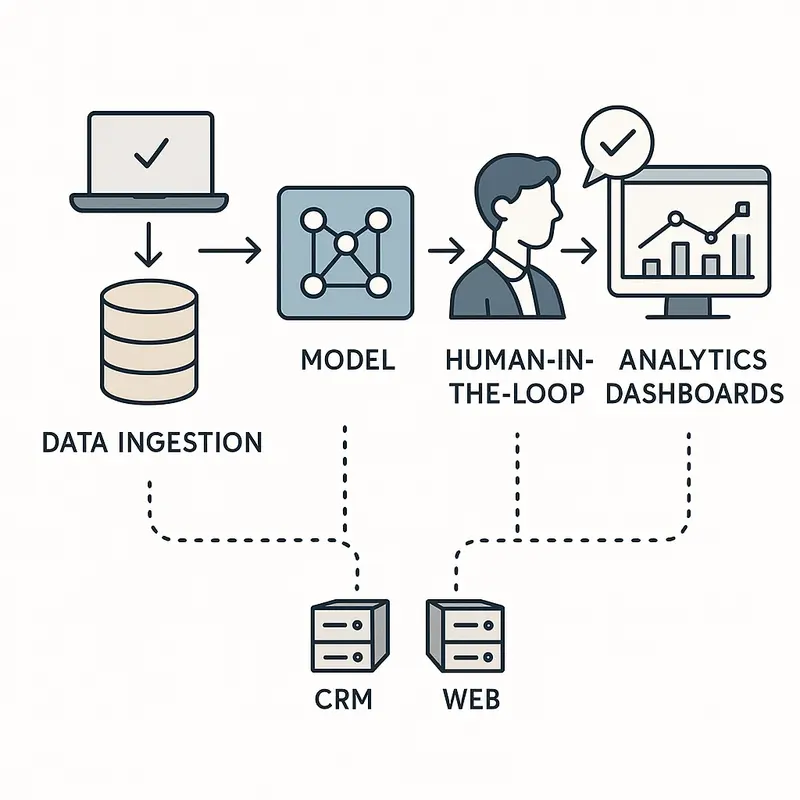
2026 has matured a distinct category: AI agents for business that can execute multi-step tasks. But autonomy is not binary—it's a spectrum. Use agents where they can act within sandboxed environments and where outcomes are reversible.
- Routine account management. Agents that update CRM fields, flag duplicates, or standardise lead data are effective when they operate on copies or with explicit approvals.
- Marketing content workflows. Agents that draft campaign variants, run A/B tests, and push winners to staging save time. Combine them with conversion-rate-optimization pipelines and human review gates.
- Data pipeline supervision. Agents that monitor ETL jobs, identify data drift and open alerts when thresholds are breached can reduce downtime. Connect them to monitoring dashboards and incident workflows.
Where agents fail is when they are given permission to act across unconstrained systems (finance transfers, legal sign-offs, large procurement). A Gartner 2025 brief warns that agent autonomy without governance increases operational risk (Gartner, 2025). Gartner recommends a phased approach: simulate, sandbox, observe, then expand scope.
Technically, agent deployments benefit from modular architectures—separating the decision logic (LLM + prompt chains), the connector layer (APIs to enterprise systems), and the governance layer (audit logs, approvals). Our development teams have used vibe coding to prototype agents quickly, then refactor for reliability using best-practice connectors to web-applications and custom-platforms.
Workflow automation 2026: orchestration, observability and limits
In 2026 the big differentiator is not the model, it’s the orchestration and observability around it. Workflow automation must include retries, explainability logs, and automated rollback strategies.
Essential components of production-grade workflow automation
- Idempotent operations. Design tasks so re-running them doesn’t cause duplication or inconsistent state.
- Observability and audit trails. Each AI decision should emit structured events to analytics platforms; those events feed into root-cause analysis and compliance reports (see our analytics-and-reporting solutions).
- Human-in-the-loop gates. For high-risk steps, require human approval or sampled verification rather than blind automation.
- Model versioning and AB testing. Track which model/version made a decision and test new agents in shadow mode before full rollout.
We’ve seen companies skip these engineering elements and then struggle. A careful approach mitigates vendor lock-in and keeps your IT architects in control. If you’re considering outsource partners, evaluate whether they deliver connectors to your core systems (CRM, ERP, custom platforms) and whether they instrument observability from day one. At EPlanet Soft we combine our AI & Automation Solutions with platform connectors and analytics so automation is measurable and auditable.
What to automate with AI — and what to avoid
Choosing the right candidate workflows is the most tactical decision a leader makes. Below is a practical rule-set we use during discovery.
Automate when:
- Volume is high and the task is repetitive or templated.
- Errors are primarily mechanical and can be validated with rules or checks.
- Outcomes are reversible or have a straightforward remediation path.
- There is a clear metric (time saved, cost per transaction, error rate) to measure success.
Avoid automating when:
- Decisions require tacit knowledge or deep negotiation (complex contract approvals, nuanced legal judgement).
- The enterprise lacks sufficient structured data or canonical sources—models will hallucinate against noisy inputs.
- Automation would create single points of failure without fallback paths (e.g., automated funds movement without multi-sig controls).
- Regulatory constraints demand human certification that cannot be delegated.
In many cross-functional projects, the right strategy is hybrid: let AI handle data preparation and low-risk decisions, with humans handling exceptions. We design these hybrid flows for clients and tie outputs back to dashboards so leaders can see the automation’s impact.
Real example: US uniform rental company — automated page creation and chat
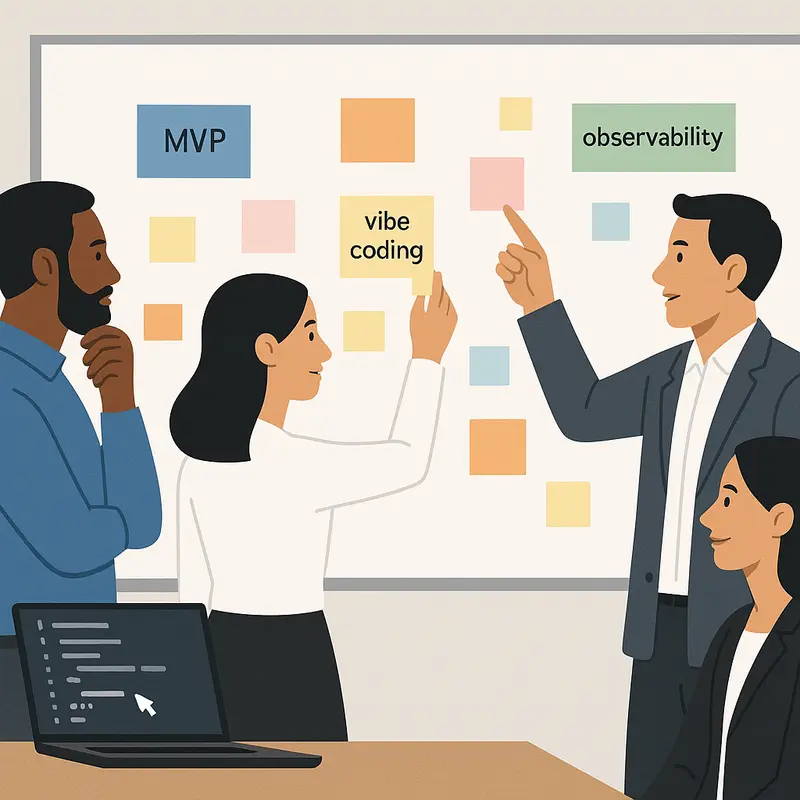
To make this concrete: we built an AI automation system for a US-based uniform rental company that automated localized page creation and added an AI chatbot to help users find products and services. The project timeline was eight weeks from discovery to live MVP. Technical highlights included:
- Automated page generator that consumed a CSV of local branches, mapped attributes to SEO templates, and produced localized landing pages with structured metadata. We used prompt templates combined with deterministic field mapping to avoid hallucinations.
- An AI chatbot limited to product discovery, order tracking, and local branch queries, instrumented with fallbacks to human agents for complex order issues.
- Integration with the client’s CMS and analytics stack so every generated page and chatbot session produced event telemetry for A/B tests and SEO tracking.
We implemented the proof-of-concept with vibe coding to accelerate development—using Cursor for paired edits, Claude Code for rapid back-end scaffolding, and Lovable for prompting experiments—then hardened the system with production-grade connectors to their web CMS. The outcome: the client saved hundreds of hours of manual page creation and reduced costs and errors by 50%. This is a clear example of where AI automation for business 2026 produced measurable operational impact. EPlanet Soft led the MVP-to-production path and remain engaged on iterating the bot’s answer quality and page templates.
If you want a deeper technical walkthrough of the architecture used, our team documents these patterns and integrates them into analytics pipelines—see how our analytics-and-reporting and web-applications capabilities fit together.
Governance, compliance and vendor selection
Two areas trip up enterprise leaders: data governance and vendor claims. Models are only as safe as the data and access policies behind them. Implement data classification, restrict training on sensitive datasets, and insist on auditable logs.
When evaluating partners, ask for:
- Evidence of production deployments and rollback procedures.
- Details on connector architecture (how they talk to CRM, ERP, or your custom-platforms).
- Plans for observability and model versioning.
- Clear SLAs and scope for human oversight.
For many US companies, working with partners who can supply both engineering talent and governance disciplines is critical. If you’re hiring talent directly, consider hiring dedicated AI engineers or using our hire-ai-engineers service to augment your team.
Operational checklist before you automate
- Define success metrics up-front (time saved, error reduction, throughput improvement).
- Map all downstream dependencies and rollback paths.
- Start with a sandboxed MVP using vibe coding to validate assumptions fast; then operationalise the winning approach.
- Instrument every automation decision into your analytics stack for continuous improvement.
- Document data lineage and maintain an approvals register for all high-risk automations.
If you’re evaluating vendors, look for an automation partner who can build an MVP fast, instrument outcomes, and scale with governance. At EPlanet Soft we combine AI & Automation Solutions with practical engineering: fast vibe coding prototypes, robust production connectors, and ongoing analytics. Our team also supports complementary areas like custom-platforms, data-intelligence, and web-applications to ensure your automation delivers sustained value.
If you want to explore which workflows in your organisation are the highest-value candidates for automation, our AI & Automation Solutions team can run a rapid discovery workshop and a vibes-first MVP to validate impact in weeks. Learn more about our AI & Automation Solutions or contact us to get started: Ai Services. For staffing support, consider our hire-ai-engineers service or our work on analytics-and-reporting to make automation measurable. Need integrations to customer-facing systems? See our web-applications and custom-platforms capabilities.
For a practical, no-nonsense approach to AI automation that avoids hype and focuses on measurable outcomes, reach out via our contact page. EPlanet Soft has built and deployed automation systems for enterprises across the US and India—our approach is designed to deliver results without introducing excessive risk.
Frequently Asked Questions
AI Automation for Business 2026.
What is the best first use case for AI automation in an enterprise?
Start with high-volume, templated tasks such as content generation for localized pages, invoice extraction, or ticket triage. These have clear metrics and low regulatory risk, enabling fast ROI.
How do AI agents for business differ from traditional automation scripts?
AI agents can interpret unstructured inputs, manage multi-step tasks and adapt to context. They require governance, connectors and observability; traditional scripts are deterministic and simpler to audit.
What are common failure modes for automation projects in 2026?
Common failures include poor data quality leading to hallucinations, lack of observability, missing rollback plans, and granting agents excessive privileges without governance.
How long does it take to validate an automation idea using vibe coding?
Using vibe coding approaches and tools like Cursor or Claude Code, an MVP to validate assumptions can often be built and tested in 4–8 weeks, depending on integrations required.
When should an enterprise avoid AI automation?
Avoid automating decisions that require deep legal or ethical judgement, that are irreversible without complex remediation, or where regulations mandate human certification.
Ready to Grow Your Business?
Get a free consultation from our digital marketing and development experts. Let's discuss how we can help you achieve your goals.
- No commitment required
- Detailed technical roadmap
- Customized to your infrastructure
By submitting this form, you agree to our privacy policy. · 4,000+ businesses served · 24hr response · 98% satisfaction