Enterprise AI & Automation Agency | Eplanet Soft
AI App Development: How Businesses Automate Operations with AI
Discover how AI app development transforms operations—reduce costs, speed workflows, and scale automation. Learn best practices, tools, and ROI strategies.

Key takeaways
- AI app development is a strategic lever for automating operations across industries and functions.
- Successful AI automation requires robust data strategy, MLOps, user-centric design, and governance.
- Choose platforms and tools based on integration, scalability, and cost trade-offs; hybrid approaches often work best.
- Measure ROI with both leading and lagging metrics, and prioritize change management to scale adoption.
- Security, privacy, and ethics must be integrated into design and deployment to avoid legal and reputational risks.
Introduction
AI app development is no longer a speculative experiment reserved for data scientists in research labs; it has become a strategic imperative for businesses seeking to automate operations, increase efficiency, and unlock new revenue streams. Organizations across industries—from logistics and manufacturing to retail and professional services—are embedding artificial intelligence applications into daily workflows to reduce manual effort, accelerate decision-making, and deliver superior customer experiences. In this deep-dive guide, we examine how businesses are using AI to automate operations, the building blocks of AI software development, industry use cases, and the practical steps to design and deploy robust AI-driven applications.
The pace of adoption and the sophistication of AI app development have intensified every year. According to McKinsey’s Global AI Survey, organizations that adopt AI across multiple workflows tend to report measurable performance gains, and investment in AI is growing rapidly. These trends mean product leaders, CTOs, and operations managers must understand not just the promise of AI, but also how to translate algorithms into production-level software that integrates with legacy systems, respects compliance boundaries, and drives measurable ROI.
In this article we cover the end-to-end landscape of AI app development for automation: why companies invest, the core technical and organizational components of AI software development, common automation use cases, how to choose tools and platforms, design and UX considerations for intelligent apps, steps to scale AI initiatives, and the ethical and security dimensions you cannot ignore. We’ll include concrete examples and case studies, a comparative table of leading platforms, actionable best practices, and real-world data to help you prioritize AI investments. Along the way, you’ll find links to specialized services you can engage—such as AI and machine learning solutions and resources for teams like hire AI engineers—so your organization can move from pilots to production faster.
Why Businesses Invest in AI App Development to Automate Operations
The business case for AI automation is compelling: improved throughput, lower error rates, faster decision cycles, and better use of human talent. For many organizations, automation via AI translates into direct cost savings—replacing routine manual tasks with intelligent processes—and indirect gains such as improved customer retention and faster time-to-market for new services. In addition to cost efficiencies, AI apps unlock capabilities that were previously impossible at scale, such as real-time personalization and predictive maintenance.
Consider how sectors differ in their automation priorities. In manufacturing and energy, predictive maintenance driven by AI can prevent costly downtime and extend asset life. In retail and e-commerce, intelligent recommendation engines and automated pricing models increase average order value and conversion rates. For service businesses and B2B firms, AI-powered process automation—like automating invoice reconciliation or contract review—reduces cycle times and allows employees to focus on higher-value tasks like strategy and client relationships.
Adoption statistics underscore the momentum. For example, Statista projects rapid expansion of AI revenue and investment across software segments, while surveys by industry analysts show the majority of early adopters have delivered measurable value from AI pilots. Beyond raw financials, AI app development delivers strategic differentiation. Firms that embed AI into operations move faster, gather richer operational intelligence, and can offer new services that competitors without AI cannot.
Finally, businesses are driven by customer expectations. Consumers expect fast, accurate responses and personalized experiences. Internally, employees expect tools that reduce drudgery. AI apps bridge these expectations by automating routine work while retaining human oversight for exceptions. That's why integrating AI into operations is not a one-off project—it's a strategic shift toward building AI business solutions that amplify people and processes across the enterprise.
Core Components of AI Software Development
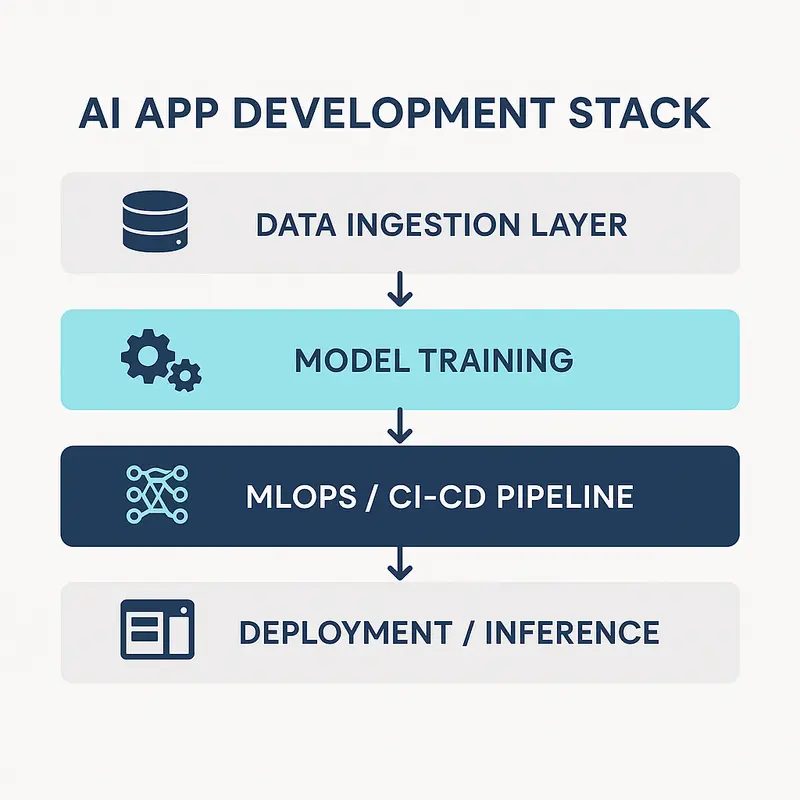
AI software development brings together multiple disciplines: data engineering, model training, MLOps, APIs, and front-end application development. The journey typically starts with data: collecting, cleaning, and structuring the datasets that will feed machine learning models. Data pipelines and storage must be designed for scale and governance. This often requires creating feature stores, implementing ETL/ELT processes, and ensuring high data quality and lineage so models can be trusted and audited.
Model development is the next major pillar. Data scientists evaluate algorithms—supervised, unsupervised, reinforcement learning, or hybrid architectures—based on the problem at hand. For instance, computer vision models for visual inspection in manufacturing will use convolutional neural networks, while natural language processing (NLP) models for document understanding will leverage transformer-based architectures. Iterative experimentation, hyperparameter tuning, and cross-validation are core activities that precede production readiness.
MLOps and deployment are critical to transforming experimental models into reliable AI apps. Continuous integration/continuous deployment (CI/CD) pipelines for models, model versioning, canary releases, and monitoring frameworks (for data drift, concept drift, and model performance) are necessary to maintain accuracy over time. Productionization also requires scalable inference: decisions about on-premises vs. cloud inference, batching vs. real-time streaming, and cost/performance trade-offs.
Finally, application integration and user experience complete the stack. AI must present results in a way that end-users can trust and act upon. That means building intuitive interfaces, integrating with existing ERP/CRM systems, exposing secure APIs for other services, and tracking downstream business KPIs. Organizations often involve web application teams and UI/UX design specialists to ensure that AI insights are accessible and actionable.
Data Strategy and Governance
Data strategy is the foundation of any successful AI app development program. Organizations must inventory data sources, evaluate data quality, and build governance processes that define ownership, privacy controls, and retention policies. For regulated industries—finance, healthcare, or insurance—data governance is not optional; it determines what models you can build and how you can use them. A well-defined governance strategy mitigates legal and reputational risk while enabling faster experimentation.
Implementing data catalogs and metadata management tools accelerates discovery and reuse. Feature engineering becomes repeatable when teams adopt standardized feature stores. This reduces duplication, shortens time-to-model, and improves reproducibility. Data governance also ties directly to model explainability: when data lineage is clear, interpreting model decisions becomes simpler and audit trails remain intact.
MLOps: From Prototype to Production
MLOps practices adapt software engineering rigor to machine learning systems. Automated testing for models, validation suites, and monitoring alerts are part of maintaining production AI apps. Without MLOps, organizations run the risk of model decay and manual rework. Successful teams adopt tooling for model registry, CI/CD for models, and observability to detect anomalies in inference patterns quickly.
Common AI Automation Use Cases in Operations
Across sectors, businesses are deploying AI automation tools to streamline workflows that used to be highly manual. Below are several high-impact categories with examples and data points showing real-world value.
1) Intelligent Process Automation (IPA): IPA combines robotic process automation (RPA) with AI capabilities—like NLP and document understanding—to automate complex business processes. For example, in accounts payable, IPA systems extract invoice data using OCR and NLP, match invoices to purchase orders, and route exceptions to human reviewers. This reduces cycle times and cut processing costs dramatically.
2) Predictive Maintenance: Industrial firms use AI models trained on sensor telemetry to predict equipment failures before they occur. An example is GE’s Predix and Siemens’ MindSphere platforms powering predictive analytics for turbines and compressors. Businesses report reductions in unplanned downtime and maintenance costs when predictive models are integrated into maintenance scheduling systems.
3) Customer Service Automation: AI-powered chatbots and virtual assistants handle routine customer inquiries and triage complex requests to human agents. When combined with sentiment analysis and conversational context, these tools improve first-contact resolution and free agents to focus on high-value interactions. Leading contact centers have reported up to 30-40% reduction in call volume for routine queries after deploying intelligent virtual assistants.
Case Study: Logistics and Route Optimization
Logistics companies have adopted AI-driven route optimization and dynamic scheduling to reduce fuel consumption and improve delivery times. UPS’s ORION system, which optimizes delivery routes using advanced algorithms and machine learning, reported annual savings of tens of millions of dollars in fuel and labor after widespread adoption. Route optimization is a clear demonstration of how AI automation tools can directly impact operational costs and service KPIs.
Case Study: Retail and Personalization
Retailers use personalization engines to recommend products, tailor promotions, and optimize inventory placement. Netflix and Amazon are textbook examples: their recommendation systems drive a substantial portion of user engagement and sales. E-commerce businesses that implement AI-based product recommendations often see double-digit increases in conversion rates and average order values, making this an attractive avenue for AI app development.
Designing and Building AI-Powered Applications: Best Practices
Designing AI-powered applications demands a blend of technical proficiency and product thinking. Developers must balance model accuracy with latency, scalability, and interpretability. Good AI app design starts with a clear problem statement and measurable success criteria. For example, if the goal is to automate invoice approvals, define KPIs like percent of invoices fully automated, exception rate, and time-to-payment improvements.
Iterative development is key. Start with a Minimum Viable Model (MVM) that demonstrates clear value and can be integrated with existing systems. Use A/B testing to validate business impact and collect feedback. Once the model proves its worth, invest in robustness: edge-case handling, monitoring for drift, and human-in-the-loop mechanisms for high-impact decisions. Deploying a model without monitoring and retraining pipelines is a common pitfall.
Another best practice is to design AI systems for explainability and auditability. For regulated decisions or high-risk outcomes, provide clear reasons behind model predictions and create logs for audits. Techniques like SHAP values or LIME can help explain model behavior, while model cards and data sheets can summarize dataset and model limitations for stakeholders.
Human-in-the-Loop and Exception Handling
No AI system is flawless. Building human-in-the-loop workflows ensures that the system escalates uncertain or risky predictions to human experts. For example, in medical imaging, AI may flag potential issues but a radiologist signs off on the final diagnosis. Incorporating confidence thresholds and seamless escalation paths ensures both safety and continuous learning: humans can correct model errors and those corrections can be fed back into subsequent training cycles.
UX Considerations for AI Apps
AI outputs must be understandable and actionable. Work with designers to present predictions with context—confidence scores, visualizations, and recommended next steps. When possible, let users query AI decisions and receive justifications. Good UX reduces friction and increases trust, which is essential for adoption in operational settings. Collaborating with creative design and product teams early avoids late-stage rework.
Selecting the Right AI Automation Tools and Platforms
Choosing the right platform is a strategic decision that affects cost, speed of development, and long-term maintainability. Options range from cloud-managed services (AWS SageMaker, Google Vertex AI, Azure ML) and fully-managed automation suites to open-source toolkits (TensorFlow, PyTorch) and specialized third-party applications for tasks like document understanding or speech-to-text. Your selection should weigh factors such as integration with your infrastructure, scalability, developer experience, total cost of ownership, and vendor lock-in.
Below is a comparative table highlighting common platform characteristics to help teams narrow options quickly. This sample is illustrative and should be adapted to your specific needs, such as compliance requirements or on-premises constraints.
| Platform | Best For | Scalability | Ease of Use | Cost Level |
|---|---|---|---|---|
| AWS SageMaker | End-to-end ML on AWS | High (cloud auto-scaling) | Moderate (managed services + learning curve) | Medium to High |
| Google Vertex AI | ML Ops & AutoML | High | High (AutoML options) | Medium to High |
| Azure Machine Learning | Enterprises on Microsoft stack | High | Moderate | Medium to High |
| TensorFlow / PyTorch (Open Source) | Custom research & models | Variable (depends on infra) | Low to Moderate (requires expertise) | Low to Medium (infra costs apply) |
| Specialized AI SaaS (Document AI, OCR) | Task-specific automation | High | High | Variable |
To choose, run small proofs of concept (POCs) across candidate platforms and measure speed-to-value, not just feature lists. Consider platforms that offer robust MLOps and governance features if you plan to scale. If your organization already uses a cloud provider extensively, leaning into that provider’s AI services often reduces friction and speeds integration with existing systems.
When to Use Prebuilt SaaS vs. Custom Platforms
Prebuilt AI SaaS products accelerate deployment for narrowly scoped tasks: chatbots, document processing, or image recognition for specific domains. They lower development cost and time-to-live but may be limited for differentiated, proprietary use cases. Custom platforms—built on cloud tooling or open-source libraries—are preferable when your model needs deep integration, proprietary datasets, or when you want full control over model architecture and deployment.
Hybrid approaches are common: use prebuilt services for low-risk tasks and invest in custom development for mission-critical capabilities that provide competitive advantage. For example, you might leverage a third-party OCR for simple invoices while developing a custom NLP model for complex contracts.
Implementing AI Solutions at Scale: Change Management and ROI
Scaling AI from pilot to enterprise deployment is as much an organizational challenge as a technical one. Successful scale requires executive sponsorship, cross-functional teams, and a clear set of KPIs that link AI outputs to business outcomes. Common challenges include data silos, lack of skillsets, resistance from staff fearing job loss, and difficulty quantifying value.
Change management is essential. Communicate the role of AI clearly: demonstrate how automation shifts tasks away from repetitive work and toward higher-value activities. Offer training programs to upskill employees in working with AI tools and establish feedback loops where users can report issues and improvements. Engage business owners early to define success metrics and to ensure that AI outputs align with operational objectives.
Measuring ROI for AI automation initiatives requires both leading and lagging metrics. Leading indicators might include automation rate, reduction in manual steps, or throughput improvements. Lagging indicators include cost savings, error rate reduction, and revenue impact. Track these with robust analytics and reporting—partnering with a data intelligence team can help translate model outputs into executive-level dashboards.
“Organizations that treat AI as a long-term investment and deploy scalable MLOps practices achieve far greater operational impact than those that run one-off pilots.” — Industry surveys and practical experience
Case examples show that when companies institutionalize AI—creating shared platforms, standard toolkits, and centers of excellence—they reduce duplication and accelerate time to market for new automation solutions. Implementing governance and monitoring reduces risk and helps productize AI capabilities rather than leaving them as isolated experiments.
Security, Ethics, and Compliance in AI App Development

Security and ethics are foundational in AI app development. Models trained on sensitive data must be protected against theft and adversarial attacks. Data privacy laws like GDPR and sector-specific regulations constrain how data can be used for model training and inference. Ensuring compliance requires privacy-preserving techniques such as data anonymization, differential privacy, and federated learning where appropriate.
Ethical considerations also include bias mitigation and fairness. AI models trained on historical data can replicate or amplify biases present in that data, leading to discriminatory outcomes in hiring, lending, or policing. Developing fairness-aware models requires careful dataset curation, fairness metrics, and human oversight. Documenting model assumptions and limitations through model cards increases transparency and reduces regulatory and reputational risk.
Implementing secure ML pipelines involves securing model artifacts, encrypting data at rest and in transit, and applying role-based access controls on model registries and feature stores. Regular security audits and penetration testing for AI systems help identify vulnerabilities early. For high-stakes applications, engage legal and compliance teams during the design phase so the product aligns with regulatory frameworks from day one.
Regulatory Landscape and Best Practices
Regulators are increasingly focused on AI accountability. The EU’s AI Act and other national initiatives propose requirements for risk classification, transparency, and human oversight. Even before regulations become law, adopting practices like model documentation, explainability measures, and rigorous testing will prepare organizations for compliance. Consider forming an AI ethics board or cross-functional review panel to evaluate high-risk deployments and guide governance policies.
Roadmap: From Pilot to Production — A Practical Checklist
Transitioning AI app development from pilot to production is a structured process. The following checklist synthesizes the technical and organizational steps that successful teams follow. Each item is accompanied by practical advice from teams that have implemented enterprise-grade AI automation tools.
- Define clear business objectives and KPIs: Align AI features to revenue, cost, or operational metrics.
- Start with a focused pilot: Keep scope narrow to demonstrate measurable value fast.
- Design data pipelines and governance: Ensure data quality and lineage before scaling.
- Establish MLOps practices: Automate training, deployment, and monitoring.
- Implement human-in-the-loop flows: Handle exceptions safely and use corrections for retraining.
- Prioritize security and compliance: Engage legal, security, and privacy teams early.
- Plan for change management: Upskill staff and communicate clear role changes.
- Measure and iterate: Use analytics to refine models and expand use cases.
Many firms also benefit from partnering with experienced engineering teams to accelerate delivery. If your roadmap involves building complex integrations or custom platforms, consider engaging experienced development partners that provide both technical execution and strategic guidance—services like custom platforms and hire remote team models can be particularly effective when internal bandwidth is limited.
How to Start: Resources, Partnerships, and Next Steps
Starting an AI automation journey can feel overwhelming, but the right sequence of actions reduces risk and accelerates value. Begin by identifying high-impact processes with clear KPIs and available data. Run a small POC to test feasibility and measure results. If internal expertise is limited, engage external partners who specialize in AI app development and automation. Partnering enables organizations to combine domain knowledge with technical execution and reduces time to production.
Key resources include specialized teams for data engineering, model development, and product integration. Many businesses choose to augment internal teams by hiring AI engineers or by working with dedicated development partners to build scalable solutions. Additionally, involve stakeholders from compliance, security, and business operations to ensure solutions align with organizational priorities. For marketing-driven automation initiatives—like personalization or demand forecasts—collaborate with demand generation and paid marketing teams to track performance impact.
Conducting vendor evaluations and selecting the right partner requires clarity on outcomes, timelines, and budget. Inspect case studies, request references, and evaluate technical depth. An ideal partner will offer a balanced mix of AI expertise and practical engineering to operationalize models. If you plan to deliver customer-facing AI experiences, integrate UI/UX design from the outset and leverage website redesign or digital product teams for seamless integration.
Finally, treat AI as a continuous program rather than a one-off project. Create internal capabilities—centers of excellence, reusable components, and governance frameworks—to replicate success across the enterprise. With a disciplined approach, AI app development becomes a catalyst for sustainable operational transformation and competitive advantage.
Conclusion
AI app development is transforming how businesses automate operations by enabling smarter workflows, real-time decision-making, and continuous learning. From predictive maintenance to intelligent process automation and personalization, artificial intelligence applications deliver measurable operational improvements when built with the right blend of data strategy, engineering rigor, and human-centered design. Companies that invest in robust MLOps, governance, and change management are the ones that turn pilots into production-grade AI business solutions that scale.
If you are ready to explore AI automation for your operations, start by identifying a high-impact process with clear KPIs and accessible data. Consider partnering with experienced teams to accelerate development: whether you need end-to-end AI and machine learning solutions, help to hire a dedicated team, or support to build secure web applications that integrate AI, the right expertise can reduce time-to-value and ensure outcomes align with business goals.
Contact us to discuss how AI app development can automate your operations, cut costs, and create new opportunities. Let us help you design a pragmatic roadmap from pilot to production and deliver AI business solutions that drive measurable impact.
Frequently Asked Questions
AI App Development.
What is AI app development and how does it differ from traditional software development?
AI app development integrates machine learning models, data pipelines, and MLOps into software, enabling systems to learn from data and make predictions. Unlike traditional software that follows deterministic rules, AI apps require continuous model training, monitoring for data drift, and specialized infrastructure to serve inference at scale.
Which business processes are most suitable for AI automation?
Processes with high volumes, repetitive tasks, structured data, or clear historical patterns are ideal—examples include invoice processing, customer support triage, demand forecasting, predictive maintenance, and route optimization. Start with processes that have measurable KPIs and accessible data.
How long does it take to build an AI-powered application?
Timelines vary based on scope and data readiness: a focused proof-of-concept can take 6-12 weeks, while a production-grade AI app with MLOps, integrations, and governance typically takes 3-9 months. Complexity, regulatory requirements, and the need for custom models affect the schedule.
What tools and platforms should we consider for AI automation?
Consider cloud-managed platforms like AWS SageMaker, Google Vertex AI, and Azure ML for end-to-end capabilities, and open-source frameworks like TensorFlow and PyTorch for custom work. Also evaluate specialized AI SaaS providers for narrow tasks such as document AI or speech recognition.
How can we measure ROI for AI automation projects?
Track both leading and lagging indicators: automation rate, process cycle time reduction, error-rate reduction, cost savings, and revenue impact. Start with baseline metrics, run pilots to estimate gains, and use dashboards to continuously monitor outcomes.
What are the main risks of deploying AI in operations and how can we mitigate them?
Risks include model drift, biased outcomes, data privacy issues, and security vulnerabilities. Mitigate them through strong data governance, MLOps practices, monitoring, bias testing, privacy-preserving techniques, access controls, and involving compliance teams early.
Ready to Grow Your Business?
Get a free consultation from our digital marketing and development experts. Let's discuss how we can help you achieve your goals.
- No commitment required
- Detailed technical roadmap
- Customized to your infrastructure
By submitting this form, you agree to our privacy policy. · 4,000+ businesses served · 24hr response · 98% satisfaction