Enterprise AI & Automation Agency | Eplanet Soft
How to Validate Your Startup Idea Before Building: Step-by-Step
Learn proven startup idea validation methods to test demand, build effective MVPs, and achieve product-market fit. Follow this step-by-step guide and act with confidence.
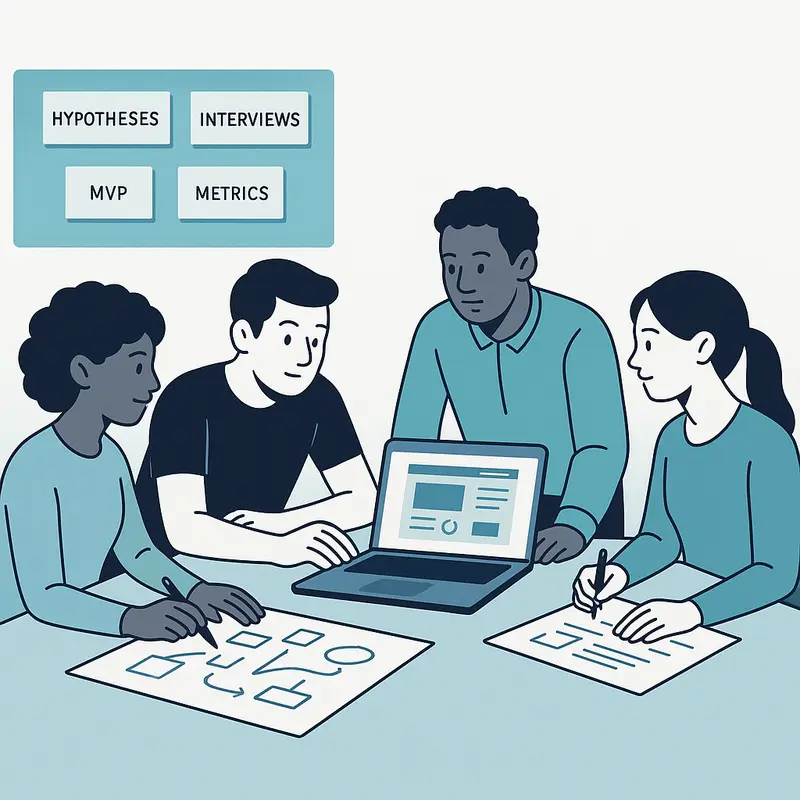
Key takeaways
- Prioritize riskiest assumptions: Test what must be true for your business to work, starting with demand and monetization.
- Use a mix of qualitative and quantitative methods: Interviews uncover friction, while landing pages and paid ads measure intent at scale.
- MVPs are learning tools: Build the smallest thing that proves your core hypothesis, and instrument it for activation and retention metrics.
- Measure before you scale: Monitor CPA, retention cohorts, and willingness-to-pay signals to validate product-market fit.
- Document decisions: Use evidence-based thresholds to pivot, persevere, or stop — and keep a validation log for transparency.
Introduction
Every entrepreneur has at least one bold idea that could disrupt a category, save users time, or create new markets altogether. But big ideas alone don’t pay bills — market fit, timing, execution, and evidence that customers actually want what you plan to build are what separate successful launches from costly failures. That’s why startup idea validation is the critical first step: it helps you confirm demand, reduce risk, and conserve capital before you commit months of development and a pile of resources.
In this comprehensive guide, we’ll walk through how to validate startup idea effectively and practically — from framing assumptions and running cheap experiments to building a minimum viable product and measuring traction. Whether you’re a solo founder, a product manager, or part of a small team, the steps below show you how to identify the riskiest parts of your concept, design low-cost tests to prove or disprove your hypotheses, and interpret results so you can make confident build-or-kill decisions.
We’ll cover specific idea validation techniques including customer discovery interviews, surveys, landing page smoke tests, concierge MVPs, and early-adopter pricing experiments. You’ll get real-world examples and data-driven advice on what metrics matter in the MVP validation process, how to avoid common cognitive biases, and how to move from a validated experiment to building a scalable product. By the end, you’ll have an actionable checklist and frameworks to validate business idea quickly and repeatably.
This post also links to helpful resources — for market analysis, prototyping, and growth experiments — and shows how to align validation activities with core company capabilities, whether you need to hire a dedicated team for rapid prototyping or augment analytics through data intelligence. Ready to reduce your odds of building the wrong product? Let’s dive in.
Why Validate Your Startup Idea Before You Build
Validating a startup idea is more than a checkbox in a founder’s checklist; it’s a strategic discipline that reduces uncertainty and aligns your limited resources with market realities. When you validate early, you reveal hidden assumptions, surface customer pain points, and identify the smallest set of features that actually create value. This prevents expensive rework, preserves runway, and helps you design a coherent product roadmap that targets measurable outcomes like activation, retention, and revenue.
A key reason to validate is cost control: building a full-featured product without validation is often the most expensive way to learn that the idea doesn't resonate. According to industry analyses, the majority of startups fail due to lack of market need — a problem that early validation specifically addresses. By running cheap, fast tests, you trade time for information: you buy market clarity at a fraction of the cost of full development.
Validation also helps attract early partners, investors, and talent. Early traction indicators — email signups, pre-orders, paid pilots — convert prospects into advocates and reduce the friction of fundraising or hiring. For example, companies that show validated MVP metrics often get better deal terms because the risk profile is demonstrably lower. If you’re considering working with an external team to accelerate your efforts, pairing validation with the right design skills like UI/UX design can dramatically improve prototype conversion rates, turning curiosity into measurable intent.
The cost of not validating
When founders skip validation, they often fall into the trap of building feature-rich products based on personal assumptions or biased feedback from friends and family. This results in sunk engineering costs, user confusion, and, in many cases, poor retention. A well-known analysis of startup failures found that a leading cause of failure is building something nobody wants; researchers and industry analysts corroborate that user problem-solution fit is a top predictor of success. The lesson: validating helps you avoid wasting months building features that don’t solve a meaningful problem.
Benefits: faster learning, smarter pivots, and lower risk
Beyond preventing wasted development, validation yields strategic benefits. Fast learning cycles enable data-driven pivots — small, early shifts in direction that preserve the most valuable elements of your product while discarding what doesn’t work. This iterative approach increases the probability of reaching product-market fit and provides evidence-based narratives for investors. In short, validation turns uncertainty into a manageable process rather than a guessing game.
Step 1: Define Assumptions and Hypotheses
Every startup idea rests on multiple assumptions, and not all assumptions carry equal risk. The first step in rigorous idea validation is to enumerate and prioritize those assumptions. At a minimum, you should identify assumptions about who your customer is, what problem they experience, why current solutions fail, and whether they'd be willing to pay for your alternative. Frame each as a testable hypothesis: "X percent of Y will do Z given A condition" gives you a measurable target and a clear pass/fail criterion.
Prioritize risks using a simple matrix that weights impact and uncertainty. High-impact, high-uncertainty assumptions — like whether customers will actually pay for your solution — deserve immediate testing. Low-impact assumptions, like the ideal color for a landing page CTA, can be deferred until later iterations. By focusing on the riskiest assumptions early, you get the highest information value for the least cost, enabling quicker pivot or persevere decisions.
Concrete language matters in hypothesis framing. Replace vague beliefs with measurable statements such as “At least 5% of small e-commerce owners will sign up for a $29/month early-adopter plan”. This turns validation into an operational process with deadlines, sample sizes, and success thresholds. Remember to log your hypotheses and experimental results so you can track learning and avoid confirmation bias — a practice professional teams use in partnership with analytics and reporting capabilities like analytics and reporting to maintain decision transparency.
Identifying the riskiest assumptions
To find the riskiest assumptions, ask: what must be true for this business to work? Often the riskiest items are demand-related (do customers care?), monetization (will they pay?), and executional (can we build and operate profitably?). Use a simple scoring method — rate each assumption for impact (1–5) and uncertainty (1–5) — then total the scores. The top scorers are your immediate experimental targets. For example, a SaaS startup might find that "willingness to switch from existing software" scores highest, so early tests should focus on switching costs and migration value propositions.
Framing tests and success criteria
Good tests have clear success criteria before you launch them. If you run a landing page, decide in advance what conversion rate or number of email signups constitutes a signal worth building on. For paid tests, specify cost per acquisition (CPA) thresholds that make the unit economics plausible. This approach prevents post-hoc rationalization and keeps teams focused on pursuit of validated learning rather than vanity metrics.
Step 2: Market Research and Customer Discovery
Market research and customer discovery are complementary: research gives you market-level context (size, trends, competitors), while discovery surfaces individual user problems, buying behaviors, and shortcuts to adoption. Begin with secondary research to quantify market size and dynamics — resources like Statista or industry reports help you frame opportunity and prioritize segments. For example, if your idea targets B2B procurement, a market sizing estimate will tell you whether the segment offers enough revenue potential to justify acquisition costs.
Customer discovery is qualitative by design — it’s about listening. Conduct at least 20–30 cumulative hours of customer interviews early. Use open-ended questions that probe recent behavior ("Tell me about the last time you solved X") rather than hypothetical interest ("Would you use an app that does Y?"). Real behavior is a better predictor than stated intent. Record and synthesize answers into JTBD (Jobs To Be Done) statements and persona maps that inform product features, pricing anchors, and messaging.
Combine qualitative insights with quantitative surveys for scale. A short, well-designed survey distributed to an appropriate audience segment can validate how widespread a problem is, what features are prioritized, and how much users are willing to pay. Use targeted channels like niche forums, LinkedIn groups, or paid ad sampling to reach your initial audience. If you need help scaling your outreach, consider using growth channels and demand creation expertise such as social media marketing and paid marketing to reach and segment respondents efficiently.
Qualitative interviews: structure and sample questions
Structure your interview in three parts: context (understand the user's environment), trigger (what causes them to take action), and process (how they currently solve the problem). Sample questions include: "Can you walk me through the last time you faced X?", "What did you try to solve it?", and "How much time/money did you spend?" Avoid leading questions and focus on concrete past actions. The goal is to capture pain intensity and frequency — two dimensions that often predict willingness to pay.
Surveys and sample sizes for reliable signals
When using surveys, aim for statistical significance where practical. For early-stage validation, even a few hundred targeted responses can reveal meaningful patterns. If you’re testing a niche B2B segment where 200 responses are unrealistic, prioritize high-quality interviews over noisy survey data. Use A/B tests in survey messaging to check for framing effects and ensure questions map directly to your hypotheses (e.g., "Would you pay $X/month for feature Y?").
Step 3: Prototype and MVP Validation Process
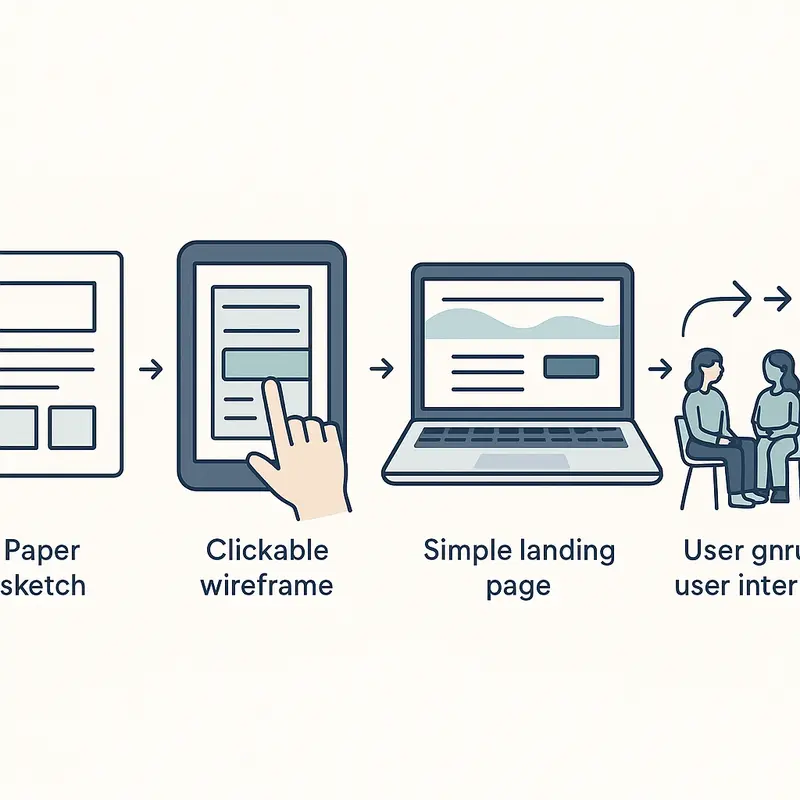
Prototyping and MVP development are about maximizing learning while minimizing build costs. Start with paper or clickable prototypes to test the concept flow and value proposition before any engineering hours are spent. Tools like Figma or basic HTML landing pages let you test product logic, pricing, and messaging. The process should be iterative: test a prototype, capture behavioral signals, refine, then run the next experiment.
An effective MVP isn’t feature-complete — it’s the smallest product that allows you to test your riskiest hypothesis. For example, Airbnb’s early validation involved listing a spare room to test whether people would pay for a stay in a non-hotel environment. They didn’t build a complete marketplace; they tested supply and demand in a low-cost way. Similarly, a concierge MVP where the founder manually provides the service can validate whether the value proposition resonates before engineering automation.
In the MVP validation process, focus on leading indicators that predict long-term success: activation (does the user experience the value?), retention (do they come back?), and monetization (do they pay and at what rate?). Define metrics that map to each of these pillars and instrument the prototype with basic analytics. If you don’t have internal engineering resources, you may temporarily use a lean web application delivered via web applications or a simple e-commerce landing powered by a custom e-commerce solution to test transactions.
Low-fidelity prototypes: speed over polish
Low-fidelity prototypes are invaluable for rapid iteration. They allow you to test workflows and core value propositions without expensive UI work. For instance, a clickable wireframe can simulate checkout flows and capture drop-off points. The goal is behavioral evidence: if users complete the key action in the prototype, you’ve likely validated the core interaction.
MVP metrics: what to measure and why
Key metrics for an MVP include conversion rates (visitor -> sign-up), activation events (first key action), retention cohorts (day-7, day-30), and revenue signals (pre-orders or paid pilots). For early monetization tests, measure LTV/CAC directionality even if absolute numbers are noisy; what matters is the trend and whether customer acquisition at test prices seems plausible at scale.
Step 4: Test Go-to-Market and Early Traction Strategies
Validation isn’t only product-centric — go-to-market (GTM) tests are equally important. GTM experiments reveal whether you can reach and convert your target audience cost-effectively. Run small, measurable acquisition experiments across multiple channels (content, paid ads, partnerships, community) to compare CPAs, conversion quality, and lifetime value. This helps you prioritize channels for scale and prevents over-indexing on a single uncertain acquisition path.
Early traction experiments can be as simple as a targeted landing page with segmented messaging, a pilot with a handful of customers, or a paid trial campaign with explicit conversion goals. When feasible, run paid experiments because they reveal real economic cost of customer acquisition immediately. Paid ads are not the only test — community-led approaches such as content and partnerships can produce higher-quality leads in niches where trust and domain expertise matter.
Test pricing and packaging as part of GTM. Offer pilot discounts to early users and capture feedback about perceived value and elasticity. Pricing experiments — even small ones — can inform whether your business model is viable. If early pilots refuse to pay even at low prices, it indicates a core problem in perceived value or target segment selection. For rapid experiment support and specialized campaigns, you might collaborate with teams focused on paid marketing or email marketing to structure tests and scale winners efficiently.
Paid experiments: structure and guardrails
Design paid experiments with tight guardrails: set a daily budget, targeting parameters, and a conversion funnel you can measure end-to-end. Use small budgets to explore channel hypotheses; once a channel demonstrates consistent performance toward your success criteria, scale gradually while monitoring CPA and conversion quality. Always validate that cost per conversion aligns with long-term unit economics before scaling further.
Community and partnership-led traction
In many niche B2B and technical markets, community and partnerships outperform paid channels for quality and sustainability. Early partnerships — integrations with complementary products, reseller pilots, or industry associations — provide credibility and an efficient path to early adopters. Document partner conversations as part of your validation evidence: signed letters of intent, pilot agreements, or referral commitments are strong signals for investors and internal stakeholders.
Step 5: Measure, Analyze, and Decide — Product-Market Fit Validation
After running multiple experiments, you’ll have a portfolio of evidence: interview notes, survey data, landing page conversion rates, pilot results, and early revenue signals. The next step is to synthesize these into a decision: pivot, persevere, or kill. Use pre-defined decision criteria that tie back to your original hypotheses to avoid biased assessments. For instance, you might require a minimum email-to-paid conversion rate, a baseline retention metric, and initial LTV/CAC directionality to continue to full product development.
Product-market fit validation is not a single metric, but a pattern of signals. Look for increasing retention cohorts, rising willingness to pay, productive word-of-mouth or community referrals, and declining friction in the acquisition funnel. Hitting these milestones suggests you can scale with predictable economics. If you see poor retention or poor willingness to pay despite high initial interest, that’s a flag: people may like the idea but not enough to form a durable habit or a paying relationship.
Decision frameworks help eliminate emotion from the process. Use a RICE or ICE model for prioritization, and map experiment outcomes to go/no-go thresholds. If you choose to build, align the early product roadmap to validated features and the highest-converting segments. If you decide to pivot, focus on transferring validated assets — your customer relationships, distribution channels, or parts of the product that still deliver value — into the new direction.
Key metrics that indicate product-market fit
Some commonly used signals include: 40%+ of users saying they’d be very disappointed without the product (a classic PMF proxy), retention rates that stabilize or improve across cohorts, and repeat purchase or usage behavior. For SaaS, a strong early signal is net retention and expansion; for marketplaces, balanced supply-demand dynamics and transaction frequency are critical. Synthesize multiple metrics rather than relying on a single vanity signal.
Decision frameworks and evidence logging
Maintain a validation dashboard that logs every experiment, hypothesis, sample size, and result. Use versioned experiment notes so you can audit decisions and revisit them with fresh data. This level of rigor demonstrates to investors and partners that your approach is systematic and that the next phase of investment is low-risk relative to the initial concept.
Validation Techniques: Comparative Table and When to Use Them
Different validation techniques serve different purposes; choosing the right technique depends on the assumption you’re testing, time constraints, and budget. Below is a practical comparison of common validation methods, including cost, time to run, what they test best, and the key metrics to watch.
| Technique | Typical Cost | Time to Run | Best for Testing | Key Metrics |
|---|---|---|---|---|
| Customer Interviews | Low (time) | 1–4 weeks | Problem intensity, usage context | Qualitative pain signals, frequency |
| Surveys | Low–Medium | 1–3 weeks | Market prevalence, willingness to pay | Response distribution, price sensitivity |
| Landing Page / Smoke Test | Low–Medium | Days–2 weeks | Demand intent, messaging | Conversion rate, sign-ups |
| Concierge MVP | Medium (operational labor) | 2–8 weeks | Value proposition & willingness to pay | Repeat use, revenue, NPS |
| Paid Ads | Variable | Days–weeks | Acquisition cost, channel viability | CPA, conversion, LTV directionality |
| Prototype Testing | Low–Medium | 1–4 weeks | Usability, core flows | Task completion, time-on-task |
“According to multiple studies, one of the top reasons startups fail is the absence of a market need; early validation directly addresses this by proving whether customers actually want your solution.”
Real-World Examples and Case Studies

Understanding how other companies validated their ideas provides invaluable context. Airbnb famously used a primitive landing page and simple listings to validate demand for renting out spare space. They tested willingness to book and pay before building the marketplace technology, using early transactions as proof of concept. Similarly, Buffer began with a single landing page describing a simple social scheduling flow and a pricing page to measure interest and pre-commitments. Both cases highlight the power of quick experiments that test core monetization and demand signals.
On the enterprise side, many B2B startups validate by offering free pilots or concierge services to a small set of companies. These pilots allow close observation of workflows, billing willingness, and integration pain points. For example, a startup in HR tech validated their product by doing manual onboarding for three customers; the found process revealed key integrations and clarified the metrics customers valued most, which then informed the automated product roadmap.
Case studies like these show a common pattern: start small, measure real behavior, and use evidence to scale. If you need help executing complex prototyping efforts or integrating validation results into a roadmap, teams often augment with technical capabilities or hire specialized talent — for example to hire a dedicated team for rapid prototyping or to bring on experts in creative design for higher-converting prototypes.
Conclusion: From Validation to Build (and When to Call for Support)
Validating your startup idea is not a one-time activity — it’s an iterative discipline that reduces risk and informs every major decision you make as a founder. By defining hypotheses, running inexpensive experiments, and measuring the right signals, you can move from uncertainty to clarity without burning runway. The techniques described here — from interviews and surveys to landing pages and concierge MVPs — provide a toolkit you can adapt to your industry, whether consumer, SaaS, marketplace, or hardware.
When experimental results show consistent positive signals — improving retention cohorts, actual willingness to pay, and sustainable acquisition costs — you’re ready to commit engineering resources to build the scalable product. Conversely, when results are weak, the structured validation approach helps you pivot efficiently, conserving resources and refocusing on opportunities with stronger evidence. If your validation efforts require specialized development or analytics support, lean on partners who can accelerate prototypes and rigorous measurement; for example, teams skilled in web applications and analytics and reporting can help convert early learning into a production-ready roadmap.
Further Reading and Authoritative Sources
- Startup failure reasons and statistics — Statista
- The Lean Startup and the importance of validated learning — Harvard Business Review
- Common reasons startups fail and prevention strategies — Forbes
Frequently Asked Questions
How to Validate Your Startup Idea Before Building.
How do I start validating my startup idea with no budget?
Begin with customer interviews and free or low-cost tools: use Google Forms for surveys, LinkedIn or niche forums to recruit interviewees, and free Figma prototypes to simulate flows. Focus on qualitative learning first and run a simple landing page or smoke test with organic outreach to measure intent before spending money on paid ads.
What are the most reliable metrics in the MVP validation process?
Reliable early metrics include conversion rate (visitor to sign-up), activation (users completing the key value action), retention cohorts (day-7 or day-30 retention), and early revenue or pre-orders. Track these together to identify sustainable growth patterns rather than relying on single vanity metrics.
When should I pivot based on validation results?
Consider pivoting when multiple, well-run experiments repeatedly fail to meet predefined success criteria, such as low willingness to pay, poor retention, or unsustainable acquisition costs. Use documented decision thresholds to avoid reactive changes and ensure your pivot preserves validated assets where possible.
Can I validate a hardware startup idea the same way as a software idea?
Yes, but the tactics differ: hardware validation often relies more on prototype mockups, pre-orders, factory feasibility checks, and small-batch manufacturing pilots. Use crowdfunding or pre-order landing pages to test demand early, and combine interviews with rapid physical prototypes to validate user fit and manufacturability.
How many validation experiments should I run before building?
There’s no fixed number, but aim for a mix that covers your riskiest assumptions: at least one qualitative discovery, one demand test (landing page or paid ad), and one monetization test (pre-orders or paid pilot). The goal is converging evidence rather than quantity — prioritize experiments that directly test high-impact risks.
Do I need analytics tools during early validation?
Basic analytics are essential: tools like Google Analytics, Mixpanel, or simple event tracking help quantify conversions and retention. Even minimal instrumentation allows you to compare experiments and make evidence-based decisions; for deeper support, consider partnering with analytics specialists to set up dashboards and automate reporting.
Ready to validate your idea with a structured plan?
Start with a simple hypothesis list and one small experiment this week: a 48-hour landing page, five customer discovery interviews, or a paid ad test at a modest budget. If you’d like help designing experiments, building rapid prototypes, or scaling validated MVPs, reach out via our contact page — we partner with founders to move from validated learning to product-market fit faster and with less risk.
- No commitment required
- Detailed technical roadmap
- Customized to your infrastructure
By submitting this form, you agree to our privacy policy. · 4,000+ businesses served · 24hr response · 98% satisfaction