Enterprise AI & Automation Agency | Eplanet Soft
Turn Ideas into Products in Days: Vibe Coding for Startups
Discover vibe coding — the hybrid AI + no-code approach that helps startups build MVPs fast. Learn tools, workflows, case studies, and how to scale. Start today.
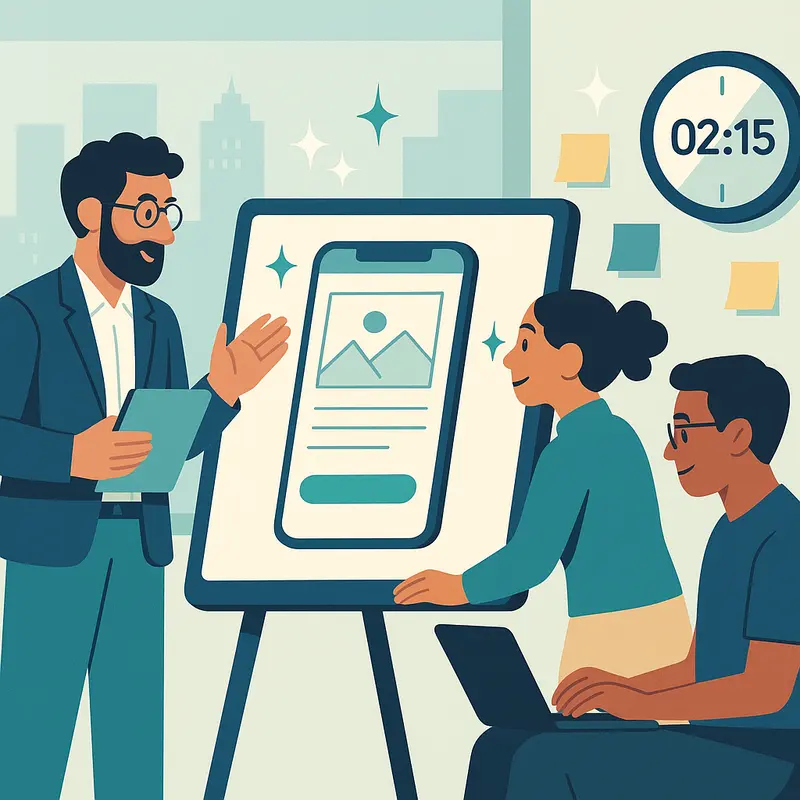
Every startup founder dreams of moving from idea to product faster than their competitors. The traditional software development lifecycle — long spec documents, multi-month sprints, and expensive engineering teams — can suffocate momentum and waste precious runway. Enter vibe coding: a pragmatic, outcome-driven approach that blends AI coding tools, no-code/low-code blocks, and human design intuition to prototype and ship functional MVPs in days, not months. For founders aiming to validate product-market fit quickly, vibe coding isn’t just a buzzword; it’s an operational shift that changes how teams think about product discovery and development.
In this article we unpack why vibe coding startups are gaining traction, how the methodology actually works, and the tools and workflows that let you build an MVP fast. We’ll walk through a step-by-step playbook you can apply on day one, provide a tooling matrix that compares classical engineering, low-code, and vibe coding approaches, and share real-world examples and metrics showing the impact on time-to-market and cost. If you’re wondering whether you can build an app without coding knowledge—or how AI app development tools fit into the stack—this guide offers practical clarity and actionable next steps.
Vibe coding lives at the intersection of rapid app development, AI-assisted engineering, and modular no-code blocks. It allows teams to get a functional product in front of users for early feedback, then iterate with data-driven confidence. Throughout the article we’ll present case studies from early-stage founders who reduced their MVP build time by 60–80%, empirical advice for choosing the right mix of tools, and a clear migration path for scaling an initial vibe-coded MVP into a robust web application or custom platform.
Whether you’re a non-technical founder, a growth lead tasked with building experiments, or a CTO wanting to accelerate feature discovery, you’ll find concrete tactics here: checklists, comparisons, and decision criteria that help you choose when to use vibe coding and when to invest in traditional engineering. We’ll also link to services and hiring models that support each stage of the journey, from custom mobile app development for polished prototypes to custom platforms for long-term scale. Let’s get started.
What is Vibe Coding? Origins, Definition, and Core Principles
Vibe coding is a pragmatic methodology rather than a single technology. At its core, it combines three vectors: AI coding assistance (from models like GPT-based copilots and generative code tools), modular no-code / low-code blocks (visual builders, pre-built integrations), and a human-centered design loop focused on rapid validation. The term "vibe" reflects an emphasis on product feel and user flow — founders prioritize a believable experience that communicates value fast, rather than engineering every last edge case. This distinguishes vibe coding from traditional development which often optimizes for completeness over speed.
Historically, low-code and no-code platforms democratized app creation, enabling non-engineers to ship working prototypes. Meanwhile, AI coding tools have accelerated developers’ productivity by auto-generating snippets, refactorings, and even full components. Vibe coding places these advances into a single workflow: designers and founders use visual builders for UI and integrations, AI tools generate logic and prototypes, and engineers intervene selectively to harden essential components. The result is an MVP development cycle measured in days or weeks, not months.
Core principles of vibe coding include: (1) prioritize the minimum lovable feature set that proves your value proposition, (2) lean on modular building blocks and composable APIs to reduce custom code, (3) use AI to speed repetitive or boilerplate coding, and (4) keep humans in the loop for design, testing, and governance. This approach favors shipping early and iterating over perfecting before launch — a shift that matches how modern product-market validation works.
Vibe coding also embraces tooling pragmatism: it’s agnostic about which specific platform you use and more focused on the velocity and feedback loops you create. That makes it especially compelling for early-stage teams that need to experiment across channels (web, mobile, chatbots) and pivot quickly when user feedback indicates a different direction. When combined with the right hiring or augmentation strategy (for example, bringing in specialists through a hire dedicated team model), vibe coding becomes an organizational capability, not a one-off trick.
Origins: Where the Concept Came From
The seeds of vibe coding trace back to two parallel trends: the growth of no-code/low-code for non-technical entrepreneurs and the rapid improvements in AI-assisted development. No-code platforms like Webflow, Bubble, and Glide showed that entire product flows could be assembled visually. Simultaneously, AI tools such as GitHub Copilot and other code-generation offerings made it feasible for developers to scaffold logic faster. Founders started combining the two into hybrid paths — visual frontends wired to auto-generated backends — and refined workflows that prioritized shipping a convincing experience first.
Practitioners adopted the word "vibe" because early wins were often about capturing an emotional response or perceived value — a clean onboarding flow, a smooth checkout, or an immediate time-saver. Vibe coding institutionalizes that instinct: build the part users will judge first, then harden the rest as traction emerges. That mindset echoes lean startup principles, but amplified by modern tooling that compresses development time dramatically.
How Vibe Coding Differs from Pure Low-Code or No-Code
Pure no-code empowers non-technical users to assemble full applications visually, but it can hit limitations around custom logic, performance, or data governance. Pure low-code usually requires more engineering oversight and can still involve significant custom development. Vibe coding intentionally lives in the middle. It acknowledges no-code/low-code strengths for wiring UI and integrations, and supplements them with AI-assisted code generation and targeted engineering to address gaps. This hybrid model increases speed without sacrificing the possibility of future scale.
For example, a founder using a visual builder to create onboarding screens and Stripe-based payments might use AI-generated serverless functions to handle edge-case validation or a small, hand-coded microservice for a proprietary recommendation algorithm. That pragmatic mix reduces total engineering hours while still enabling technical depth when required — an essential trade-off for MVP development for startups that must optimize for time and learning.
Why Vibe Coding Is a Game-Changer for Startups
For startups, time and capital are limited. The most valuable question is not whether your codebase is elegant but whether users will adopt your product. Vibe coding aligns development inputs with that reality: it maximizes validated learning per dollar and per week. Founders using vibe coding can bring a working product in front of users within days, gather real usage signals, and pivot or double down based on data. That ability to reduce the feedback loop directly impacts odds of survival and success.
Speed to market is the headline benefit. With vibe coding, the classic build-measure-learn cycle shrinks considerably. Instead of spending months building a full-featured platform that might miss the mark, teams ship a minimal experience and start learning immediately. A shorter cycle increases the number of experiments you can run within the same time window, which improves the probability of finding a scalable product-market fit. This approach is particularly valuable in markets with short windows of opportunity, like seasonal commerce or trending social products.
Cost efficiency is another key advantage. Early-stage startups often can’t afford large engineering teams. Vibe coding reduces the upfront engineering burden by combining no-code components with AI-generated code and selective developer involvement. Those savings allow teams to allocate capital toward growth, user acquisition experiments, or hiring customer-facing roles that accelerate learning. For many founders, the difference between a three-month runway and a nine-month runway hinges on development costs; vibe coding can materially extend your runway by lowering initial build costs.
Finally, vibe coding fosters an experimental culture. When shipping is inexpensive and fast, teams are more willing to try bold ideas, A/B test flows, and iterate aggressively. That cultural shift is non-trivial: companies that institutionalize fast learning cycles tend to out-innovate peers. As services and tools mature around rapid prototyping, startups that adopt vibe coding practices can sustain a rhythm of continuous experimentation that becomes a competitive advantage.
Speed to Market: Quantifying the Advantage
How much faster? Anecdotal and early empirical data suggests vibe coding workflows can cut MVP development time by 60–80% versus traditional development. McKinsey’s 2023 AI report highlights how AI can compress development tasks and accelerate delivery timelines, particularly for repetitive or templated work (according to McKinsey). When combined with no-code builders, startups often report shipping usable prototypes within a week for relatively simple consumer or B2B flows.
Those numbers translate into business outcomes: faster validation, fewer wasted engineering cycles, and earlier revenue or user signal. In competitive, fast-moving verticals—fintech components, creator economy tools, or productivity integrations—the first credible product to market frequently captures disproportionate attention and partnership opportunities.
Cost Efficiency and Capital Allocation
Saving engineering hours directly impacts burn rates. By prioritizing minimal, testable flows and substituting tools for custom code where reasonable, vibe coding reduces the need for large initial engineering teams. That enables founders to channel funds toward growth experiments, customer development, or strategic hires. Gartner’s research into low-code adoption highlights how organizations redirect engineering bandwidth to higher-value tasks, which results in faster ROI on digital initiatives (Gartner report).
Anatomy of a Vibe Coding Workflow: Tools, Roles, and Processes
To operationalize vibe coding, teams need a repeatable workflow. A typical vibe coding pipeline has five stages: 1) define the minimum lovable feature set (MLFS); 2) map the user flow and wire UI with visual builders; 3) generate or scaffold back-end logic with AI coding tools; 4) assemble integrations and data flows through no-code connectors or lightweight APIs; and 5) deploy a testable product, run experiments, and collect feedback. Every stage includes rapid review and decision gates to determine whether to harden, iterate, or pivot.
Key roles in a vibe coding team are intentionally lean: a product lead who owns the MLFS and metrics; a UX/UI designer who assembles the experience using tools like Webflow or Figma-to-builder flows; an AI-assisted engineer or developer who scaffolds custom logic and secures integrations; and a growth or analytics person who captures user signals and sets up experiments. Many startups also use fractional or project-based specialists — for example through hire dedicated team arrangements — to fill gaps without full-time hires.
The tooling ecosystem is diverse. AI coding tools include code copilots and model-based generators that create serverless functions, API client code, or even database schema suggestions. No-code builders and platforms (e.g., Glide, Bubble, Webflow, Airtable) provide UI and data primitives. Integration tools such as Zapier, Make (Integromat), and native platform connectors glue third-party services together. Monitoring and analytics are essential from day one — lightweight instrumentation (event tracking, session recording, funnel analytics) gives you the early signals that inform iteration.
Human governance is necessary to manage technical debt, security, and regulatory requirements. AI-generated code and visual components can speed initial development, but they also create hidden complexity if unchecked. Vibe coding teams should set explicit criteria for when code should be refactored, when a no-code implementation must be replaced, and when to bring in engineering support to optimize performance and compliance. That discipline allows startups to move fast without accumulating crippling technical debt.
Tools and Platforms: AI Coding Tools and No-Code Builders
AI coding tools (e.g., GitHub Copilot, Replit Ghostwriter, and other model-driven generators) accelerate routine programming tasks such as writing APIs, setting up authentication, or generating unit-test scaffolds. No-code and low-code platforms help designers and operators assemble user-facing flows and data models. Using both together enables rapid end-to-end prototypes: a visual builder for the front-end, AI for intermediate glue logic, and pre-built connectors for third-party services like payments or analytics.
It's useful to think of tools in three layers: presentation (Webflow, Glide), orchestration (Zapier, Make, Airtable workflows), and logic (AI-generated serverless functions or small microservices). Choosing the right tool for each layer keeps the build minimal while maintaining extensibility.
Human-in-the-Loop: When to Intervene
Vibe coding isn’t zero-human oversight. Designers must validate UX assumptions, product leads must set analytics and acceptance criteria, and engineers must vet performance and security for user-facing features. Use acceptance checks such as unit-of-work thresholds (e.g., >1000 concurrent users or transactions involving sensitive data) to trigger engineering reinvestment. This approach balances speed with prudence and ensures the MVP can be evolved into a reliable product as usage scales.
Build an MVP Fast: A Step-by-Step Playbook
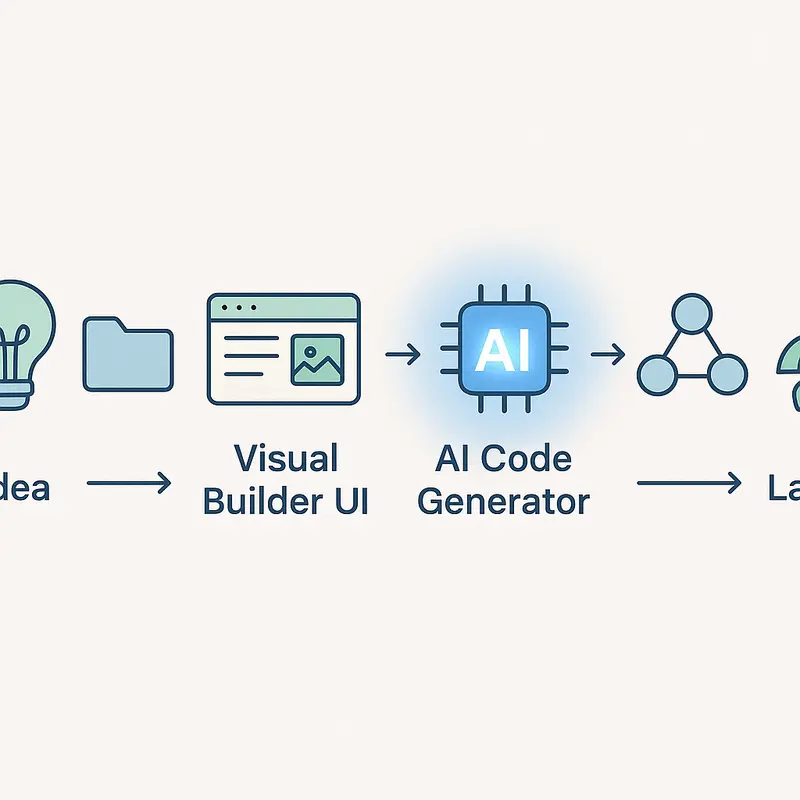
Turning an idea into a product in days requires discipline: a clear scope, the right toolset, and a ruthless focus on learning. Below is a practical playbook that compresses the MVP timeline while maximizing validated learning. Each step includes decision criteria and tactical examples so you can execute quickly.
Step 1: Define your Minimum Lovable Feature Set (MLFS). Unlike a minimum viable product that sometimes skews to technical functionality, MLFS focuses on the experience that convinces a user your product is worth using. Write a single-user story that defines the core value: "As a [persona], I want to [core action] so that [benefit]." If you can’t articulate that in one sentence, your scope isn’t minimal enough.
Step 2: Map the flow and prioritize screens. Sketch the onboarding, the primary interaction, and the success state. Prioritize the screens that directly contribute to the MLFS. Use rapid UI builders to assemble screens (for example, prototype the onboarding in a visual builder and wire it to sample data). This is where a designer’s sensibility matters: a convincing flow with realistic copy and visuals can yield accurate user feedback even when backend logic is rudimentary.
Step 3: Scaffold the backend with AI and serverless primitives. For logic that no-code can’t handle, use AI-assisted tools to generate serverless functions or database queries. Tools that auto-generate endpoints for common operations (auth, CRUD, payments) can save hours of boilerplate. Connect these functions to your visual UI and run end-to-end checks. This hybrid scaffolding enables you to support real users and payments without a monolithic backend.
Step 4: Instrument and launch experiments. Before inviting users, add lightweight analytics: event tracking for core actions, funnel conversion metrics, and simple session recordings for early user interviews. Launch to a small cohort (beta, waiting list, or targeted ad spend) and collect data. Use the results to iterate — add or remove features, change copy, or alter onboarding — and use A/B tests for higher-confidence decisions.
Step 5: Decide on hardening or pivot. Based on usage and feedback, determine whether the idea merits investment in a more robust architecture. If the metrics meet thresholds (for example, retention at day 7 or conversion to paid), plan a migration path that prioritizes the most critical components for reengineering. If not, capture learnings and pivot quickly.
Quick Checklist: What to Ship First
- Single core flow that proves value (MLFS).
- Realistic onboarding and initial data population.
- Payment or sign-up integration if monetization is part of validation.
- Analytics and error monitoring from day one.
- Clear success metrics and acceptance criteria.
When to Use External Help vs. DIY
Non-technical founders can often assemble a believable MVP using no-code builders and external integrations. However, if your product requires specialized algorithms, proprietary data processing, or strict compliance (e.g., HIPAA, PCI), you should bring in experienced engineers or consultants early. Services such as custom mobile app development or targeted hires (for example, a contract React developer) can accelerate time-to-market while keeping the architecture future-ready.
Case Studies and Real-World Examples
To ground the discussion, let’s review several case studies that illustrate typical vibe coding outcomes. These examples emphasize time savings, metrics, and the decisions that determined whether to harden or pivot.
Case Study 1 — Creator Marketplace MVP: A two-person founding team wanted to validate demand for a niche freelance marketplace. They used a landing page built in Webflow, a payment flow using Stripe, and a simple Airtable backend to manage listings. AI-assisted functions handled onboarding emails and scheduling logic. Within 5 days they had a functioning marketplace and obtained 120 signups in the first week. They judged the product-market fit promising and invested in a single developer to reimplement critical flows as a web application backend after securing a small seed round.
Case Study 2 — B2B Workflow Automation Pilot: A startup needed to prove an automation workflow for HR teams. They created a prototype using a combination of Glide for UI, Make for automation, and small AI-generated microservices for custom data transforms. In two weeks they closed a pilot with an enterprise client that paid upfront for a three-month evaluation. The team used the revenue to fund a phased re-architecture with a dedicated backend and team members sourced via a hire dedicated team arrangement.
Case Study 3 — Consumer Fintech Onboarding Flow: A founder built a slick onboarding and KYC flow in days using no-code identity verification integrations and AI-generated validation logic. A targeted paid campaign converted at 8% for the onboarding flow, providing convincing evidence of product-market fit. The team decided to rewrite sensitive components in-house for security and compliance and engaged specialized AI and machine learning solutions partners for fraud detection and scoring.
Across these examples, the unifying theme is pragmatic tool selection and the willingness to iterate quickly. Each startup used a mix of visual builders, third-party integrations, and selective code to achieve a credible, testable product fast — then made informed decisions about when to invest in engineering based on real user signals.
Metrics That Matter for Early Validation
When evaluating any vibe-coded MVP, focus on leading indicators that predict growth: activation (first key action completion), retention (day 1/day 7), conversion (free-to-paid or trial-to-paid rates), and engagement (frequency and depth of use). These metrics provide the evidence needed to justify further engineering investment. For example, if your onboarding activation rate is above industry benchmarks for your vertical, it’s a strong signal to harden the experience.
Lessons Learned: Pitfalls and How to Avoid Them
Common pitfalls include over-scoping, relying on fragile third-party integrations without fallback plans, and neglecting analytics. Avoid these by sticking to the MLFS, creating basic redundancy for critical dependencies, and instrumenting everything from day one. Also plan a migration path: know which components are temporary and which need to scale when usage grows.
Choosing the Right Tools: AI, No-Code and Hybrid Platforms
Selecting the right tools is a pragmatic exercise in trade-offs. The table below compares four approaches — Full Custom Engineering, Low-code, No-code, and Vibe Coding — across dimensions that matter to startups: speed, cost, flexibility, technical debt, and typical time-to-MVP. Use this matrix to choose the approach that matches your risk profile and timeline.
| Approach | Typical Time-to-MVP | Upfront Cost | Flexibility | Scalability/Technical Debt |
|---|---|---|---|---|
| Full Custom Engineering | 3–6+ months | High | Very High | High if not properly architected |
| Low-code | 4–8 weeks | Medium | Medium | Medium; vendor lock-in risks |
| No-code | Days–4 weeks | Low | Low–Medium | Low short-term; can become ad-hoc at scale |
| Vibe Coding (Hybrid) | Days–3 weeks | Low–Medium | High (with selective code) | Medium; demands governance to manage tech debt |
From the table, vibe coding sits between no-code and full custom engineering. It offers the speed of no-code with a path to scale through selective engineering. When choosing platforms, evaluate connectors, exportability, and governance — these determine how easily you can migrate functionality later.
When to Use AI App Development Tools
AI app development tools shine when tasks are repetitive or templated: scaffolding endpoints, generating form validation, creating boilerplate tests, or converting simple specs into working components. Use them to accelerate development, but validate the generated output and incorporate human review for security-critical logic. As McKinsey highlights, AI accelerates productivity but requires oversight to ensure correctness and alignment with business policies (source).
When to Hire Developers or Move to Custom Platforms
Hire developers when you hit scaling thresholds or non-negotiable requirements: sustained user growth across hundreds or thousands of concurrent users, strict compliance needs (HIPAA, PCI-DSS), or proprietary algorithms that require secure and optimized execution. Start the hiring process early by defining the core systems that will need engineering — for instance, backend services and data layers — and consider fractional or contract specialists from teams that provide hire ReactJS developers or other focused skill sets.
Scaling Beyond the Prototype: Turning Vibe into Product
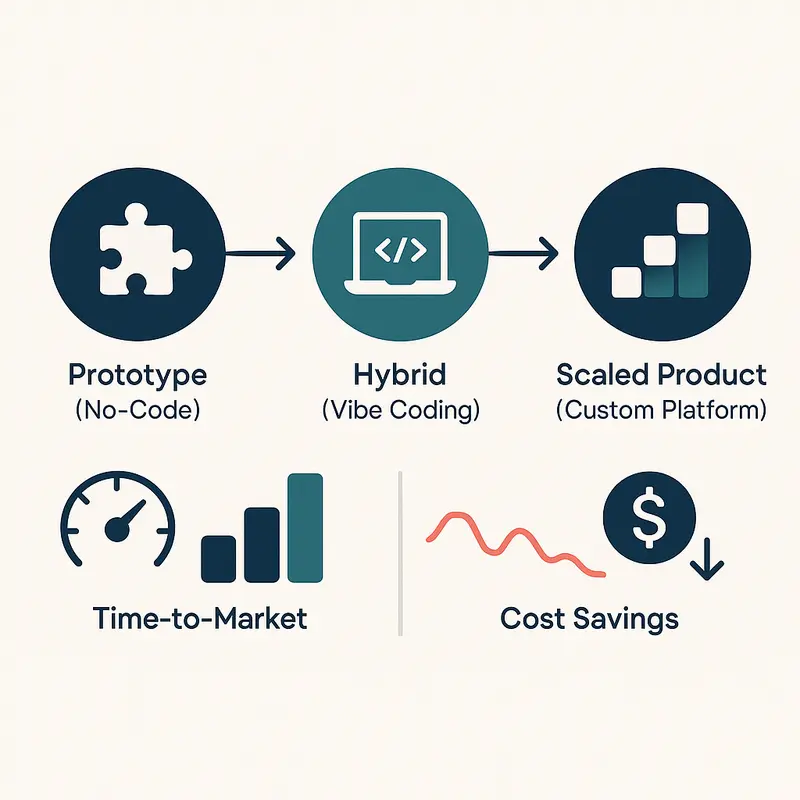
Once an MVP proves its core value, the next challenge is scaling responsibly. Vibe-coded prototypes are meant to be flexible and fast, but they can accumulate technical debt if left unchecked. The transition from prototype to product requires a roadmap that prioritizes which components to harden, how to migrate data, and what architecture to choose for long-term performance and compliance.
Start by auditing your MVP: identify single points of failure (third-party integrations, rate-limited APIs), security risks (exposed credentials, insufficient access control), and areas of poor maintainability (spaghetti automations, opaque AI-generated logic). Create a prioritization matrix that uses real metrics — usage volume, revenue impact, and error rates — to choose the first targets for refactor. This metrics-driven approach prevents premature optimization and focuses resources where they create the most value.
Hiring strategy matters. Many startups adopt a staged approach: hire a small core engineering team to own infrastructure and critical services, while keeping product and growth teams focused on experiment velocity. Services that offer hybrid engagement models (on-demand engineers plus product support) can be especially effective. When you’re ready to expand, consider building a cross-functional team with full-stack engineers, QA, DevOps, and product design to ensure reliability at scale.
Security and compliance must be front-and-center as usage grows. Integrations chosen for speed may not meet enterprise security requirements; therefore, plan for secure data handling and audits. If your product processes payments or personal health data, bring in security expertise early. A strategic approach is to encapsulate fragile or sensitive functionality into replaceable microservices, simplifying future hardening work.
Migrating from No-Code to Custom Backends
Migration is often iterative. Replace components one at a time rather than doing a big-bang rewrite. For example, start by implementing a custom API for a high-traffic endpoint while keeping UI in the no-code builder. Ensure API contracts remain stable and provide compatibility layers to minimize disruption. This incremental replacement reduces risk and allows the product to stay live during migration.
Staffing and Hiring for Scale
As the company grows, shift from tactical hires to strategic roles: engineering leads, platform engineers, data engineers, and compliance officers. Use targeted hiring pages and staffing models to source expertise quickly — for example, if your front-end is React-based, you may benefit from working with teams that provide hire ReactJS developers on a contract or permanent basis. Alternatively, retain access to a pool of engineers for bursts of work via a hire remote team strategy.
“Startups that embrace rapid prototyping and data-driven iteration are more likely to find product-market fit — and to do so at a lower cost and in less time.”
Key Takeaways
Vibe coding blends AI coding tools, no-code builders, and focused engineering to build MVPs fast. Start with a clear Minimum Lovable Feature Set, instrument everything, and use analytics to decide whether to harden or pivot. Use AI and no-code for speed, but establish governance to manage technical debt. When scaling, prioritize critical components for refactor, hire strategically, and plan incremental migrations from no-code to custom backends.
Conclusion: Start Building — And Know When to Scale
Vibe coding is more than another development fad; it’s a strategic approach that matches the realities of modern startup life. By using AI coding tools, no-code and low-code platforms, and a clear product-first mindset, founders can validate ideas faster, preserve runway, and make informed decisions about scaling. The approach reduces the risk associated with long, expensive build cycles and replaces guesswork with measurable learning.
If you’re ready to test an idea, start by defining your MLFS and assembling the minimal team: product lead, designer, and a technical partner who can scaffold AI-generated functions and integrations. You can prototype in days using public builders and AI tools, then scale consciously by migrating core systems to a robust architecture. When you need support — whether building a polished mobile experience or planning a migration — our expertise can help: consider connecting with teams that specialize in custom mobile app development, web applications, or broader custom platforms to make the transition smoother.
Further Reading and Resources
- McKinsey — The State of AI in 2023 (insights on productivity gains from AI)
- Gartner — Low-code Market Growth (why organizations adopt low-code/no-code)
- Forbes — How to Build a Minimum Viable Product (practical MVP guidance)
Frequently Asked Questions
Turn Ideas into Products in Days.
What is vibe coding and how does it differ from no-code or low-code?
Vibe coding is a hybrid methodology that combines AI-assisted code generation, no-code/low-code visual builders, and selective manual engineering to build product prototypes quickly. Unlike pure no-code, which relies entirely on visual tooling, and pure low-code, which often still leans on engineering, vibe coding intentionally mixes approaches to maximize speed while retaining a clear path to scale.
Can non-technical founders build an app without coding using vibe coding?
Yes — non-technical founders can often assemble a convincing MVP using visual builders, third-party integrations, and AI-generated functions for intermediate logic. However, for certain requirements like advanced algorithms, security, or high performance, you’ll need engineering assistance to ensure reliability and compliance.
How fast can a startup build an MVP using vibe coding?
Vibe coding aims to deliver a testable MVP in days to a few weeks, depending on complexity. Many founders report shipping core flows within 3–10 days for simple consumer or B2B workflows, while slightly more complex prototypes (payments, authentication, integrations) can take 2–3 weeks.
What AI app development tools are commonly used in vibe coding?
Common tools include AI coding assistants (like GitHub Copilot or Replit’s tools) to generate boilerplate code and serverless functions, and model-driven tools that help scaffold APIs. These are typically paired with no-code builders and integration platforms such as Webflow, Glide, Airtable, Zapier, or Make to create end-to-end flows quickly.
When should we move from a vibe-coded MVP to full engineering?
Move to full engineering when metrics show clear signs of product-market fit or when you face scalability, security, or compliance issues. Typical triggers include sustained user growth (hundreds or thousands of concurrent users), processing sensitive data, or monetization thresholds that justify the investment in architecture and dedicated engineering talent.
How do we manage technical debt created by fast prototyping?
Manage technical debt by maintaining a clear inventory of temporary components, instrumenting usage metrics to identify high-impact areas, and planning incremental replacements. Prioritize refactoring based on usage, revenue impact, and failure risk. Encapsulating fragile features into replaceable microservices simplifies later migration.
Ready to turn your idea into a product in days?
Reach out to accelerate your MVP development, explore AI and machine learning solutions for prototyping, or hire experienced engineers to scale your vibe-coded prototype into a production-grade product. Great ideas deserve fast, disciplined execution.
- No commitment required
- Detailed technical roadmap
- Customized to your infrastructure
By submitting this form, you agree to our privacy policy. · 4,000+ businesses served · 24hr response · 98% satisfaction