Enterprise AI & Automation Agency | Eplanet Soft
How to Scale Your Startup After Product-Market Fit (2026 Guide)
Learn proven startup scaling strategies after product-market fit. This 2026 guide covers growth tactics, hiring, metrics, GTM, and international expansion. Start scaling now.

Introduction
Reaching product-market fit is one of the most exhilarating milestones for any founder: you’ve found a real audience, customers are buying, and retention signals indicate that your product solves a genuine pain. But product-market fit is not the finish line — it’s the launchpad. Scaling a startup requires a different playbook than finding initial traction. The processes that helped you reach PMF, such as founder-led sales, handcrafted onboarding, and manual customer success, will often buckle under the weight of rapid growth. This guide, focused on how to scale a startup after product market fit in 2026, walks you through the strategic, operational, and cultural changes required to move from early product-market fit into repeatable, sustainable growth.
Scaling startup operations without careful planning can create chaos: costs blow out, unit economics worsen, churn increases, and team morale suffers. The reality in 2026 is even more complex — customer expectations are higher, competition is global, regulatory scrutiny is increasing in many markets, and technologies like AI are both accelerants and operational challenges. Founders and leadership teams must adopt a systems-oriented mindset while preserving speed and customer focus. Throughout this guide we’ll cover startup growth strategies that balance these tensions: building a scalable engineering and product foundation, designing a distinct go-to-market engine, hiring and structuring teams for growth, instrumenting metrics and analytics, and preparing for geographic expansion and strategic partnerships.
You’ll find practical frameworks, real-world examples, and actionable checklists in each section so you can apply the lessons to your own company. Whether you’re a SaaS startup moving from 1,000 to 10,000 customers, a marketplace expanding to new verticals, or a product-led business adding channel-driven revenue, these startup scaling strategies apply. We’ll include key metrics to monitor, common pitfalls to avoid, and decision frameworks for prioritizing investments so your growth is both fast and healthy. This article also points you to services and capabilities you might consider to accelerate scaling, such as building robust web applications or expanding your go-to-market with systematic demand generation programs.
1. Assessing Readiness to Scale: Metrics, Signals, and Common Pitfalls
The first critical step in how to scale a startup is an objective assessment of readiness. Product-market fit is necessary but not sufficient — you need repeatability in acquisition, retention, and unit economics. A mature startup should track core metrics such as LTV:CAC ratio, gross margin, churn by cohort, payback period, and customer acquisition channel ROI. For SaaS businesses, a healthy LTV:CAC is often above 3:1, a gross margin north of 70% is desirable after excluding customer acquisition costs, and median time-to-payback should be under 12-18 months in high-growth models. These numbers vary by business model and vertical, but the discipline of measuring them is non-negotiable. Use cohort analysis to understand whether recent signups are as valuable as earlier ones, and stress-test your assumptions with scenario models (e.g., what happens to unit economics if CAC rises 20%?).
Beyond the numbers, there are qualitative signals that signal readiness or the lack of it. Indicators such as consistent inbound demand beyond a specific campaign (not founder-driven), repeatable sales cycles that multiple reps can replicate, and standardized onboarding that reduces time-to-value are signs you're ready. Conversely, if you still rely on the founder to close the majority of deals, or the product requires extensive custom services to work, scaling will be expensive and fragile. An honest gap analysis helps you prioritize investments — for instance, automate onboarding flows before hiring a large sales force if onboarding limits conversion to paid plans.
Founders often rush to scale due to investor pressure or competitive fear, which brings common pitfalls. The three most common issues are (1) over-indexing on growth without fixing retention and unit economics, (2) hiring too quickly into unstructured roles leading to misalignment and cost inflation, and (3) neglecting engineering and data foundations resulting in poor observability and technical debt. A practical framework is to require a validated growth hypothesis for each major investment: define the metric you expect to change, the experiment, and the measurement plan. If your hypothesis doesn’t pass basic statistical significance checks, pause the spend. In doing so you convert scaling into a controlled scientific process rather than a leap of faith.
H3: Key diagnostic questions for founders
Run a readiness checklist: Can three different reps close the deal? Do you have a steady outbound and inbound funnel? Is your onboarding process documented and automated where possible? Do you have insights into why customers churn? These diagnostic questions help prioritize what to fix before scaling. For example, if three reps cannot close similar deals independently, investing in sales hiring will amplify variance and waste. On the other hand, if onboarding is manual and customers take weeks to derive value, adding marketing dollars will only increase churn. This diagnostic prioritization will guide whether you invest in product improvements, automation, hiring, or marketing.
H3: Real-world example: A SaaS startup that paused growth
Consider a B2B SaaS company that saw strong early traction but rising churn as they added customers quickly. They paused outbound spend, invested two months in a program to standardize onboarding (templates, in-app guidance, and dedicated playbooks), and improved time-to-value from 21 days to 7 days. When they resumed paid acquisition, CAC rose slightly but LTV improved dramatically because churn fell. The lesson: scaling without shoring up retention is a high-cost mistake. This pragmatic example highlights that readiness assessment must include both leading and lagging indicators and a plan to fix critical weaknesses before scaling aggressively.
2. Building a Scalable Product and Engineering Foundation
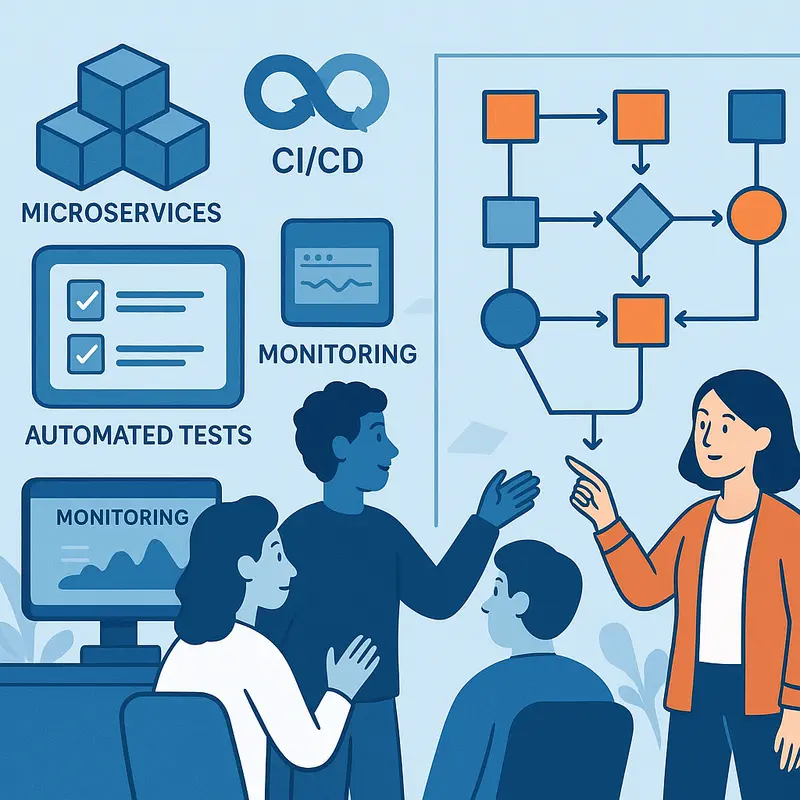
Scaling product and engineering is central to any strategy to scale a startup. Early-stage systems are often designed for speed of iteration rather than scale, and technical debt accumulates as teams hack to ship. To scale effectively, you must shift from a purely feature-driven mindset to platform thinking: modular architecture, robust API-first design, observability, and automation. Start by mapping the most common performance and reliability bottlenecks in your stack and prioritize infrastructure investments that remove constraints. For example, moving to a microservices or bounded-context architecture can enable independent team deployments, but it’s not useful unless accompanied by CI/CD pipelines, automated testing, and clear service ownership. Investing in these operational capabilities reduces the coordination cost of growth and enables higher deployment frequency with lower risk.
Security and compliance also become exponentially important as you scale, especially if you operate in regulated industries or across borders. Ensure data classification, encryption at rest and in transit, and privacy-by-design patterns are implemented early; retrofitting compliance after scale is costly. Use modern cloud providers and managed services to accelerate baseline security and leverage well-documented frameworks. If your product incorporates AI components or processes personal data, keep an audit trail and model governance practices to track data provenance, model versions, and performance drift. This is not just technical hygiene — it’s a business enabler that builds customer trust and reduces legal friction in new markets.
Finally, product scalability is also about extensibility and partner ecosystems. Design APIs and integration patterns that make it simple for partners, resellers, and customers to build on top of your platform. You might launch a developer portal, publish SDKs, and create a partner program to accelerate adoption and reduce go-to-market friction. Complement these product investments with a roadmap that distinguishes between growth-facing features (that reduce friction and increase conversion) and optional premium capabilities. Prioritize and sequence investments so your engineering efforts directly align with business outcomes — increasing activation, reducing churn, or enabling higher ARPU.
H3: Engineering organizational changes to support scale
As you grow, reorganize engineering into product-aligned squads or pods with clear KPIs. Each squad should own a vertical slice of the product, including code, tests, monitoring, and documentation. This ownership model reduces cross-team dependencies and speeds up delivery. Introduce platform or infrastructure teams that provide internal developer tools and shared components to reduce duplication. The result is more predictable delivery and clearer career paths for engineers. If hiring is constrained, consider augmenting with a specialized partner; built-in ramp plans and knowledge-transfer are crucial to avoid vendor lock-in.
H3: Example: Migrating to a resilient architecture
A marketplace company that scaled from regional to national operations encountered repeated outages due to synchronous payment and inventory checks. They decomposed the monolith into domain services, introduced asynchronous event-driven patterns for inventory updates, and implemented circuit breakers for payment gateways. This reduced outage blast radius and improved availability from 94% to 99.8%, which translated to fewer failed checkouts and material revenue retention. Migration plans should be incremental and backed by load testing and feature flags so you can validate impact without exposing all users to risk.
3. Go-To-Market at Scale: Channels, Sales Motion, and Growth Engines
Go-to-market is where scaling materially accelerates or stalls. At PMF, founder-led sales and opportunistic marketing often suffice, but scaling requires repeatable demand funnels and predictable sales playbooks. Segment your GTM by customer value and acquisition complexity: self-serve or product-led growth (PLG) for low-touch customers, inside sales for SMBs, and enterprise account teams for larger deals. Each motion needs distinct onboarding, pricing, and success playbooks. Align your marketing and sales KPIs — conversion rates by funnel stage, marketing qualified lead (MQL) to sales qualified lead (SQL) conversion, average deal size, and sales cycle length — and make them visible across the company so teams can optimize collaboratively.
Invest in measurable demand channels and be disciplined about channel economics. Paid channels can accelerate early scale but must be tested against channel-specific CAC and lifetime value. Organic channels such as SEO, content, and product-led virality are higher margin sources of growth but take time and product investment. Pursue a balanced multi-channel approach and double down on channels where payback and scalability are proven. For many startups, combining an SEO-led content strategy with targeted paid campaigns and account-based marketing to high-value prospects yields a diversified funnel that is resilient to changes in a single channel. If you don’t yet have a scalable content and SEO program, consider partnering with experienced teams to accelerate organic growth.
Sales operations and enablement become critically important as you add reps. Standardize sales collateral, playbooks for common objections, pricing sheets, and contract templates. Use CRM-driven automation for predictable touchpoints and implement lead scoring to prioritize high-intent prospects. Ensure customer success is integrated early in the sales process so onboarding and long-term value are baked into the sale. Also, plan for channel partnerships and integrations: partner ecosystems can amplify reach faster than building a direct sales team, particularly if you build a developer-friendly platform and clear partner economics.
H3: Channel mix and testing framework
Adopt a disciplined testing cadence: create small, time-boxed experiments for new channels with predefined success criteria, sample sizes, and budgets. For example, run a three-week paid search pilot targeting specific long-tail keywords and measure CAC and conversion. If the pilot passes, scale by 3x while monitoring diminishing returns. Always calculate incremental CAC (what you would pay to acquire additional paying customers) and the marginal LTV from that channel. This experimentation approach ensures you don’t commit to expensive channels before you understand unit economics.
H3: Internal link: Expand your growth with demand generation
When building scalable demand, many startups benefit from augmenting internal teams with targeted programs. A structured demand generation program — combining inbound content, targeted paid campaigns, and ABM for top accounts — can create predictable pipeline. If you’re optimizing landing pages and funnel flows to convert that traffic, pairing demand generation with technical improvements in your product and onboarding will compound growth effects.
4. Hiring, Organization Design, and People Operations for Growth
Hiring at scale is one of the riskiest and highest-impact activities for a growing startup. The wrong hires or an incoherent org structure can slow decision-making, increase churn, and blow budgets. Design a hiring plan that aligns with your product roadmap and GTM priorities. Prioritize roles that unlock growth—senior engineering leads who can build scalable systems, a head of sales with a track record in your segment, and product managers who can systematize onboarding. Don’t over-hire for optimism: hire to current and near-term priorities with a clear onboarding plan and measurable 30/60/90 day goals.
Organizational design should enable autonomy while minimizing coordination overhead. Use a lightweight, two-tier model where small cross-functional teams own user journeys or product areas, and a small leadership layer focuses on strategic alignment and removing impediments. Document decision rights — who approves pricing changes, who signs partnerships, and who defines roadmap priorities. As you scale internationally, design localized teams with clear escalation paths and playbooks so local hires can move fast without confusion. Compensation design is also important: use a mix of salary, equity, and measurable performance incentives to align incentives across growth stages.
If recruiting talent is a bottleneck, consider flexible models: staff augmentation, staff leasing, or hiring through vetted partners while you build internal recruiting capacity. Working with a partner to hire dedicated teams can accelerate ramp while you establish recruiting standards. For specialized needs like customer success at scale or ML engineering, consider hiring experienced talent who’ve run scale motions before, and invest in leadership development so mid-level managers can grow into senior roles as the company expands.
H3: Building a hiring pipeline and EVP
Develop an employer value proposition (EVP) to attract talent: highlight mission, career growth, tech stack, and flexible work arrangements. Maintain a talent pipeline by nurturing candidates, offering internships, and engaging with communities and universities. Use structured interviews and scorecards to reduce bias and make hiring decisions more predictable. A data-driven recruiting process helps you measure time-to-hire, offer acceptance rates, and early attrition, and allows you to iterate on recruiting channels.
H3: Internal link: Scale quickly with talent options
When you need to scale engineering or product quickly, hiring a dedicated team with clear SLAs and knowledge-transfer processes can be a practical option. This hybrid approach can give you speed without permanent overhead, as long as you maintain strong onboarding and code ownership practices.
5. Metrics, Analytics, and Systems to Manage Scaled Growth
Data-driven decision-making is the backbone of successful scaling startup strategies. At PMF, founders often rely on intuition; at scale, you need robust analytics to make repeatable decisions. Create a single source of truth for customer, financial, and product data. Implement event-based analytics for product behavior, and integrate billing, CRM, and marketing data for a complete funnel view. A data warehouse with automated ETL/ELT pipelines lets you run cohort analysis, calculate LTV:LTV by channel, and detect early signs of churn. For many startups, the investment in an analytics stack pays off quickly by revealing where dollars produce the most incremental growth.
Operationalize dashboards and alerting so teams can act on data rather than chase reports. Build KPI dashboards for leadership, revenue ops to monitor pipeline health, and product analytics for feature adoption. Use anomaly detection and automated reporting to highlight issues early: for example, a sudden drop in activation rate or an increase in support tickets after a release should trigger an incident review. Establish data governance and a model for self-service analytics to avoid bottlenecks where only engineers can run queries.
Beyond dashboards, embed experimentation in product and marketing workflows. A/B testing, feature flags, and measurement plans let you scale improvements with confidence. Prioritize experiments based on expected impact and effort, and ensure you have proper statistical power for your tests. Use experiments not only to optimize conversion but also to test broader strategic choices such as pricing tiers or new onboarding flows. For startups looking to augment their analytics capabilities, consider partnering for advanced analytics and reporting services that accelerate insights while you build internal expertise.
H3: Key metrics and benchmarks
Track metrics across acquisition, activation, retention, revenue, and referral. Examples include CAC, LTV, churn rate (gross and net), MRR growth, ARR cohort expansion, and activation rate. Table: typical benchmarks for early growth-stage startups provide a useful heuristic for planning investments and setting goals.
| Metric | Early-Stage Benchmark | Scaling Target | Why It Matters |
|---|---|---|---|
| MRR Growth (MoM) | 10-20% | 5-15% (sustainable) | Indicates momentum and ability to compound revenue |
| LTV : CAC | 2:1 – 3:1 | >3:1 | Healthy unit economics for profitable scaling |
| Gross Churn (monthly) | 2-5% | <2% (SaaS target) | Lower churn stabilizes revenue and reduces acquisition needs |
| Payback Period | 6-18 months | <12 months for growth-stage | Shorter payback reduces cash burn risk |
“Startups that institutionalize data and experimentation scale more predictably. Centralizing analytics and making it self-service reduces time-to-insight and improves growth outcomes.” — internal analysis across high-growth companies
H3: Internal link: Analytics and reporting best practices
If you need to accelerate analytics quickly, you can combine internal teams with external expertise. Consider external analytics and reporting support to standardize your ETL pipelines, build dashboards, and train teams on self-service analytics so insights translate to action faster.
6. International Expansion, Partnerships, and Strategic Scaling Moves
Once your core markets are stable, many startups look to international expansion as the next lever for growth. Internationalization is not just translating UI copy; it requires market research, localization, local legal and tax understanding, and often, local partnerships. Prioritize markets where product-market fit can be replicated with reasonable go-to-market adaptations. Consider adjacent markets that share buyer behavior or regulatory similarity first, and validate demand with pilot programs before committing to full-scale launches. A frequent pattern is to run a country pilot with local partners or resellers, refine the product-market fit locally, and then decide on a full investment such as hiring local sales reps or establishing a regional office.
Partnerships and channel strategies are powerful accelerators for scaling startups. Strategic partnerships — with platforms, resellers, or large enterprise vendors — can provide instant distribution and credibility. Prioritize partnerships that offer measurable pipeline and clear integration paths. Build partner playbooks and technical integration guides, define partner-level SLAs, and create joint marketing plans. In some cases, M&A or bolt-on acquisitions accelerate capability or market entry faster than organic growth, especially when acquiring a specific technology stack or local go-to-market team. Be realistic: acquisitions carry integration risk and should be evaluated with the same rigor as new product investments.
Legal, tax, and compliance overhead increases with expansion, and ignoring them is dangerous. Work with local counsel to understand employment law, data residency, and tax obligations. Set up clear contracting frameworks and consider using local master service agreements to streamline local deals. Don’t underestimate currency and payment system complexities — in many countries, payment methods and collections practices vary significantly and can materially affect conversion and churn.
H3: Example: Partner-led market entry
A fintech startup entered a European market by partnering with a regional bank that had complementary distribution. The bank handled regulatory compliance and provided access to a large customer base, while the startup delivered modern UX and rapid product iterations. This partnership reduced the time-to-market by nine months compared to establishing a legal entity and hiring local staff. The key is alignment — both parties structured commercial terms that included joint KPIs and shared incentives for customer success.
H3: Internal link: Build custom platforms for new markets
For businesses expanding into new verticals or regions where specific functionality is required, investing in custom platforms or tailored solutions can be the difference between success and a missed opportunity. Customization should be modular and maintainable to avoid unscalable forks of your product.
Key Takeaways

- Validate readiness: Ensure repeatable acquisition, retention, and strong unit economics before scaling aggressively.
- Invest in foundations: Prioritize architecture, CI/CD, observability, and compliance to reduce scaling risk.
- Segment GTM: Differentiate PLG, inside sales, and enterprise motions and measure each independently.
- Hire with intent: Align hiring to growth levers, establish clear ownership, and consider dedicated teams for rapid ramp.
- Measure obsessively: Build a single source of truth, run experimentation, and use data to prioritize investments.
- Expand thoughtfully: Use partnerships, pilots, and localized playbooks to enter new markets with lower risk.
Conclusion: Turning PMF into Repeatable, Profitable Growth (and Next Steps)
Scaling a startup after product-market fit is a strategic journey that requires discipline, measurement, and coordination across product, engineering, go-to-market, and people. The temptation to move fast must be balanced with the need to build durable systems and predictable unit economics. Start with an honest readiness assessment, shore up the weakest link (onboarding, retention, or technical debt), and then build a prioritized plan to invest in product scalability, repeatable go-to-market motions, and people systems. Use experimentation and analytics to validate growth hypotheses and de-risk investments. Consider targeted external support where internal bandwidth or expertise is constrained — whether for building resilient web applications, accelerating paid marketing pilots, or establishing a formal SEO and content strategy to drive sustainable organic acquisition.
If you’re ready to scale but need specialized support — from analytics and reporting to dedicated engineering capacity — a pragmatic next step is to engage partners who have run these plays before and can transfer knowledge while you scale. For many startups, combining internal talent with external acceleration creates the best of both worlds: speed plus sustainable building blocks. When you’re ready to explore tailored options and create an execution plan, connect with experts who can help you design and implement the right growth architecture for your business. Reach out through our contact page to discuss practical next steps and a custom engagement plan.
Frequently Asked Questions (FAQs)
- How do I know when to start scaling my startup? Start scaling when you have repeatable customer acquisition channels, sustainable unit economics (e.g., LTV:CAC > 3:1 for many SaaS models), and standardized onboarding that shortens time-to-value. Combine quantitative metrics with qualitative signals such as replicable sales cycles and predictable retention cohorts to make the decision.
- What is the single biggest mistake startups make when scaling? The most common mistake is scaling acquisition before shoring up retention and unit economics. This often leads to high churn and wasted marketing spend. Fix core product-market fit issues and automate onboarding before significantly increasing acquisition budgets.
- How should I structure my go-to-market as we grow? Segment GTM by customer size and complexity: product-led/self-serve for low-touch customers, inside sales for SMBs, and enterprise teams for large accounts. Build distinct playbooks, pricing packages, and onboarding flows for each segment to maximize conversion and ROI.
- When should I consider international expansion? Consider expansion once you have validated repeatability in at least one core market, and you can pilot demand and distribution in the target market with limited investment. Use local partnerships and pilots to validate product-market fit before full-scale launches to reduce risk.
- What metrics should leadership monitor during scaling? Track acquisition metrics (CAC, channel ROI), activation (time-to-value), retention (cohort churn and net revenue retention), and financial health (MRR/ARR growth and payback period). Also maintain operational metrics like deployment frequency and uptime as product dependencies grow.
- Should we hire aggressively or use partners for rapid scaling? Use a hybrid approach: hire core leadership and mission-critical roles, and use experienced partners for rapid, tactical execution such as building a dedicated engineering squad or running demand generation programs. Ensure knowledge transfer and clear SLAs to avoid long-term dependency.
References and Further Reading
Ready to Grow Your Business?
Get a free consultation from our digital marketing and development experts. Let's discuss how we can help you achieve your goals.
- No commitment required
- Detailed technical roadmap
- Customized to your infrastructure
By submitting this form, you agree to our privacy policy. · 4,000+ businesses served · 24hr response · 98% satisfaction