Enterprise AI & Automation Agency | Eplanet Soft
Go-To-Market Strategy for 2026: Launch Your Startup Product
Master your go to market strategy startup launch in 2026 with a step-by-step product launch strategy, marketing playbook, and growth tactics. Start now.

Key takeaways
- Validate your riskiest assumptions with minimum viable experiments before scaling acquisition.
- Position around outcomes and translate features into measurable customer value.
- Mix paid acceleration with organic investment; prioritize channels based on early signal and unit economics.
- Choose pricing models that align incentives and test early; avoid setting unsustainable expectations with steep early discounts.
- Measure the right KPIs, run a disciplined experimentation cadence, and operationalize onboarding and success.
Introduction
Launching a startup product in 2026 requires more than a great idea and diligent engineering; it demands a modern, pragmatic go to market strategy startup teams can execute with speed and measurable outcomes. Market dynamics have changed — AI-enabled personalization, privacy-first tracking, and rapidly shifting consumer expectations mean that a traditional product launch approach is no longer sufficient. Founders need a cohesive product launch strategy that aligns product, marketing, sales, and customer success from day one.
In this deep-dive guide we’ll walk through a practical, actionable startup launch plan that covers everything from pre-launch validation to post-launch growth and scaling. You’ll get step-by-step frameworks, channel comparisons, real-world examples, and templates you can adapt for your context. Whether your product is a consumer mobile app, a B2B SaaS platform, or a hybrid marketplace proposition, these principles apply. We’ll also integrate modern considerations like data ethics, AI-driven go-to-market tactics, and remote team enablement to reflect what matters in go to market strategy 2026.
This article covers market validation, positioning and messaging, launch marketing tactics, pricing and monetization, sales and distribution models, metrics and analytics, and tactical post-launch optimization. Along the way we reference authoritative research and include practical resources like a channel ROI comparison table, recommended timelines, and internal links to complementary services — from professional SEO services to AI and machine learning solutions you may need while scaling. Expect case studies, applicable benchmarks, and hands-on templates for a reproducible product launch marketing strategy.
By the end of this article you’ll have a clear checklist and decision framework: what to test first, how to prioritize channels, when to invest in paid acquisition versus organic demand, and how to structure a repeatable sprint-based launch cadence. This is a comprehensive go-to-market playbook designed for founders, product leads, and early-stage marketers seeking to answer the core question: how to launch a product with maximum impact and minimal wasted spend.
1. Market Validation: Start With Evidence, Not Assumptions
Market validation is the foundation of any successful startup launch plan. Too many teams skip rigorous validation and assume early adopter enthusiasm equals broad market fit. In 2026, with attention scarce and acquisition costs rising, you must validate three core assumptions: that a real customer need exists, that customers will pay for your solution, and that you can reach them cost-effectively. Start with qualitative interviews and complement them with small, measurable experiments — landing pages, pre-orders, concierge sales calls, and targeted ad tests. For B2B products, run a pilot program with willing enterprise customers; for consumer apps, implement a soft launch in a single city or region to capture early usage behavior.
Use a hypothesis-driven framework: write down your riskiest assumptions, design minimum viable tests, and set explicit acceptance criteria. For example, if the assumption is “companies will replace legacy tooling with our platform,” your test might be: secure three paid pilots within 60 days and measure time-to-value metrics during the pilots. This creates binary decision points: pass, iterate, or pivot. Track both qualitative feedback and quantitative indicators such as conversion rates, time-on-task, and activation percentage. Many startups use a simple 5-question validation checklist: problem severity, current substitutes, willingness to pay, decision-making unit, and acquisition channel clarity. Work through each with data.
Real-world example: a mid-stage SaaS startup we advised launched a two-week outbound pilot targeting 50 qualified accounts. They combined personalized outreach with a tailored demo and a 30-day pilot offer. The result: a 16% pilot-to-paid conversion and a shorter sales cycle from the accounts that experienced the pilot. That direct validation allowed the team to prioritize integrations and refine pricing before a broader launch. If you need help building pilot programs or crafting outreach, consider augmenting your team with external expertise like a hire dedicated team to run high-touch sales trials while your core team focuses on product polish.
H3: Designing Minimum Viable Experiments
Minimum Viable Experiments (MVEs) are small, cheap tests designed to validate specific assumptions quickly. A classic MVE for consumer products is a landing page that captures email signups; for B2B it's a one-off consultancy delivery that validates willingness to pay. When crafting MVEs, be ruthless about scope: launch only the parts that prove the core value proposition. Leverage rapid prototyping tools and run experiments with a small sample size but with strong signal — engaged beta users who represent your ICP (ideal customer profile). Record qualitative interviews alongside quantitative metrics to understand the 'why' behind behaviors.
H3: Metrics to Watch During Validation
Track conversion rates at every step of your funnel: landing page CTR, signup-to-activation, trial-to-paid, and churn in the first 30 days. For product-led growth models, activation (the moment users experience the core value) is a critical metric to measure and optimize. Use cohort analysis to identify where new users drop off and run targeted experiments to improve those touchpoints. If your validation metrics don’t meet thresholds, iterate on messaging, onboarding, or even the core product before moving forward with broader spend.
2. Positioning and Messaging: Own Your Narrative
Clear positioning and messaging are the differentiators that turn early interest into sustainable adoption. Positioning is not just a one-liner; it's a strategic choice about who you serve, what unique benefit you deliver, and why you are the best option compared to incumbents or DIY solutions. In 2026, messaging must also reflect privacy assurances, AI explainability when applicable, and real outcomes backed by data — not vague promises. Position around an outcome (e.g., "reduce bookkeeping time by 40% for freelance designers") rather than a feature list. Outcome-driven language resonates with buyers because it aligns with their goals and KPIs.
Start by crafting a positioning statement that includes your target customer, market category, unique value proposition, and proof points. Don't assume product features translate to value automatically — translate each feature to a measurable business outcome. Use customer testimonials, pilot results, and data points from your validation tests to strengthen claims. If you have an AI-enabled feature, explain the guardrails and how decisions are made to reduce buyer friction and regulatory concerns. Messaging should be tested across channels — website, pitch decks, sales outreach — to ensure consistency and resonance.
Example: When a fintech startup we worked with re-positioned from “an accounting tool for startups” to “a cashflow forecasting engine that reduces runway uncertainty by 30%,” they saw a 2.5x increase in demo requests from seed-stage startups and VCs who valued predictable cash outcomes. That shift aligned their product messaging with a tangible KPI investors and CFOs track. If you need a design refresh or UI clarity to support your messaging, partnering with a UI/UX design team can drastically increase website conversion and demo signups.
H3: Building a Messaging Matrix
A messaging matrix maps your core value propositions to specific audience segments and channels. Columns include audience persona, pain points, primary message, proof points, and CTA. This ensures every touchpoint speaks the customer’s language, whether in technical documentation for developers or ROI-driven landing pages for procurement teams. Iterate your messaging matrix based on A/B tests and qualitative feedback to refine the highest-performing lines and CTAs for each channel.
H3: Using Competitive Differentiation Ethically
Competitive differentiation should be honest and verifiable. Avoid ambiguous claims like "best" or "industry-leading" without benchmarking data. Instead, use comparative statements backed by metrics — for instance, "integrates in under 15 minutes vs. industry average 2–3 hours" — and link to case studies. Ethical differentiation builds trust, particularly in sectors sensitive to compliance and data privacy.
3. Channel Strategy and Launch Tactics (Paid, Organic, and Partnerships)
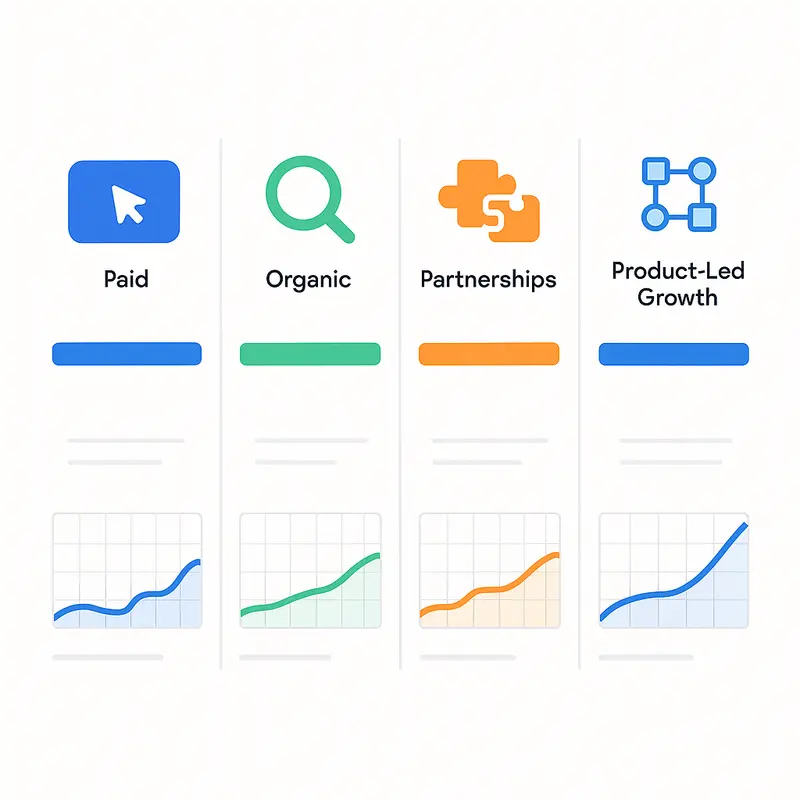
Choosing the right mix of channels is a pivotal part of your product launch marketing strategy. Channels differ not only in cost and reach, but in timing and suitability for different stages of your startup launch plan. Organic channels (SEO, content, community) compound over time and are ideal for sustainable growth, whereas paid channels (search ads, social ads, programmatic) can accelerate initial traction but require tight optimization to avoid burn. Partnerships and channel sales can unlock distribution quickly for B2B products, leveraging existing trust and networks.
Design your channel strategy against three horizons: immediate activation (0-90 days), early scaling (3-9 months), and sustainable growth (9+ months). Immediate activation often relies on targeted paid ads, PR outreach, and focused community engagement (e.g., Slack groups, relevant subreddits). Early scaling shifts budget to high-performing channels identified during the initial phase and tightens conversion optimization. Long-term growth invests in organic channels such as SEO and content to build defensibility. Use a hybrid approach: a small paid budget to generate initial data and a parallel organic program to build long-term acquisition.
Real-world distribution example: a B2B marketplace used a combination of targeted LinkedIn outreach and content-driven SEO to seed early demand. They ran ads to a gated guide that fed into an email nurture sequence, followed by a webinar series to convert high-intent buyers. Over six months they reduced CPA by 42% and moved 60% of signups to the inbound channel, improving LTV/CAC. If you need help executing omnichannel campaigns, consider services like demand generation and paid marketing to execute targeted experiments and scale winners.
| Channel | Typical Cost | Time-to-Impact | Best For | Estimated ROI |
|---|---|---|---|---|
| SEO & Content | Low-medium (content production) | 3-9 months | Evergreen demand, thought leadership | High over 12+ months |
| Paid Search/Ads | Medium-high (CPC/CPM) | Immediate | High-intent acquisition | Moderate, scalable if optimized |
| Partnerships & Channel Sales | Variable (revenue share) | 1-6 months | B2B distribution, enterprise reach | High with product-market fit |
| App Store Optimization | Low-medium | 2-6 months | Mobile-first consumer apps | Good for organic installs |
| PR & Earned Media | Low-medium | Immediate to 3 months | Brand awareness, credibility | High for launches & funding rounds |
H3: Paid vs Organic — How to Allocate Budget
Start with a 60/40 rule for early-stage launches: 60% focused on fast feedback channels (paid ads and paid social to validate messaging), 40% on organic (content, SEO, community) to build long-term traction. Adjust monthly based on signal: if paid ads deliver ACVs (average contract value) that justify spend, scale; otherwise, reallocate to organic and partnerships. Monitor early CAC and LTV closely: early overspend on paid can cripple your runway if the LTV doesn't support scaling.
H3: Partnerships and Integrations
Partnership channels amplify reach when aligned with complementary products and services. Integrations can also drive organic discovery through partner marketplaces and co-marketing. Prioritize partners with overlapping audiences and clear incentive structures. For example, a CRM integration for a sales enablement tool opens a natural cross-sell path into an existing, qualified user base and can drastically lower acquisition friction.
4. Pricing, Monetization, and Early Revenue Models
Pricing is both an art and a science. Your monetization model — subscription, freemium, usage-based, transaction fee — must align with customer expectations and the perceived value of the product. In 2026, usage-based and hybrid pricing models are increasingly popular because they align incentives and lower adoption friction, especially for data- or computation-intensive offerings. When choosing a pricing strategy, consider unit economics, competitor pricing, and customer willingness to pay discovered during validation tests.
Run pricing experiments early. Offer limited-time discounts to drive initial trials but avoid deeply discounted early pricing that resets customer expectations for lifetime pricing. Instead, consider offering time-limited credits, pilot pricing tied to outcome milestones, or tiered plans that encourage expansion. Use anchoring in your pricing pages by showing a higher-priced tier with additional features — this often increases conversion on the mid-tier. For marketplaces, design pricing to balance supply incentives with buyer affordability and ensure the platform captures enough revenue to reinvest in growth.
Example of pricing pivot: A startup moved from a flat monthly subscription to a tiered usage-based model after observing large variance in customer consumption. This change reduced churn by 18% among light users and increased ARPU by 27% among heavy users. Pricing transparency, flexible billing, and clear documentation reduce buyer friction; if you need assistance implementing flexible billing or subscription logic, our custom platforms team can help integrate modern monetization engines into your product.
H3: Pricing Tests and Acceptance Criteria
Design simple A/B pricing tests: evaluate headline price sensitivity, packaging options, and discounting triggers. Track conversion at each price point and measure churn across cohorts. Acceptance criteria are essential — decide in advance what success looks like (e.g., 3% conversion at $X/month or a 10% increase in demo requests without excessive churn). Use customer interviews to understand perceived value gaps and price elasticity.
H3: Handling Negotiations and Enterprise Deals
Enterprise deals require flexibility and a value-selling approach. Create a playbook for negotiators: define minimum acceptable terms, standard concessions, and an escalation path for non-standard requests. Use pilot results and ROI projections during negotiations to demonstrate TCO and time-to-value, and lock in referenceable outcomes to support broader sales efforts.
5. Sales Motion and Distribution: Aligning GTM for Scalability
Your sales motion — inbound, outbound, self-serve, or channel-led — should map directly to your target customer and product complexity. Low-touch products benefit from product-led growth (PLG) with frictionless signups and automated onboarding, while complex B2B solutions require a blend of inbound demand and targeted enterprise outreach. Develop clear playbooks for each motion, including lead qualification criteria, SDR scripts, demo flows, and a post-sale onboarding process to ensure retention.
A critical early decision is whether to hire sales reps or build an automated funnel. If your average contract value (ACV) is low, focus on optimizing the self-serve funnel and investing in product-led features that increase activation. For higher ACV deals, invest in experienced sellers, a CRM with disciplined pipeline tracking, and targeted account-based marketing (ABM) campaigns. Sales compensation should incentivize the right behaviors — sustainable growth over pipeline stuffing. Align sales and marketing SLAs for lead follow-up time and quality standards to ensure demos convert into revenue efficiently.
Case study: A SaaS company used an ABM approach combined with a small SDR team to target 200 high-value accounts. They personalized outreach based on intent data and supported conversations with tailored content and workshops. Within nine months they closed 12 accounts, each with multi-year contracts, and built a repeatable ABM sales playbook that scaled into a broader enterprise motion. If scaling your go-to-market requires recruiting sales talent quickly, consider hire sales team services to accelerate ramp-up while maintaining quality hiring standards.
H3: Onboarding and First-90-Day Success
Onboarding is the unsung hero of retention. Define a clear first-90-day success plan for customers with milestones, outcomes, and designated success owners. Use automated in-app guidance, a kickoff call, and a success checklist to guide users through activation. Measuring leading indicators like time-to-first-value and the percentage of customers reaching key milestones in the first 30 days helps predict churn and informs proactive interventions.
H3: Sales Enablement and Content Alignment
Create battle-tested sales enablement assets: competitor comparison sheets, ROI calculators, case studies, and objection-handling guides. Align content calendar with sales campaigns so marketers produce assets that directly support active deals. A closed-loop feedback system between sales and marketing improves messaging and reduces friction in the buyer journey.
6. Analytics, KPIs, and Iteration Cadence

Metrics should be your north star from day one. Establish a core set of KPIs that map to your business model: MRR/ARR, CAC, LTV, churn, activation rate, NPS, and cohort retention. Track funnel-level metrics and unit economics daily to catch regressions early. Use dashboards that combine product analytics (instrumented through tools like Mixpanel or Amplitude), marketing analytics (UTM tracking, conversion attribution), and revenue data (CRM, billing). Accurate attribution is harder than it looks — build a pragmatic model that prioritizes decision-making speed over perfect accuracy.
Set an iteration cadence: weekly tactical standups for ongoing campaign optimization, monthly strategic reviews for cross-functional alignment, and quarterly OKR planning tied to growth milestones. Use hypotheses and experiments to iterate: each change should have a hypothesis, experiment design, and success criteria. When you see positive lift, document the learning and scale it; when a test fails, capture the insight and de-risk future iterations.
Example KPI monitoring: a startup that introduced a new onboarding flow tracked activation improvements and conversion to paid across cohorts. They saw a 12% lift in activation within two weeks and a subsequent 9% increase in trial-to-paid conversion. That data justified further investment in onboarding and warranted reallocation of marketing spend to channels producing higher-quality leads. For advanced analytics work, teams often partner with a analytics and reporting service to build dashboards that support rapid decision-making.
“42% of startups fail because there’s no market need for their product,” according to research that highlights the importance of early validation and market fit in any launch strategy. (CB Insights)
H3: Attribution and Multi-Touch Models
Move beyond last-click thinking. Implement multi-touch attribution to understand which channels contribute to each stage of the funnel. While perfect attribution is elusive, multi-touch models provide better signal for resource allocation. Use UTM parameters consistently, instrument conversion events across your stack, and reconcile paid channel data with backend conversion records to reduce discrepancies.
H3: Experimentation Playbook
Create an experimentation playbook that standardizes hypothesis wording, traffic splits, duration, and statistical significance criteria. Prioritize experiments by expected impact and confidence. Keep experiments small and focused to isolate variables, and run them long enough to account for natural weekly cycles in user behavior.
7. Launch Day and Post-Launch Growth Operations
Launch day is only one milestone in a multi-phase plan. Treat it like a sprint kickoff: execute coordinated PR, community outreach, paid bursts, and product updates, then switch immediately to measurement and iteration. Prepare a launch playbook that specifies personnel responsible for social monitoring, server-scale contingencies, customer support staffing, and data collection. Post-launch, the focus shifts from initial buzz to conversion optimization, retention, and scaling acquisition channels that demonstrate positive unit economics.
Execute a 30/60/90-day post-launch plan: 30 days to stabilize (monitor performance, fix critical bugs), 60 days to optimize (A/B tests, refine messaging, double down on best channels), and 90 days to scale (hire, expand partnerships, increase paid budgets). Use user feedback loops: surveys, NPS, and product analytics to prioritize backlog items that materially improve activation and retention. Keep a rolling 90-day roadmap to remain agile and responsive to market signals.
Operational readiness is critical. Ensure your billing system can handle upgrades, your support team has triaged FAQs, and sales has a clear path for escalating enterprise interest. Post-launch momentum often comes from quick wins like highlighting early customer successes, publishing data-backed case studies, and deploying customer referral programs. If you want to build referral or conversion optimization programs, consider our conversion rate optimization services to maximize convertibility across your funnels.
H3: Real-World Launch Example
A health-tech startup used a staged launch: beta cohort, targeted local launch with clinician endorsements, followed by a national PR push. They used pilot metrics to craft case studies, which fed into a broader paid and organic campaign. Within 120 days, they moved from pilot revenue to multiple enterprise contracts, leveraging early clinical validation to close larger deals. The staged approach reduced operational risk and built credibility incrementally.
H3: Scaling Internationally
International launches require localization beyond language — adapt pricing, partnerships, and compliance for each market. Start with a single region and validate there before scaling. Use local partners to navigate regulatory nuances and cultural differences and consider phased rollouts to manage support load and localization costs.
Conclusion: Your 90-Day Launch Checklist and Next Steps
Launching a product in 2026 means balancing speed with rigor. Your 90-day post-launch checklist should include market validation completion, a finalized positioning statement, an initial channel mix with budget allocation, a tested pricing model, sales and onboarding playbooks, and a dashboard for critical KPIs. Plan for iteration: the first launch rarely results in instant market domination — instead, view launch as the beginning of continuous discovery.
Practical next steps: (1) finalize your validation experiments and acceptance criteria, (2) create a messaging matrix and test it across paid and organic channels, (3) run a pricing pilot with a small cohort, and (4) instrument analytics to make data-driven decisions. If you need help implementing any part of this plan — from building analytics dashboards and executing demand programs to integrating AI for personalized campaigns — teams like AI and machine learning solutions and web applications engineering can extend your capabilities quickly.
Launching well is a cross-functional effort. Bring product, marketing, sales, and customer success together under a shared set of metrics and a sprint cadence. The playbook in this guide gives you a decision-making framework and tactical blueprint to go from concept to traction. If you’re ready to accelerate your go-to-market, reach out via our contact page to discuss tailored services, from growth marketing to technical implementation and team augmentation. Execute deliberately, measure ruthlessly, and iterate swiftly — and your next launch can set the foundation for sustained scale.
Further Reading and Sources
- Startup statistics and trends — Statista
- Gartner insights on go-to-market strategies — Gartner
- Product launch best practices — Forbes
- HubSpot product launch guide — HubSpot
- Why startups fail — CB Insights
Frequently Asked Questions
Go-To-Market Strategy for 2026.
What is a go to market strategy startup founders should follow in 2026?
A go to market strategy startup founders should follow in 2026 begins with rigorous market validation, outcome-driven positioning, and a hybrid channel mix that balances paid acceleration with organic compounding. It includes a pricing test, a defined sales motion (self-serve vs. enterprise), instrumentation for key metrics, and a rapid iteration cadence tied to measurable success criteria.
How do I prioritize channels for my product launch?
Prioritize channels based on your customer profile, budget, and expected time-to-impact: use paid channels for immediate validation, organic channels like SEO for long-term growth, and partnerships/channel sales for rapid distribution to niche enterprise segments. Start small, run controlled experiments, and scale channels with the best unit economics and conversion signals.
When should a startup invest in paid marketing versus organic strategies?
Invest in paid marketing to accelerate early validation and gather data quickly, especially when time-to-feedback is critical. Simultaneously invest in organic strategies for sustainable acquisition that compounds over months. A common early allocation is roughly 60% towards rapid-feedback channels (including some paid) and 40% towards building organic foundations.
What metrics should I track immediately after launch?
Immediately track activation (time-to-first-value), conversion rates across your funnel (signup to activation, trial-to-paid), CAC, LTV, churn (first 30/90 days), and NPS or qualitative satisfaction indicators. Use cohort analysis to see how improvements affect retention and to identify weak funnel stages for targeted experiments.
How do I test pricing without harming long-term value perception?
Test pricing with small, defined cohorts or pilot customers using limited-time offers or credits rather than deep lifetime discounts. Use anchoring with tiered plans, and collect qualitative feedback to understand willingness to pay. Make pricing changes transparent and time-bound to avoid setting unsustainable expectations for future customers.
Ready to Grow Your Business?
Get a free consultation from our digital marketing and development experts. Let's discuss how we can help you achieve your goals.
- No commitment required
- Detailed technical roadmap
- Customized to your infrastructure
By submitting this form, you agree to our privacy policy. · 4,000+ businesses served · 24hr response · 98% satisfaction