Enterprise AI & Automation Agency | Eplanet Soft
How Businesses Can Appear in ChatGPT and AI Search Results
Learn ChatGPT search optimization and AI search ranking strategies to get your business surfaced in AI answer engines. Practical tactics, technical checklists, and measurement tips.

AI-powered answer engines like ChatGPT and emerging AI search platforms are reshaping how people look for information, shop, and make decisions online. For businesses, this creates a major opportunity and a new set of challenges: your website and data must now be optimized not just for traditional search engine results pages (SERPs) but for AI-driven answers that synthesize information and return concise, authoritative responses. This article focuses on ChatGPT search optimization, AI search ranking, and AI answer engine optimization—practical, tactical, and technical approaches you can implement immediately to increase the likelihood that your brand, products, and expertise appear in AI-provided answers.
Why does this matter now? Users increasingly start queries in conversational interfaces or rely on AI agents that integrate multiple data sources before surfacing a single, synthesized answer. According to usage trends, conversational AI adoption has accelerated across consumer and enterprise segments, and early movers who adapt content, structured data, and delivery mechanisms can capture high-value referral traffic and brand impressions that used to come from classic organic search alone. In short, businesses that optimize for AI search ranking will have an advantage in visibility and conversion as these systems mature.
This long-form guide covers the full stack of AI answer engine optimization: understanding how AI search works; the ranking signals that matter today; content strategies that increase the probability of being cited by ChatGPT-like models; technical SEO, structured data, and APIs that enable direct ingestion by models; product and transactional data best practices for e-commerce; and measurement frameworks to test and scale your presence. Throughout the guide you will find real-world examples, comparison tables, actionable checklists, and references to enterprise-grade services and partners that can help you execute—such as professional SEO services for content tuning and AI and machine learning solutions for integration.
Whether you are a marketing leader, an SEO specialist, or a product manager looking to capture attention in AI-driven experiences, this article will provide a step-by-step framework and concrete tactics you can add to your roadmap. By the end, you'll know which signals to prioritize, which technical upgrades are essential, and how to measure ROI from AI answer engine optimizations.
1. Understanding AI Answer Engines and ChatGPT Search
To appear in ChatGPT and other AI search results, you first need to understand what these systems are—and what they are not. ChatGPT and similar generative models are large language models (LLMs) trained on diverse corpora of text. Newer “AI search” configurations pair these models with retrieval systems that draw from real-time web data, curated knowledge bases, and proprietary APIs. The output is a synthesized answer, often citing or paraphrasing multiple sources. Unlike classic search engines that rank pages by query intent, links, and on-page signals, AI answer engines prioritize relevance, factuality, recency, and the ability to produce coherent, concise responses.
Practically speaking, that means a business’s chance of being included in AI answers depends on several things: whether the AI can discover your content (crawl/index), whether your content is formatted for consumption (structured and factual), and whether your brand or source signals indicate authority or trustworthiness. For example, an up-to-date help center article with clear, structured steps and schema markup is far more likely to be surfaced as an answer to a product usage question than a long, unstructured blog post that lacks consistent facts or structured metadata.
There are different ways AI systems source information. Some rely primarily on the web crawl—similar to search engines—while others integrate curated knowledge graphs, direct API feeds, and data partnerships. OpenAI, for instance, has integrated browsing and plugins in some configurations to allow models to retrieve real-time information; enterprise deployments may ingest private corpora and product catalogs behind authentication. Understanding the retrieval mechanisms used by the AI platforms you want to appear in helps shape your optimization priorities.
How retrieval-augmented generation (RAG) influences discoverability
Retrieval-augmented generation (RAG) is a hybrid approach where a model first retrieves relevant documents or passages and then generates an answer based on those sources. RAG systems typically score candidate passages by semantic similarity, freshness, and relevance to the user’s query. For businesses, this means that small, high-signal content fragments—like FAQ items, short product descriptions, and structured knowledge snippets—often outperform long-form pages when it comes to being selected as RAG sources. Optimizing for RAG requires structuring content into bite-sized, self-contained knowledge units, and ensuring they are discoverable through reliable endpoints.
Case example: How a SaaS documentation page was selected in an AI answer
A mid-sized SaaS company improved its AI visibility by restructuring its help articles into concise Q&A pairs with step-by-step solutions and explicit schema. After implementing FAQ schema and updating titles to match user intent, they observed that their documentation was being referenced in chatbot responses from a third-party concierge service that used a RAG pipeline. Traffic from that source translated into higher trial signups, demonstrating how structural and content-level changes can pay off directly.
2. Signals That Influence AI Search Ranking
AI search ranking is multifaceted: it blends traditional SEO signals (authority, relevance, technical health) with new signals that matter specifically to generative models. Below are the most important categories and how you can influence them. First, content-level signals: clarity, factual density, and explicit question-answer pairs carry high weight in retrieval. AI systems prefer sources that answer the user’s question directly and concisely. From an optimization perspective, this favors FAQ pages, structured help documentation, and short explanatory snippets positioned near the top of pages.
Second, structural and metadata signals: schema.org markup, canonical tags, OpenGraph metadata, and sitemaps remain crucial because they help retrieval systems identify the type and purpose of content. Third, reputation and trust signals: backlinks, brand mentions across authoritative domains, verified knowledge panels, and consistent contact information strengthen a source’s credibility. Finally, real-time signals like freshness (last updated), product availability, pricing, and review aggregates are essential for transactional queries. AI engines increasingly prefer sources that provide up-to-date, verifiable information.
As a practical guideline, optimize each page for at least one primary question, include a 30–120 word concise answer at the top, add structured data where relevant, and ensure the content is updated frequently for time-sensitive topics. This approach increases the odds that a model’s retrieval step will select your content as a source for synthesis.
Authority: cultural and link-based signals
Authority in AI search mirrors some aspects of traditional SEO. Link authority, editorial coverage, and domain reputation still matter—especially when AIs weigh multiple candidate sources. However, AI systems may incorporate alternative trust signals such as verified organizational data (from knowledge graphs) and first-party signals (API credentials, partner integrations). For organizations, investing in authoritative publications, structured press releases, and consistent business listings pays off because these sources are more likely to be trusted and cited by models.
Structured data and provenance: enabling citations
Provenance—clear evidence of the original source of a fact—is growing in importance. AI models that provide citations benefit from content with clear metadata that identifies authorship, date, and canonical sources. Markup like JSON-LD, combined with reliable hosting and server-side headers, helps ensure your content is correctly attributed. When an AI can cite your site with a link, users are more likely to trust the answer and then click through to your page, creating a virtuous cycle of visibility and traffic.
| Signal Category | Traditional SEO Weight | AI Search Weight | Actionable Tactics |
|---|---|---|---|
| Content relevance | High | Very High | Structure answers, use concise lead answers, map to intent |
| Backlinks / authority | Very High | High | Earn editorial mentions, use data-driven PR |
| Schema / structured data | Medium | Very High | Implement FAQ, Product, Article JSON-LD |
| Freshness & accuracy | Medium | Very High | Automate updates for time-sensitive pages |
| APIs / direct feeds | Low | High (for dynamic data) | Expose product catalogs via APIs and feeds |
“As AI systems increasingly synthesize answers from multiple sources, sites that provide structured, citable content are more likely to be surfaced and linked back to—creating new opportunities for referral traffic and brand recognition.”
3. Content Strategies for ChatGPT Search Optimization
Content remains the foundation of AI answer engine optimization. However, the format and intent mapping differ from classic SEO. Prioritize short, atomic knowledge units: clear question headings, concise top-of-page answers (30–120 words), step-by-step instructions, anchorable sections, and data-backed assertions with citations. This structure aligns with retrieval systems that select concise passages for synthesis. For example, a product troubleshooting article with numbered steps explicitly answering a common customer query will often be preferred over a marketing narrative that buries the answer.
Semantic clustering is another crucial technique: group related questions, definitions, and examples around pillar topics and interlink them with contextual anchors. These clusters help AI retrieval systems understand topical breadth and depth, and they increase the number of distinct snippets your domain can supply for varying queries. Use internal linking strategically to guide a retrieval system from a brief answer to a longer resource when a user needs depth, and ensure each cluster includes at least one authoritative, data-driven piece such as an industry report or case study.
Finally, pay attention to answer quality and provenance. Provide citations in your content (both inline and via structured data), include dates and authorship, and where possible, publish primary data (e.g., benchmarks, sample datasets, or case study results). AI systems that favor factual accuracy are more likely to cite sources they can corroborate; offering your own verifiable data makes your content a stronger candidate for inclusion in AI responses.
FAQ-first content templates
FAQ-first templates are particularly effective for ChatGPT search optimization. Each FAQ item should be a single, clear question, followed immediately by a concise answer and then an expanded explanation. This pattern makes it simple for retrieval systems to extract a high-signal snippet and also allows your site to host multiple answerable knowledge units. Consider implementing an FAQ landing page per product or per major service line—these pages are often crawled and prioritized by answer engines.
Use of tables, lists, and examples
AI retrieval benefits from content that is easy to parse. Tables, numbered lists, and short bullet points reduce ambiguity and provide machine-friendly units of information. For instance, a comparison table that clearly lists feature differences between two product plans can be directly used by a model to answer “Which plan includes X?” queries. Including example inputs/outputs (code snippets, sample prompts, or product SKU mappings) also increases the likelihood of being used as a sourcing document for AI responses.
4. Technical SEO and Data Structures for AI Discovery
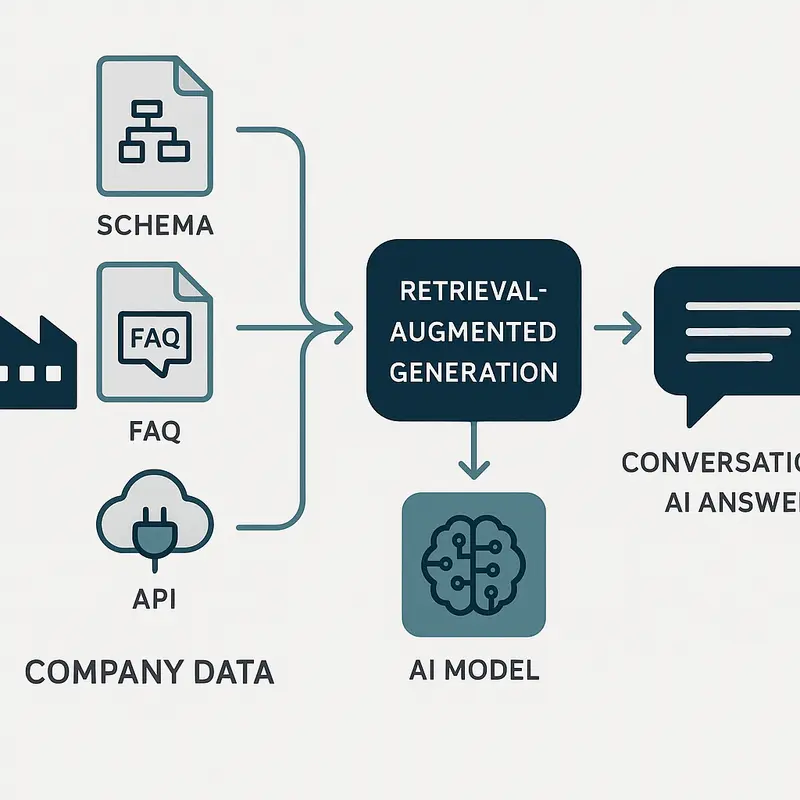
Technical readiness is non-negotiable if your goal is to be included in AI search results. While content quality gets you discovered conceptually, your technical implementation determines whether AI retrieval systems can reliably ingest and parse your content. This includes canonicalization, crawlability, server performance, API endpoints, and structured metadata like JSON-LD schema. If a page is blocked via robots.txt, behind authentication, or slow to respond, it is far less likely to be used as a source by an answer engine.
Schema markup enables machines to understand what your content represents—products, events, FAQs, articles, organizations, and so forth. Many AI systems parse JSON-LD to extract precise facts, such as product prices, availability, or event dates. Implementing robust schema not only helps with traditional SERP features but also increases the likelihood of being selected as a high-confidence source in generative answers. For product and offer data, mark up each product with Product schema and include structured price and availability fields.
APIs and sitemaps are another critical piece. For dynamic or rapidly changing content—such as inventory, pricing, or shipping windows—exposing reliable APIs or push feeds ensures that retrieval systems receive accurate, current data. Where possible, provide partner-grade endpoints or participate in marketplace data exchanges so AI platforms can retrieve your authoritative facts directly, bypassing stale crawling cycles.
Schema markup checklist
At minimum, implement: Article schema for long-form content; FAQPage schema for Q&A content; Product schema for commerce pages; Organization schema with accurate contact info; and Breadcrumb schema to assist in hierarchical understanding. Use explicit fields for author, datePublished, dateModified, offers, aggregateRating, and mainEntity for FAQ items. These fields help AI systems attribute and validate content, improving your chance of being cited.
APIs, feeds, and direct ingestion
If you run an e-commerce site or deliver time-sensitive data, build reliable APIs and structured feeds (e.g., product feeds in JSON or XML). Partnering with platforms that consume API feeds or registering your feed with data aggregators increases the probability of your content being pulled into AI knowledge stores. For instance, a retailer that exposes a product API with standardized fields for price, availability, and SKU is more likely to have its product data included in third-party AI-powered shopping assistants.
5. Leveraging Product, Brand, and Transactional Data
For businesses that sell products or services, transactional signals and product-level metadata are essential for being surfaced in AI-driven shopping and recommendation flows. AI systems evaluating purchase intent rely on product attributes (price, availability, shipping), user intent signals, and historical performance (conversion rates, return rates, reviews) to determine relevance. Ensuring your product data is precise, well-structured, and accessible via APIs or feeds directly impacts AI search ranking for transactional queries.
Start by standardizing your product taxonomy and enrich product pages with structured snippets: clear titles, short descriptions that match common user intent phrases, precise SKUs, GTINs, and high-quality product images served with fast CDNs. Include customer review aggregates and shipping information in structured data. When AI systems can access both descriptive and performance data, they can confidently recommend your products or cite them in answers that compare options.
Another practical strategy is to offer developer-friendly integration options. Some AI platforms enable plugin architectures where verified partners can serve as primary data providers for queries. If your business can provide a reliable plugin, API, or authenticated data connector, you create a direct channel for the AI to fetch authoritative answers about your products and services—often before crawling or third-party indexing occurs.
E-commerce example: feeding accurate inventory data
An online retailer integrated its inventory system with a marketplace feed and an authenticated partner API to share real-time availability for high-demand items. When a price-sensitive AI shopping assistant queried for available products, the assistant used that API to return up-to-date results that pointed to the retailer’s product pages. The retailer saw measurable lift in conversion because the AI’s citations led users to accurate product pages with immediate buying options.
Brand knowledge and verification
Establishing and verifying brand knowledge across authority platforms (Google Business Profile, knowledge panels, and industry directories) increases trust signals for AI systems. Register your organization in public data repositories, keep NAP (name, address, phone) consistent, and publish authoritative descriptions that include your brand’s unique identifiers and verified contacts. Verified profiles make it easier for AI models to attribute content to your business and avoid confusion with similarly named entities.
6. Measurement, Testing, and Scaling AI Search Presence
Measuring the impact of AI search optimization requires a blended analytics approach: track direct referrals from AI platforms where possible, monitor changes in organic traffic that correlate with AI feature launches, and instrument your content to capture downstream conversions attributable to AI-driven referrals. Because many AI answer engines currently act as intermediaries, they may or may not pass traditional referral headers. Therefore, you should also instrument pages with UTM parameters in known integrations, monitor branded query lifts, and use server logs to detect non-standard referrers.
Testing is equally important. Set up controlled experiments where you create atomic knowledge units (a FAQ, a short how-to, a product snippet), publish them in parallel with conventional pages, and measure which formats are selected as sources by AI integrations. A/B testing content formats, schema presence, and update frequency can reveal which signals cause models to prefer one source over another. Over time, scale the successful templates across major topics and product lines.
Finally, build operational playbooks to keep content fresh and authoritative. Assign owners for high-value knowledge clusters, schedule periodic audits, and automate updates where possible (e.g., via syncing product availability from your inventory system). Use analytics dashboards to monitor failure cases—queries where AI produced incorrect answers originating from your content—and correct them promptly to protect brand reputation.
Analytics integration and attribution
Because AI referrals can be opaque, combine multiple telemetry sources: traditional web analytics, server logs, partner dashboards, and direct platform reports. Where AI platforms provide citation links, track clicks and conversions from those links with UTM parameters. Maintain a dashboard that correlates content changes (e.g., adding schema, publishing an FAQ) with changes in AI-cited impressions and downstream conversions, enabling continuous optimization.
A/B testing answers and text quality
Experiment with varying answer lengths and degrees of detail. For instance, test whether a 50-word succinct answer plus a detailed follow-up section performs better than a single 300-word answer. Monitor which version gets cited and results in higher click-throughs. Use user feedback loops, like inline “Was this answer helpful?” signals, to guide iterative improvements. Over time, you will identify the answer style and depth that maximizes both AI selection and conversion.
Key Takeaways
Practical summary:
- Optimize for concise, atomic answers—lead with a 30–120 word response and expand below.
- Use structured data (JSON-LD schema) and APIs for high-confidence ingestion by AI systems.
- Prioritize authoritative signals—verified brand data, quality backlinks, and primary datasets.
- Instrument analytics, test content formats, and set ownership to keep knowledge fresh.
- Leverage existing services and partners for implementation, such as custom web applications for APIs and UI/UX design for conversational experiences.
7. Putting It All Together: A Tactical 90-Day Plan

To operationalize ChatGPT search optimization and AI answer engine optimization, follow a structured 90-day plan that blends strategy, content, and tech workstreams. In the first 30 days, conduct discovery: identify high-intent queries you want to capture, audit existing content for atomic answers, and inventory where authoritative data lives (APIs, product feeds, help centers). Prioritize low-hanging fruit—high-traffic queries where content exists but lacks structure or schema.
Days 31–60 focus on execution: convert prioritized pages into FAQ-first formats, add JSON-LD schema to top pages, and expose APIs or clean product feeds for dynamic data. If you need external expertise, engage professional teams for implementation—for example, working with professional SEO services to tune content and with AI and machine learning solutions partners to set up RAG-ready ingestion pipelines. Simultaneously, set up analytics tracking and UTM standards to capture referral attribution from AI integrations.
Days 61–90 are about testing, iteration, and scale: run A/B tests on answer lengths and schema presence, measure citations or referral lifts, and begin templating successful formats across additional topics. Consider augmenting in-house teams via staff augmentation to scale content production and technical integration—engaging a hire a dedicated team model can accelerate execution without long-term headcount risk. Maintain an ongoing roadmap for seasonal updates and to onboard new AI platforms as they open ingestion channels.
Resource allocation and team roles
Successful AI search optimization requires cross-functional collaboration. Assign a product owner, content strategist, technical SEO lead, and an engineer to manage APIs or feeds. Consider dedicated roles for measurement and for partnerships with AI providers. If internal bandwidth is tight, you can supplement with external specialists such as agencies for content production or conversion rate optimization consultants to ensure AI-driven clicks convert when users reach your site.
Scaling with automation
Automate repetitive processes: content templates, schema generation, and feed synchronization. Use content management system plugins or headless architecture that can produce JSON-LD and expose structured endpoints programmatically. Automation reduces manual errors and ensures consistency—critical for being consistently recognized and cited by AI systems.
Conclusion
AI answer engines and ChatGPT-style search are not a simple extension of traditional search—they represent a paradigm shift in how information is retrieved and presented to users. To appear in these results, businesses must rethink content formats, structure data for machine consumption, and expose authoritative, real-time data via APIs or feeds. The strategies in this article—focusing on atomic answers, structured metadata, reliable APIs, and measurement—provide a practical roadmap for organizations that want to lead in the AI-first era.
Start by auditing your highest-value knowledge clusters and converting them into FAQ-first, schema-enabled assets. Pair content changes with technical improvements—APIs, sitemaps, and server readiness—and set up measurement frameworks to capture AI-driven referrals and conversion lifts. If you need help implementing these steps, our teams can assist with integrated solutions ranging from custom web applications and conversational UI/UX to professional SEO services and AI and machine learning solutions. Reach out via our contact page to discuss a tailored plan and get a prioritized 90-day roadmap for appearing in ChatGPT and AI search results.
Next steps: prioritize three high-impact pages to convert to FAQ-first formats this week, implement schema for those pages, and schedule a measurement review 30 days after deployment to validate impact. With a disciplined approach, you can position your brand to be cited by AI answers and capture the traffic and conversions that follow.
References and further reading
For broader context on AI adoption and search trends, consult industry sources such as Statista’s AI topic overview, Gartner’s insights on enterprise AI Gartner AI insights, and commentary on the impact of generative AI on search in business press like Forbes. These resources provide complementary data and strategic perspectives to inform your roadmap.
Frequently Asked Questions
How Businesses Can Appear in ChatGPT and AI Search Results.
What is ChatGPT search optimization and why should my business invest in it?
ChatGPT search optimization involves structuring your content, metadata, and data feeds so AI answer engines can discover and cite your information. Investing in it helps your business appear in AI-generated responses, improving visibility, trust, and the likelihood of high-intent traffic and conversions as more users begin queries in conversational interfaces.
Which content formats are most likely to be used by AI answer engines?
AI systems favor concise, atomic content such as FAQ items, short how-to steps, product snippets, and tables. Pages with clear question-answer pairs, structured headers, and JSON-LD schema are more likely to be retrieved and cited by generative models.
Do I need special technical infrastructure to be included in AI search results?
At a minimum you need crawlable pages and schema markup. For dynamic or transactional data, exposing APIs or structured feeds greatly increases the likelihood of inclusion. Ensuring fast performance, correct canonical tags, and accessible sitemaps are also important technical prerequisites.
How can I measure whether AI optimization is delivering value?
Combine analytics sources: track clicks from AI citations using UTM parameters when possible, analyze server logs for non-standard referrers, monitor branded query growth, and look for conversion uplifts on pages targeted for optimization. Use A/B testing to isolate the impact of content and schema changes.
Can small businesses get featured in ChatGPT answers or is it only for major brands?
Small businesses can be featured, particularly when they own a niche topic or provide clear, authoritative answers. Focused, high-quality FAQs, accurate product data, and local or domain-specific expertise can make small businesses competitive for AI citations.
How do I start improving AI search ranking for my product pages?
Begin by standardizing product metadata (titles, descriptions, SKUs), implementing Product schema with price and availability fields, and exposing a reliable product feed or API. Create concise feature/benefit snippets and troubleshooting FAQs that answer common buyer questions directly.
Ready to Grow Your Business?
Get a free consultation from our digital marketing and development experts. Let's discuss how we can help you achieve your goals.
- No commitment required
- Detailed technical roadmap
- Customized to your infrastructure
By submitting this form, you agree to our privacy policy. · 4,000+ businesses served · 24hr response · 98% satisfaction