Enterprise AI & Automation Agency | Eplanet Soft
AEO GEO optimisation for large websites 2026: Exact Strategy
AEO GEO optimisation for large websites 2026 — a step-by-step technical strategy to appear in ChatGPT, Google AI Overviews and Perplexity for hundreds of local pages.
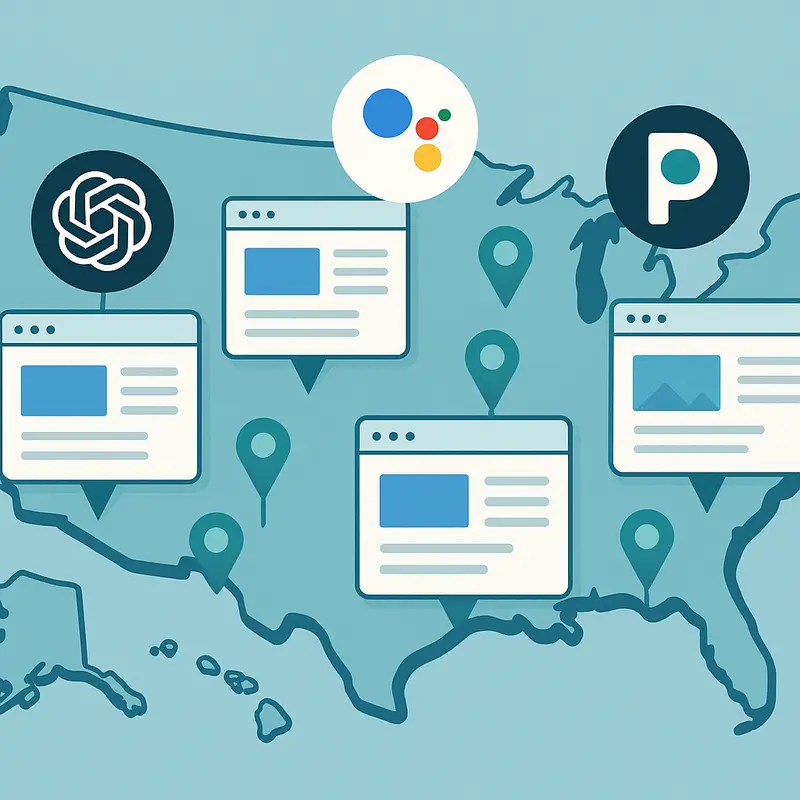
Key takeaways
- AEO GEO optimisation for large websites 2026 is distinct from classic SEO: make content explicitly answerable and machine-readable.
- Structured data and consistent NAP are not optional — they directly impact AI citation probability.
- Indexing cadence matters: staggered sitemaps and prioritized discovery accelerate inclusion in generative overviews.
- Operational templates plus editorial overrides scale reliably across hundreds of locations.
- Monitor AI citations directly and be prepared to iterate the answer paragraph to align with an engine’s extraction behaviour.
By Sanyam Singhal, Founder
Hook — If your enterprise publishes hundreds of local pages and you still depend solely on blue-link SEO, you’re missing the new battleground: AEO GEO optimisation for large websites 2026. At EPlanet Soft we re-engineered local pages and indexing for a US-based, billion-dollar client so they started appearing in ChatGPT answers, Google AI Overviews and Perplexity within one month of full indexing. This article gives the exact technical steps, signals and execution sequence that made it happen.
AEO GEO optimisation for large websites 2026: what it is and why it matters
The term AEO GEO optimisation for large websites 2026 combines answer engine optimisation (AEO) with geographic (GEO) scale: it’s the practice of architecting hundreds or thousands of local pages so AI-driven answer engines can extract, cite and surface the content as concise conversational answers. Unlike classic SEO where ranking blue links is primary, AEO/GEO optimisation prioritises structured markup, entity clarity, conversational snippets, and rapid discovery by generative engines.
Why this matters for marketing managers: more queries are now resolved directly inside AI overviews and answer boxes. According to Google’s 2025 developer notes on generative overviews, structured, entity-rich content is the top technical prerequisite for inclusion in AI summaries (Google, 2025). OpenAI’s 2025 documentation on retrieval and citations confirms the same pattern: accurate, authoritative, and well-marked content improves the chance of being cited by ChatGPT (OpenAI, 2025). Perplexity’s technical notes in 2026 add that location signals and consistent NAP are critical for local answers (Perplexity, 2026).
generative engine optimisation — structuring pages for ChatGPT, Perplexity and Google AI
Generative engines consume web content differently than search crawlers. To perform generative engine optimisation at scale, you must design each local page with three priorities:
- Entity clarity and authoritative signals — Use consistent business names, addresses, phone numbers (NAP), and schema.org-based Organization/LocalBusiness entities. Include unique local identifiers (store IDs) and canonical location UTM parameters for internal tracking. For schema, follow the latest schema documentation and validate using automated checks (see schema.org guidelines for structured data practices).
- Conversational answer-ready content — Create a short, plain-language answer block (40–120 words) at the top of each page summarising the service, coverage area, and a single-sentence differentiator. AI systems frequently extract the lead paragraph when it's written as a clear, direct answer to a user query.
- Structured evidence and citation-ready markup — Embed FAQ schema (question/answer format), Service schema, LocalBusiness markup, and JSON-LD blocks that include hours, service areas, and service attributes (e.g., "free estimates", "licensed"). The markup should be machine-readable and map directly to the short answer block to make extraction unambiguous.
Practical implementation tips:
- Keep the answer-first paragraph visible in page HTML (not only rendered client-side).
- Include internal anchor links to a central location hub for each city; generative engines prefer structured site hierarchies.
- Use automated schema validators as part of your CI pipeline to prevent regressions during frequent content pushes; see our approach in SEO services for enterprise rollouts.
answer engine optimisation: indexing, signals, and AI citation format

Answer engine optimisation reframes classic SEO tasks around AI extraction. For large websites the strategy splits into three operational workstreams:
1. Fast and controlled indexing
Mass-publishing hundreds of local pages without a deliberate indexing plan creates crawl bottlenecks and inconsistent discovery. Our process uses:
- Staged sitemap launches: divide pages into batches (100–500) and submit batch sitemaps to search consoles and AI indexing endpoints where available.
- Priority crawl headers and index-allow signals: set correct robots directives and sitemaps with lastmod timestamps so crawlers treat new batches as high-priority.
- Automated discovery pages: create index hub pages per state/region that aggregate local pages; these hubs are useful for both crawlers and generative engines to understand site topology.
2. Signal enrichment for AI citation
AI answer engines prefer sources with clear provenance. The signals we focus on are:
- Authoritative entity linking — Link local pages back to verified corporate profiles and press pages so the AI can attribute the brand as a primary source.
- Consistent NAP and schema — Use the same format across all pages; inconsistent phone formats or abbreviations break machine matching.
- Supporting citations — Where applicable, include links to regulatory pages, licenses, or customer testimonials in structured format.
3. The AI citation format
We craft a small “AI-ready citation block” at the bottom of each page containing:
- Canonical source statement: "Source: [Brand Name] — [City], [Service]"
- Structured facts: address, hours, verified phone
- JSON-LD pointer referencing the same facts
That block is intentionally concise so generative engines can copy the citation verbatim or map fields into answer templates. You can see this technique in practice across enterprise pages we audit as part of our analytics and reporting service.
local pages SEO 2026 and AI search visibility 2026 — scaling with consistent NAP
Scaling from a single city to hundreds of service locations is as much operational as it is technical. For the billion-dollar client referenced below we automated content generation and validation with templates and editorial controls. Key components:
- Template-driven content that enforces entity signals — Every local page used the same JSON-LD template and required business attributes to publish. Templates ensured no missing fields or formatting inconsistencies.
- Editorial overrides for unique local facts — Where a location had a unique service or license, an editor updated the page to avoid duplicate-content penalties and to create unique entity context.
- Monitoring and remediation — We automated checks for schema validity, broken links, and mismatched NAP across citation sources (Google Business Profile, site footer, and local pages). These checks were fed into a dashboard that triggered remediation tasks.
Operationally this ties to cross-team workflows: engineering to publish sitemaps and index headers, content to maintain answer paragraphs and FAQs, and local ops to validate hours and compliance. For enterprise teams that want to run this in-house, we provide a hybrid approach combining our managed effort and training: see our hire dedicated team and Seo Services offerings.
Real example: how EPlanet Soft put a billion-dollar US company into AI overviews in one month

Client: A US-based company with over $1 billion in annual revenue operating across hundreds of local service locations nationwide. Challenge: create and optimise hundreds of local service area pages for AI answer engines — ChatGPT, Google AI Overviews, and Perplexity — and get them discovered quickly.
What EPlanet Soft did (exact steps):
- Content & Schema Build (Week 1): created a canonical content template that included an "answer-first" paragraph, 3 structured FAQ items per page, Service schema, LocalBusiness JSON-LD, and an AI-ready citation block. We validated schema with automated tests tied into the CI/CD pipeline.
- Batch Publishing & Indexing Strategy (Week 2): divided pages into 12 sitemaps and submitted them in staggered windows to search consoles and partner indexing endpoints. We also generated regional hub pages to improve crawl paths.
- Signal Reinforcement (Week 3): synchronized NAP across site, Google Business Profiles, and external citation partners. We added authoritative links to corporate pages and licensing details where applicable.
- Monitoring and Fine-tune (Week 4): tracked AI references using a combination of custom query monitoring and public API checks for generative engines; when a page was not cited, we adjusted the answer paragraph and re-pushed page updates for re-indexing.
Tools & integrations used: structured data validators, server-side rendered HTML to ensure the answer snippet was visible to crawlers, sitemap automation, and API-driven index submissions. We also used third-party monitoring to record when pages began appearing in ChatGPT answers and in Google AI Overviews.
Result: within approximately one month of completing the indexing process, the client began appearing consistently across ChatGPT responses, Google AI Overviews, and Perplexity for their target service queries across hundreds of locations. EPlanet Soft continued to monitor inclusion rates and adjusted template copy to improve citation frequency.
This approach is reproducible for any enterprise with high-location density; it requires coordinated publishing, schema discipline, and a fast re-indexing plan.
Execution checklist: technical and content tasks
- Answer-first paragraph present in HTML for each local page
- LocalBusiness and Service JSON-LD included and validated
- FAQ schema with 3–5 questions per page focused on local intent
- Staged sitemap submission and index-priority headers
- Regional hub pages that link to individual local pages
- Consistent NAP across site, Google Business Profile, and citations
- AI-ready citation block (concise source statement + structured facts)
- Monitoring dashboard for AI citations and crawl status (weekly)
If you want deep technical support, our enterprise SEO team has built and validated these exact processes in production. We integrate schema, indexing automation and citation monitoring with other parts of the stack — including web applications for content management and website redesign projects where needed — and feed outputs into analytics and reporting to quantify AI visibility.
CTA — If you’re looking to appear in ChatGPT, Google AI Overviews and Perplexity for hundreds of locations, our SEO Services team at EPlanet Soft executed this playbook for a billion-dollar US client — get a consultation on AEO/GEO optimisation.
References: Google Search Generative Experience developer notes (2025) (Google, 2025); OpenAI documentation on answer citations (2025) (OpenAI, 2025); Perplexity sources update (2026) (Perplexity, 2026). For schema best practices consult schema.org.
Frequently Asked Questions
AEO GEO optimisation for large websites 2026.
What is AEO GEO optimisation and how does it differ from traditional SEO?
AEO GEO optimisation combines answer engine optimisation (AEO) with geographic scaling (GEO). Unlike traditional SEO that targets ranking blue links, AEO/GEO focuses on creating machine-readable, answer-ready content and consistent location signals so AI-driven engines (ChatGPT, Google AI Overviews, Perplexity) can extract and cite concise answers from local pages.
How fast can AI engines start citing newly published local pages?
With a controlled indexing strategy — staged sitemaps, prioritized discovery signals and clear schema — pages can begin appearing in AI answers in weeks. In one enterprise project, EPlanet Soft observed consistent citations across generative engines roughly one month after completing the indexing process.
Which structured data types are most important for AI citation?
LocalBusiness and Service JSON-LD, FAQ schema, Organization entities, and a concise citation block are critical. These provide clear fields for address, hours, phone and service attributes, making it easier for AI systems to extract and attribute facts.
Can generative engines use content rendered client-side with JavaScript?
Some engines can render JavaScript, but for predictable extraction it’s best to expose the answer-first paragraph and critical structured data in server-side HTML or pre-rendered markup. This reduces extraction errors and speeds up inclusion.
What operational practices help scale AI visibility across hundreds of locations?
Use template-driven content with required schema fields, staged sitemap and index submissions, regional hub pages, automated schema validation in CI, and a monitoring dashboard for AI citations and crawl status. Editorial overrides for unique local facts keep pages distinct and compliant.
Ready to Grow Your Business?
Get a free consultation from our digital marketing and development experts. Let's discuss how we can help you achieve your goals.
- No commitment required
- Detailed technical roadmap
- Customized to your infrastructure
By submitting this form, you agree to our privacy policy. · 4,000+ businesses served · 24hr response · 98% satisfaction