Key takeaways
- SEO wins rankings on results pages, while GEO wins mentions and citations inside AI generated answers.
- The two share the same foundation, which includes crawlable pages, strong content, topical authority and trusted backlinks.
- GEO adds answer first formatting, schema, entity clarity, third party mentions and prompt level tracking.
- Most AI cited pages already rank well in Google, so GEO without SEO rarely works.
- Two separate agencies usually means duplicate research, conflicting page edits and blurred accountability.
- A separate GEO agency only makes sense when your SEO partner cannot measure AI visibility or refuses to adapt.
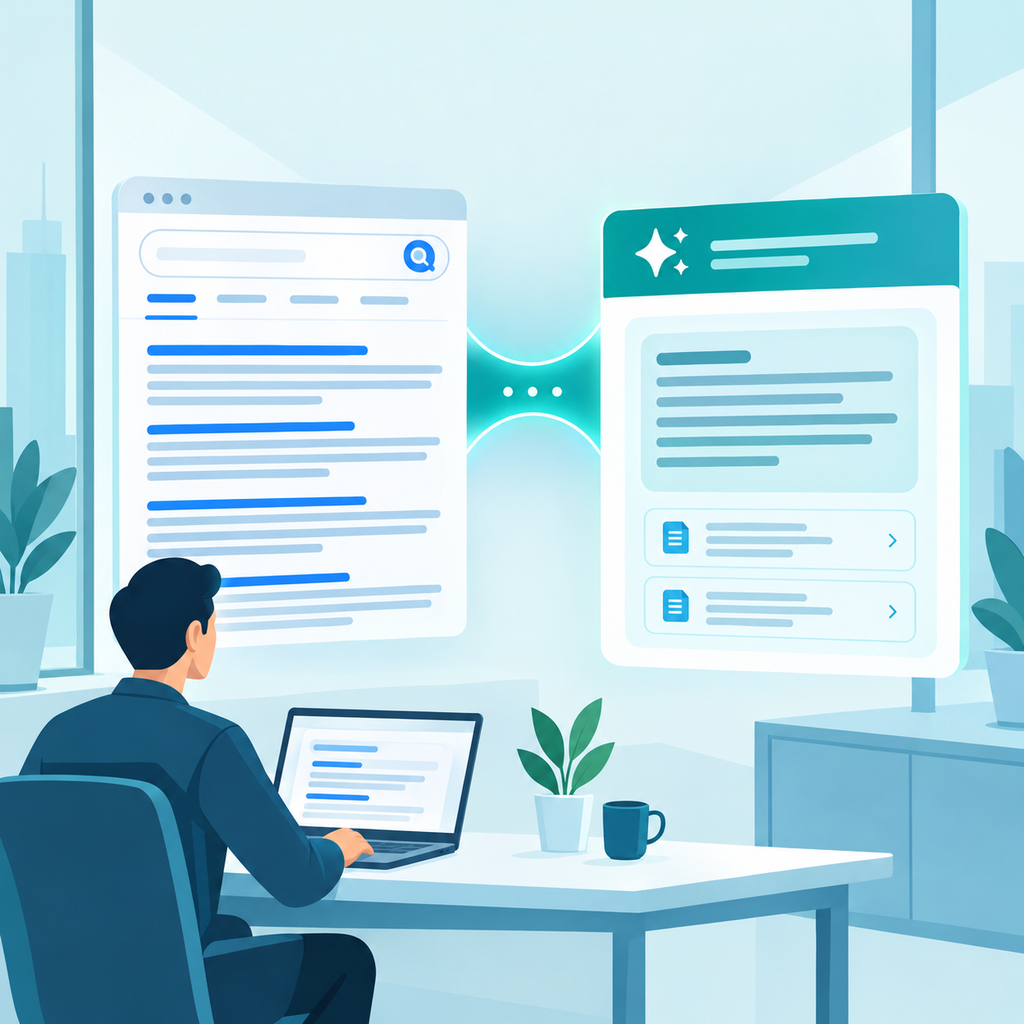
Search has split into two lanes. Buyers still type queries into Google, but a growing share now ask ChatGPT, Perplexity or Google AI Overviews and act on the answer they get. That shift has pushed many brands to ask whether proven SEO services are still enough, or whether winning AI search needs a separate GEO agency. This guide breaks down the GEO vs SEO question in plain language, shows where the two overlap and where they differ, and gives you a simple framework to decide which agency setup fits your budget, team and growth goals.
What Is SEO and What Is Geo?
Before comparing agencies, it helps to be precise about what each discipline actually optimizes for. Vague definitions are the reason so many businesses end up paying twice for the same work.
SEO in Plain Terms
Search Engine Optimization is the practice of getting your pages to rank on Google and Bing results pages for the queries your buyers type. It rests on three pillars that have not changed much in a decade.
- Technical health so crawlers can find, render and index every important page quickly.
- Relevant content that matches search intent better than the competing pages.
- Authority signals such as quality backlinks, brand searches and genuine engagement.
Success is measured in rankings, organic sessions, leads and revenue. If you want a sense of what a full program covers today, our SEO services page breaks down the technical, on page and off page work involved.
GEO in Plain Terms
Generative Engine Optimization is the practice of making your brand the source an AI engine trusts, quotes and recommends when it writes an answer. Instead of a list of ten links, the user gets one synthesized response that names a handful of brands. There is no page two.
GEO focuses on a different set of questions.
- Does the AI engine understand who you are and what you do?
- Can it lift a clean, self contained answer from your page?
- Do other trusted sites mention you in the same breath as your category?
- Are your facts, prices and claims consistent everywhere the model looks?
The term itself came out of academic research. A 2023 study from Princeton and partner universities tested content tweaks on generative engines and found that adding citations, quotations and statistics lifted source visibility by as much as 40 percent in their experiments. That finding is why GEO is less about tricks and more about evidence rich, well structured content.
Where AEO and AI SEO Fit In
You will also hear Answer Engine Optimization (AEO), LLM SEO and AI SEO. In practice these labels overlap almost completely. An AI SEO agency and a GEO agency are usually selling the same core service, which is visibility inside AI generated answers. Do not let the naming change your buying decision. Judge the agency on what it measures and ships.
The Difference Between Geo and SEO at a Glance
The simplest way to see the difference between GEO and SEO is to put them side by side. Notice how many rows share the same foundation even when the end goal changes.
| Factor | Traditional SEO | GEO (Generative Engine Optimization) |
| Main goal | Rank a page in the top results | Get named or cited inside an AI answer |
| Where it shows up | Google and Bing results pages | ChatGPT, Perplexity, Gemini, Claude, Copilot, Google AI Overviews and AI Mode |
| What the user sees | A list of links and snippets | One written answer with a few sources |
| Content format | Keyword focused pages and long guides | Question led headings with short, direct answers near the top |
| Key signals | Backlinks, relevance, technical health, engagement | Entity clarity, schema, factual consistency, third party mentions, freshness |
| Off site work | Link building and digital PR | Reviews, directories, forums, expert quotes and brand mentions across trusted sources |
| Main metrics | Rankings, organic traffic, conversions | Citation rate per prompt, share of AI voice, AI referral sessions, branded search lift |
| Click behavior | User clicks to learn more | User often gets the answer without clicking, so the mention itself builds trust |
| Speed of change | Algorithm updates a few times a year | Model and retrieval behavior shifts every few weeks |
Five Differences That Actually Change Your Strategy
- The unit of success shifts from a page to a passage. AI engines pull a sentence or a table row, not your whole article. Every section has to make sense on its own.
- Brand mentions matter almost as much as links. A Reddit thread or an industry roundup that names you can do more for AI visibility than a generic backlink.
- Consistency becomes a ranking factor. If your pricing says one thing on your site and another on a directory, models hedge or skip you.
- Zero click is the norm. You will see fewer visits from AI answers, but the visitors who do come tend to be further along in their decision.
- Measurement needs new tools. Rank trackers cannot tell you whether Perplexity recommended you this morning. Prompt level tracking can.
Where Geo and SEO Overlap More Than Agencies Admit
Here is the part some GEO vendors skip. AI engines do not invent their sources out of thin air. Google AI Overviews and AI Mode draw heavily on pages that already rank in Google. ChatGPT search and Perplexity run live web retrieval, and the pages they retrieve are usually the ones search engines already trust.
In other words, weak SEO puts a ceiling on GEO. If crawlers cannot reach your pages, no amount of answer formatting will get you cited.
The Shared Foundation
- Fast, crawlable, mobile friendly pages with clean internal linking
- Content that genuinely answers the question better than competing pages
- Topical depth across a cluster rather than one lonely blog post
- Real expertise, with named authors, first hand data and clear sourcing
- A trustworthy backlink and mention profile
All of this is classic SEO work, and it feeds both channels at once. Strong content creation services that start from real buyer questions will lift rankings and AI citations together.
AI Overviews Optimization, the Bridge Between Both
AI Overviews optimization is where the two disciplines meet most clearly, because it lives inside Google itself. Teams that do it well usually follow a short checklist.
- Target question style queries where an AI Overview already appears.
- Answer the question in the first 40 to 60 words under a matching heading.
- Support the answer with a list, table or step sequence that is easy to extract.
- Add FAQ, HowTo, Product, Organization and Article schema where it truly applies.
- Keep facts current and date your updates so freshness is obvious.
- Earn mentions on the sites Google already cites for that topic.
If your current SEO partner already does most of this, you are closer to a working GEO program than you might think.
So, Do You Need a Separate GEO Agency?

For most businesses, no. You need one team that treats SEO and GEO as two outputs of the same strategy. Splitting them across vendors tends to create more problems than it solves.
Why Two Agencies Often Backfire
- Duplicate research. Both teams pull the same keyword and question data, and you pay for it twice.
- Conflicting page edits. The SEO agency rewrites a page for a keyword while the GEO agency restructures it for answers, and neither sees the full picture.
- Blurred accountability. When traffic drops, each vendor points at the other.
- Disconnected reporting. Rankings live in one deck and AI citations in another, so nobody sees how one channel feeds the other.
When a Specialist GEO Agency Does Make Sense
There are honest exceptions. A dedicated GEO agency can be the right call in these situations.
- Your SEO partner has no way to track AI citations and no plan to build one.
- You are a large enterprise with a mature in house SEO team that only needs a GEO layer on top.
- Your category is dominated by AI recommendation queries, such as software comparisons or professional services shortlists.
- You need fast entity cleanup across dozens of directories, review sites and knowledge panels.
Quick Decision Guide
| Your Situation | Best Setup | Why |
| Small or mid size business with weak rankings | One integrated SEO and GEO partner | GEO cannot outperform a weak SEO base, so fix the foundation first |
| Strong rankings but invisible in ChatGPT and Perplexity | Current SEO partner plus a GEO add on, ideally from the same team | The foundation exists, the answer layer is missing |
| Enterprise with an in house SEO team | In house SEO plus a GEO specialist | Internal team owns technical work, specialist owns AI visibility |
| Agency partner refuses to measure AI visibility | Switch to an AI SEO agency that does both | Unmeasured channels never get budget or attention |
| Startup with a tight budget | One partner, or a small team of hired digital marketers | Focus beats coverage at this stage |
If you prefer to build capability internally, hiring dedicated digital marketers who are trained in both channels can be cheaper than paying two retainers. At EPlanet Soft Pvt. Ltd., we see plenty of clients choose this route once they realize how much of the work overlaps.
What to Look for in an AI SEO Agency
Whether you stay with one partner or bring in a specialist, the vetting questions are the same. A capable AI SEO agency should answer every one of these without hand waving.
8 Questions to Ask Before You Sign
- Which AI platforms do you track, and how often do you check them?
- How many buyer prompts will you monitor for my brand and my competitors?
- Can you show me a before and after citation report from a real client?
- How do you connect AI visibility to traffic, leads or pipeline?
- What technical fixes do you make for AI crawlers, such as robots.txt rules and schema?
- How do you build off site mentions beyond backlinks?
- Who writes the content, and how do you check facts before publishing?
- How will your SEO and GEO work be coordinated so pages are not edited twice?
The fourth question matters most. AI visibility that never shows up in your CRM is a vanity metric. Look for teams that pair citation tracking with solid analytics and reporting, including AI referral sessions in GA4 and branded search trends.
Red Flags to Watch For
- Guaranteed placement in ChatGPT or AI Overviews. Nobody controls those outputs.
- Mass produced AI content with no human editing or original data.
- Reports full of screenshots but no repeatable prompt set or trend line.
- A pitch that tells you to stop SEO because GEO has replaced it.
- No plan for what happens after an AI visitor lands on your site.
That last point is often ignored. AI referred visitors arrive with high intent, so the landing experience has to close the loop. Pairing GEO with conversion rate optimization turns citations into actual enquiries instead of polite visits.
A Simple Scorecard
| Capability | Must Have | Nice to Have |
| Technical SEO audits and fixes | Yes | |
| Prompt level AI citation tracking | Yes | |
| Schema and entity optimization | Yes | |
| Original research and data led content | Yes | |
| Digital PR and brand mention building | Yes | |
| Competitor share of AI voice reports | Yes | |
| Video and LinkedIn answer content | Yes | |
| Multilingual AI visibility tracking | Yes |
How an Integrated SEO and GEO Program Works in Practice
At EPlanet Soft Pvt. Ltd., we run SEO and GEO as a single program inside our wider demand generation work. The idea is simple. Every page we touch should earn rankings, earn AI citations and convert the visitor who arrives from either source.
A Practical 90 Day Roadmap
| Phase | Timeline | Focus | Output |
| Baseline | Weeks 1 to 2 | Technical audit, AI crawler access, prompt set of 30 to 100 buyer questions | Rankings and AI citation benchmark |
| Foundation | Weeks 3 to 6 | Fix crawl issues, add schema, clean up entity data across profiles | A site both Google and AI engines can read cleanly |
| Content | Weeks 5 to 10 | Rewrite priority pages answer first, publish comparison and FAQ content | Pages built to rank and to be quoted |
| Authority | Weeks 6 to 12 | Digital PR, expert quotes, review and directory coverage | More third party mentions in your category |
| Review | Week 12 | Compare citation rate, AI referrals and organic leads against baseline | Clear view of what moved and what to scale |
Sometimes the audit shows that the site itself is the bottleneck. Thin templates, slow pages and messy structure hurt both channels at once, and a focused website redesign can unlock more visibility than months of content work.
What Results Look Like
Expect the first movement in AI citations within 6 to 10 weeks for pages that already rank. New topics take longer, often 3 to 6 months, because the authority has to be earned first. You can browse our case studies to see how integrated search work has played out across industries.
Final Verdict on GEO vs SEO
The GEO vs SEO question is not really a choice between two disciplines. SEO builds the foundation that AI engines read, and GEO shapes how those engines describe and recommend you. Treat them as one strategy with two scoreboards.
“Search visibility in 2026 has two scoreboards. Teams that report rankings and AI citations together spot gaps faster and spend less fixing them.”
Hire a separate GEO agency only when your current partner cannot measure AI visibility or will not adapt. For everyone else, one accountable team is faster, cheaper and far easier to manage.
If you want to know where your brand stands today in both Google and AI answers, the team at EPlanet Soft Pvt. Ltd. can run a combined visibility check for you. Talk to an expert and get a clear picture before you commit a single rupee or dollar to a new vendor.