Enterprise AI & Automation Agency | Eplanet Soft
Vibe coding MVP development: We Built an MVP in 3 Weeks
vibe coding MVP development: a step-by-step story of how EPlanet Soft shipped a working SaaS MVP in 21 days using AI-assisted tools like Cursor and Claude Code.

Key takeaways
- Vibe coding MVP development compresses timelines by combining AI-assisted generation with senior engineering review.
- AI can handle roughly 60% of the repetitive build work — but human architects must own security, data modeling, and UX trade-offs.
- Ship vertical slices (auth → dashboard → payments) to validate value quickly with customers and investors.
- Use a disciplined handoff and a short post-launch support window to prevent momentum loss after deployment.
- When evaluating partners, ask for toolchain transparency (Cursor, Claude Code) and a demo of a previous vertical-slice MVP.
By Sanyam Singhal, Founder
vibe coding MVP development is no longer a marketing buzzword — it is a repeatable way to ship usable products in weeks. At EPlanet Soft we treat it as a discipline: alignment, AI-first builds, design sprints, and tight QA. This piece is a first-person account of exactly what happened when our vibe coding team took a SaaS founder’s brief and delivered a working MVP in 21 days.
What / Why: why vibe coding MVP development matters for founders
The problem is simple and familiar: most agencies quote three months and USD 30,000 for a first-version MVP. For early-stage founders that timeline kills momentum — missed demo days, lost customers, and funding friction. Our approach flips the equation: we use vibe coding MVP development to compress discovery, design, and engineering through AI tooling and focused human review. That combination preserves product quality while reducing calendar time and cost.
Before I walk you through the three-week timeline and the exact tools we used, two quick clarifications: when I say "AI handled 60% of the build" I'm describing the distribution of work on an average project in our lab (prompting, code generation, repetitive integrations). Core product decisions, orchestration, architecture, and critical security checks remained human tasks. Also, the story below centers on a recent client project handled by EPlanet Soft’s vibe coding team.
How vibe coding MVP development shrinks timelines
Vibe coding is a methodology: small cross-functional squads, iterative vertical slices, and heavy use of modern AI-assistant tools to generate, refactor, and test code. We combine three pillars:
- Design-led alignment — rapid wireframes and an interactive prototype so developers and founders agree on scope before code starts. We frequently pair this with our UI/UX design process to keep the UX polished while engineering moves fast.
- AI-assisted engineering — Cursor and Claude Code for code generation, Lovable or Bolt for component scaffolding, and automation for CI/CD pipelines. These tools remove repetitive work and let senior engineers focus on integration and system design.
- Vertical slices and continuous validation — rather than finishing all backend then frontend, we ship end-to-end slices: user authentication, then dashboard, then payments. Each slice is demoed and validated with the founder.
This structure is why we can build MVP fast without creating technical debt that sabotages scale. The AI-generated code is reviewed and hardened by senior engineers, and we keep a running checklist of security and compliance checks informed by our web applications and custom platform best practices.
How we build MVP fast — process, tools, and handoffs
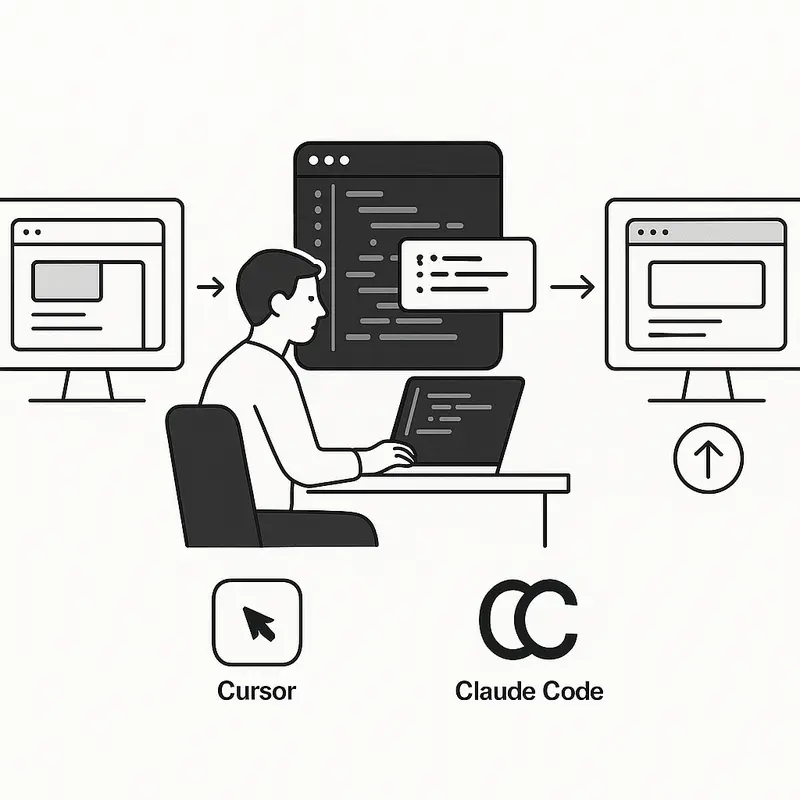
Here is the play-by-play we used on the 21-day SaaS build. Read it as a template you can adapt:
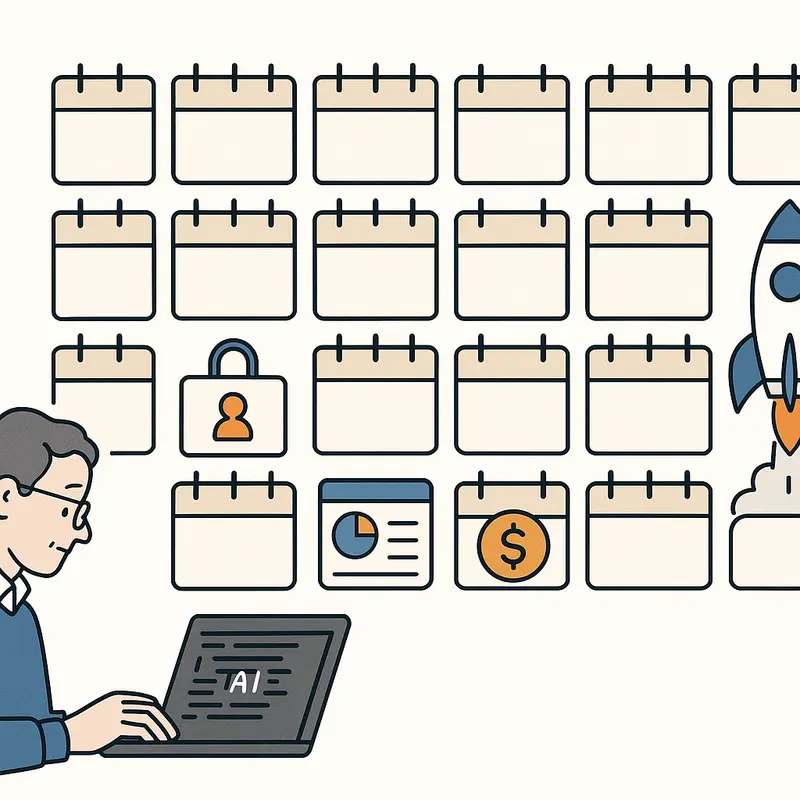
- Day 0 — alignment call (0.5 day): 60-minute session to freeze the MVP scope: user auth, dashboard, payment integration. We used a one-page spec and a prioritized feature matrix. The founder had already been quoted 3 months / USD 20,000 by another agency; our job was to prove a faster route.
- Days 1–2 — design sprint (2 days): Rapid wireframes, clickable Figma screens, and a simple component library. We used our UI/UX design team to produce screens optimized for fast front-end implementation.
- Days 3–6 — core engineering scaffolding (4 days): Backend setup, DB schema, auth system, and CI pipelines. We scaffolded code with Claude Code and wrote custom hooks using Cursor. Senior engineers set up test suites so generated code would be validated automatically.
- Days 7–12 — vertical slices (6 days): First slice: user registration, login, and basic profile. Second slice: core dashboard views and basic analytics. We used Lovable-style component libraries for consistent UI and shipped working endpoints every 48 hours.
- Days 13–16 — payment integration (4 days): We implemented a payment flow (Stripe Connect for marketplace-style onboarding) and end-to-end tests for payment reconciliation. This was a focused engineering sprint with pair programming and AI-assisted tests.
- Days 17–19 — hardening, analytics, and monitoring (3 days): Add logging, error reporting, and instrumentation. We configured basic analytics so the founder could track activation and retention during demos.
- Days 20–21 — final demo and handoff (2 days): Final acceptance testing, documentation, and deployment to a production environment. We trained the founder on the admin panel and provided a 30-day priority support window.
Key tools: Cursor and Claude Code for generation and refactor; GitHub Actions for CI; Stripe for payments; a lightweight Node.js API and React front-end. The work was coordinated via our hire dedicated team approach when necessary for post-launch support.
AI-assisted MVP development: where AI takes over 60% of the build
The 60% figure is an operational observation from our recent projects. What does it include?
- Boilerplate code: auth flows, CRUD endpoints, form validation, and component scaffolding.
- Test generation: unit tests and integration stubs created by Claude Code and then adjusted by engineers.
- Documentation and deployment scripts: initial Dockerfiles, basic CI templates, and Kubernetes manifests.
What AI does not replace:
- Architecture decisions and trade-offs (data models, multi-tenant considerations).
- Security reviews, threat modeling, and compliance checks.
- Product prioritization and UX judgement.
External research supports the productivity gains we rely on. For a high-level view of how developer workflows changed in the last year, see GitHub’s 2025 State of the Octoverse, which discusses AI-assisted developer tools and adoption trends (GitHub, 2025). The Stanford AI Index 2025 also documents increases in model-assisted engineering adoption across software teams (Stanford AI Index, 2025). For enterprise research on AI-assisted development impact, Gartner’s 2025 analysis on developer productivity is a practical reference (Gartner, 2025).
Engineering quality guardrails
Using AI at scale demands guardrails. At EPlanet Soft we use:
- Automated security checks and dependency scanning.
- Senior engineer sign-off for every generated module.
- Continuous integration with test coverage thresholds before merge.
These measures prevented the typical pitfalls of AI-generated code — inconsistent patterns, missing edge-case handling, and undocumented assumptions.
Startup MVP India: pricing, expectations, and choosing a vibe coding agency India
For founders in India or those evaluating partners in India, you’ll see a wide range of pricing. The old market norm — three months / USD 30k — assumes traditional sequential workflows. Vibe coding agencies in India, like the one we operate at EPlanet Soft, are different: they combine design, AI-assisted engineering, and rapid ops to deliver tangible builds in weeks.
How to choose:
- Ask for a vertical-slice demo from a previous project — not a slide deck. Our web applications portfolio includes short demo clips that show end-to-end features we shipped in a sprint.
- Confirm toolchain familiarity: do they use Cursor, Claude Code, or similar? That matters for speed and maintainability.
- Check post-launch support: who will own bug fixes, scaling, and analytics? EPlanet Soft offers post-launch handoffs and options to hire a dedicated team for ongoing work.
If cost is the main constraint, ask the agency to split the work into tightly scoped iterations with measurable milestones. That’s exactly what allowed us to beat a three-month quote and deliver a production MVP in 21 days.
Real example: our 21-day SaaS MVP for a marketplace startup
This is the project I mentioned earlier. A marketplace SaaS founder approached EPlanet Soft after receiving a quote of 3 months / USD 20,000 from another provider. Their required core features were user authentication, a role-based dashboard, and payment integration (marketplace payouts). They needed a live demo to close initial customers and to present to local investors.
Timeline and deliverables:
- Start to production: 21 calendar days (21 working days counted as sprint days; weekends reserved for async QA).
- Tools: Cursor for in-editor AI code completion, Claude Code for multi-file scaffolding and test generation, Stripe for payments, React for the front-end, Node.js and PostgreSQL for the backend. We also used Lovable-like component crates to speed UI builds.
- Team: One product lead, one senior engineer (architecture + reviews), two vibe-coding engineers (AI-assisted), one UI/UX designer, and one QA engineer.
- Outcome: A deployed MVP with registration/login, role-based dashboard, and Stripe-based payments. The client used the MVP to close their first 10 customers and to present it to investors during a city-wide demo day.
What changed for that founder: time-to-first-customer dropped from a projected 12+ weeks to 3 weeks. The budget outflow was also lower than the original USD 20,000 quote because AI allowed us to convert engineering hours into higher-leverage review and product-thinking hours.
I want to be clear: this was not "throw code at the problem and hope". The senior engineer enforced architecture patterns, ran the security checks, and owned the deployment. The vibe coding part is where AI accelerated the repetitive parts and gave our engineers headroom to make better integration choices.
Note: this project was delivered by EPlanet Soft’s vibe coding team and demonstrates the company’s ability to merge AI tooling with product discipline to deliver results quickly.
If you want an operational partner that understands both product and AI tooling, EPlanet Soft’s vibe coding team has a repeatable process that gets founders from idea to demo in weeks — not months.
We also partner across adjacent services: if you need analytics and instrumentation after launch we can add data-intelligence services, or if you want to run demand campaigns we integrate with our demand generation work. For founders who want ongoing marketing automation, we can plug in marketing automation and measure early funnel metrics.
Frequently Asked Questions
Vibe coding MVP development.
how long does vibe coding MVP development take for a simple SaaS?
For a simple SaaS with essential features (user auth, a dashboard, and payment integration) a focused vibe coding squad can deliver a usable MVP in about 2–4 weeks. Our timelines average 21 days when scope is tightly defined and the founder is available for daily quick decisions. The AI-assisted parts accelerate boilerplate generation, but architecture and security still require senior engineer time.
how much does it cost to build an MVP with a vibe coding agency India?
Costs vary by scope and post-launch support. Compared to the traditional market quote of 3 months / USD 20k–30k, a vibe coding approach typically reduces engineering-hours and hence the upfront cost. At EPlanet Soft we price by the slice and provide clear estimates after a 60-minute scoping call. If you want a tailored estimate, contact our team through the contact page.
how to build an MVP in weeks using AI-assisted MVP development?
Start with a prioritized feature list, ship vertical slices, and use AI tools for scaffolding and tests (Cursor, Claude Code). Ensure senior engineer reviews for architecture and security. Repeat short sprints with demos every 48–72 hours to keep alignment. Our documented process at EPlanet Soft follows these steps and has been used to ship multiple three-week MVPs.
what are the risks of using vibe coding for an MVP?
Main risks include over-reliance on generated code without proper reviews, inconsistent patterns, and missed non-functional requirements (scaling, security). Mitigation: enforce code review policies, automated security scans, and have a senior engineer approve integrations. EPlanet Soft enforces these guardrails as part of our standard delivery.
can AI-assisted builds scale beyond the MVP stage?
Yes — if you bake in maintainable patterns, tests, and architectural boundaries during the MVP. AI tools accelerate early development, but scaling requires human-led redesign for performance, multi-tenancy, and observability. We transition many MVPs to scalable platforms by adding dedicated engineering or by helping you hire a team for the next phase.
Related articles
New articles are coming soon.
Ready to try a faster path to market?
If you want a short proof-of-concept or a three-week MVP plan, reach out via our contact page or explore our AI services to understand how we use tools like Cursor and Claude Code in production.
- No commitment required
- Detailed technical roadmap
- Customized to your infrastructure
By submitting this form, you agree to our privacy policy. · 4,000+ businesses served · 24hr response · 98% satisfaction