Enterprise AI & Automation Agency | Eplanet Soft
How Much Does It Cost to Build an App in 2026? Complete Guide
Discover realistic app development cost estimates for 2026—mobile and web, regional rates, pricing models, and startup budgeting. Plan your build with confidence.

Building an app in 2026 means navigating new technologies, evolving market expectations, and a wide range of pricing models. Whether you are a founder planning the cost to build mobile app MVP or an enterprise estimating web app development cost for a large internal system, understanding the components of app development cost 2026 is the first step toward an accurate budget and a successful launch. This guide walks you through every factor that drives cost, provides contemporary benchmark figures, and offers tactical advice to optimize spend without sacrificing quality.
In this detailed, practical guide you will learn the difference between hourly and fixed pricing models, how complexity and platform choices affect price, and which regions and vendor types deliver the best value for your needs. We'll break down costs into design, frontend and backend engineering, QA, DevOps, and ongoing maintenance and show real-world examples and case studies to ground the numbers in reality.
We’ll also compare mobile app vs web app development cost, present regional hourly-rate ranges for 2026, and provide a clear table of ballpark project costs by complexity level. You’ll discover strategies—like hiring a hybrid team, using no-code/low-code for rapid MVPs, or outsourcing to a specialized agency—to reduce costs while preserving competitive advantage. Wherever relevant, we link to services such as custom mobile app development and web application development so you can explore practical partner options.
By the end of this guide, you will have an actionable budgeting template, realistic expectations for timelines and costs, and next-step recommendations whether you’re a startup estimating a startup app development cost or an established company planning an enterprise-grade system. Let’s start by understanding why app development costs vary so dramatically in 2026.
Why App Development Costs Vary in 2026
There is no single answer to the question of app development cost because modern apps differ vastly in scope, user expectations, and technical depth. One key driver is feature complexity: an app that requires user authentication, database-backed user profiles, a payments integration, and real-time messaging will be far more expensive than a simple brochure app. Beyond features, integration complexity (third-party APIs, legacy systems), design sophistication, security and compliance requirements, and scalability goals all add to cost. In 2026, many apps also factor in AI/ML features—such as recommendations or image classification—each bringing specialist engineering costs and infrastructure needs.
Another major variable is the talent model you choose. Hiring an in-house team, contracting freelancers, engaging an agency, or assembling a hybrid team each has different cost profiles. Agencies provide project management, QA, and design disciplines bundled into a predictable scope and timeline, which can reduce hidden costs and accelerate launch—especially when you need end-to-end services like UI/UX design and product strategy. On the other hand, freelancers may reduce hourly rates but increase coordination overhead and project risk.
Geography still shapes hourly rates and therefore final budgets. 2026 market data shows continued globalization of engineering talent and the matured availability of vetted remote teams—affecting supply and demand. However, factors like time zone overlap, language proficiency, and vendor reliability also influence your decision. Decisions about native vs cross-platform vs progressive web app approaches impact both development speed and long-term maintenance costs. Finally, regulatory and compliance needs—such as GDPR, HIPAA, or industry-specific requirements—can increase upfront development and legal costs significantly.
Breaking Down the Cost: Components and Pricing Models
To estimate the total app development cost, you must break the project into components and apply a pricing model. Common components include discovery and product strategy, UX/UI design, frontend development (iOS, Android, web), backend development (APIs, database, server-side logic), QA and testing, DevOps and infrastructure, and ongoing maintenance. Each component has different labor needs and tool/service costs. For example, infrastructure choices (managed cloud vs self-hosted) determine recurring hosting budgets; choosing serverless or PaaS can simplify ops but sometimes increases per-execution costs at scale.
Pricing model choice also alters how you project and control cost. Hourly billing is common when scope is flexible or when iterative, Agile development is required. Fixed-price contracts work best with well-defined scopes and deliverables. In 2026, many vendors offer hybrid models—an initial fixed-cost discovery and MVP followed by a retainer or time-and-materials arrangement for ongoing feature development. If you want predictable burn, fixed-price for MVP and a monthly retainer for feature sprints is a workable pattern.
Here's how typical cost categories break down in most modern projects: discovery and strategy (5-10% of total), design (10-20%), frontend engineering (20-35%), backend engineering (20-30%), QA and testing (10-15%), DevOps/infrastructure (5-10%), and contingency (5-10%). Note that AI/ML features or advanced security/compliance can shift these percentages upward. If your product requires complex data engineering and models, budget an additional 15-30% for data pipeline, model training, and MLOps.
H3: Discovery and MVP Scoping
Discovery is an investment that yields clearer scope, fewer change requests, and lower downstream cost overruns. In a discovery phase you define user journeys, prioritize features into an MVP, create wireframes, and produce a technical architecture. For startups, Discovery costs may range from $5k–$25k depending on the vendor and depth; for enterprises Discovery can exceed $50k when multiple stakeholders and integrations are involved. Discovery is also the time to pick the right tech stack—deciding between native technologies (Swift, Kotlin), cross-platform frameworks (React Native, Flutter), or a web-first Progressive Web App (PWA). Choosing a stack that aligns with target devices and developer availability helps control long-term maintenance costs.
H3: Design, UX, and Prototyping
Design costs correlate to required polish and number of unique screens. A simple app with 10–15 screens and basic interactions might cost $8k–$25k for high-quality UI/UX, while a complex consumer app with 40+ unique screens, micro-interactions, and customized animations could easily be $40k–$120k. Investing in design pays off—great UX reduces churn and support costs and improves conversion rates, directly impacting lifetime value (LTV) of your users. Services like professional UI/UX design also include design systems and component libraries, which save time in development and future redesigns.
H3: QA, Security, and Compliance
QA is non-negotiable for apps that expect scale. Automated test suites, CI/CD pipelines, and manual exploratory testing together reduce bugs in production. Budgeting ~10-15% for QA work is standard, but projects with regulated data (healthcare, finance) must add specialized security audits, penetration testing, and compliance documentation which can add tens of thousands of dollars. In 2026, third-party security standards and automated scanning tools make ongoing security more affordable, yet properly implementing these tools requires experienced engineers, so plan accordingly.
Cost Estimates: Mobile App vs Web App by Complexity
Below we present ballpark cost estimates for 2026 for different project complexities. These numbers represent typical total project costs to build and launch a first production version (not including long-term ops or growth marketing). Use these figures as a starting point for budgeting and refine them with discovery. Costs vary based on features, integrations, and regional rates, but the table below provides consolidated benchmarks you can use to plan.
| Project Type | Typical Timeline | Ballpark Cost (USD) | Key Features |
|---|---|---|---|
| Simple Mobile App (iOS or Android) | 2–3 months | $20,000 – $60,000 | Basic UI, auth, simple API, push notifications |
| Medium Mobile App (Cross-platform) | 3–6 months | $60,000 – $150,000 | Payments, social login, analytics, offline support |
| Complex Mobile App | 6–12 months | $150,000 – $500,000+ | Realtime, complex backend, AI/ML, enterprise integrations |
| Simple Web App | 1–3 months | $15,000 – $50,000 | Responsive UI, CMS, basic API |
| Medium Web App | 3–6 months | $50,000 – $150,000 | User roles, workflows, integrations, reporting |
| Enterprise Web Application | 6–18 months | $150,000 – $1,000,000+ | High availability, security, multi-tenant, compliance |
These ranges reflect realistic market conditions in 2026 where app development cost continues to be influenced by feature richness and non-functional requirements like scale and resilience. For startups, a typical MVP mobile app to validate product-market fit often falls in the $30k–$80k range when employing a pragmatic feature set and cross-platform frameworks. Larger companies aiming for enterprise-grade solutions should plan for higher costs due to integration, auditability, and SLA demands.
H3: Mobile vs Web: The Hidden Cost Differences
Mobile apps often require platform-specific optimization, App Store and Play Store compliance, and ongoing OS compatibility work—even cross-platform frameworks cannot eliminate every device-specific change. Web apps avoid app store submission cycles and can iterate faster, but they may require additional backend engineering for real-time features and offline support. Over the lifetime of an app, maintenance costs can make up 15–30% of the initial development cost annually. Choose the approach that aligns with user behavior; if your users are mobile-first, migrating to a suboptimal web experience will lower engagement and ROI.
Regional Pricing and Hourly Rates in 2026
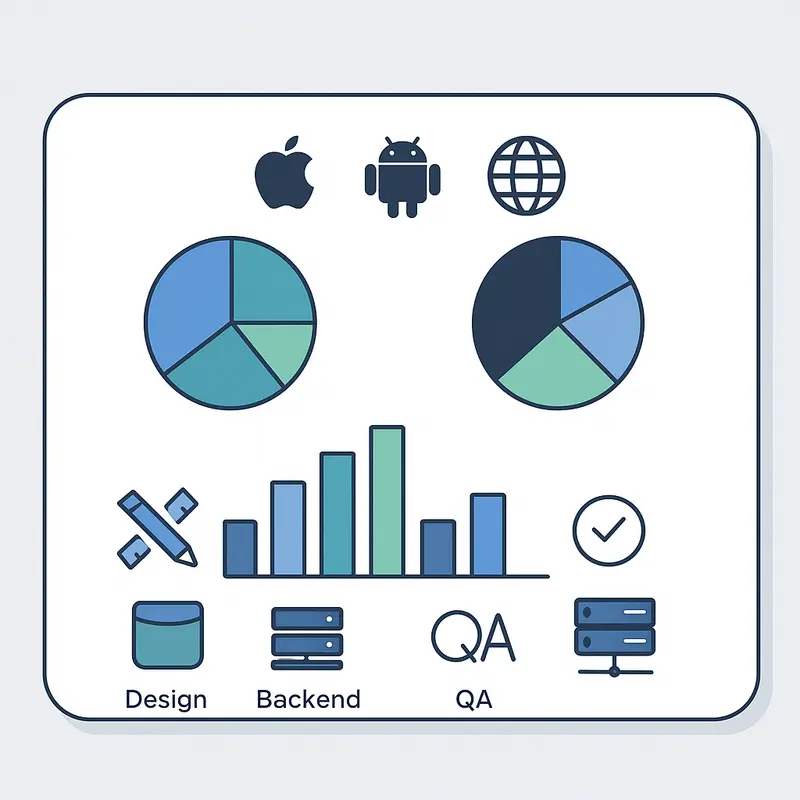
Regional labor rates remain a major determinant of the total cost to build web application and mobile apps. Below are typical hourly ranges for professional development talent in 2026. These ranges reflect market maturity, local living costs, and demand for specific technologies. Always factor in vendor reputation, portfolio, and team composition—low hourly rates do not automatically generate savings if quality issues increase project duration or rework.
Typical hourly rates (2026 benchmarks):
- North America (US/Canada): $100–$200+/hr for senior engineers and agencies
- Western Europe (UK/DE/FR): $80–$160/hr
- Eastern Europe (Poland/Ukraine/Romania): $40–$80/hr
- Latin America (Brazil/Argentina/Colombia): $35–$75/hr
- South & Southeast Asia (India/Vietnam/Philippines): $20–$60/hr
- Remote managed teams or boutique agencies: Blended rates often $45–$120/hr
For example, if you contract a North American agency to build a medium complexity app over 5 months, the labor cost alone could be $200k–$400k. The same project with a high-quality Eastern European team might fall in the $80k–$180k band. Many companies use blended models—core product owners and architects in-house or local, with dedicated development teams in lower-cost regions—to balance cost and control. If you want direct access to vetted, managed offshore teams, consider options like hire a dedicated team to secure talent while keeping day-to-day coordination predictable.
Remember to include overhead such as project management, administrative costs, and local taxes when comparing providers across regions. A cheap hourly rate can hide high coordination overhead, slower time-to-market, or poorer documentation which increases long-term costs.
Reducing Costs Without Sacrificing Quality
Reducing app development cost 2026 is not simply about choosing the cheapest hourly rate. Smart cost reduction focuses on scope discipline, reuse, automation, and choosing the right vendor model. Start with a tightly defined MVP that solves one core problem exceptionally well—feature bloat increases development time and dilutes product-market fit. Use data from discovery to prioritize features and defer secondary items to post-MVP sprints.
Another effective strategy is reuse: leverage open-source frameworks, component libraries, and design systems to reduce custom engineering. For ecommerce projects, use established ecommerce platforms and integrations rather than building a homegrown cart, unless your product requires truly unique commerce flows. Additionally, adopt CI/CD pipelines and test automation early; the upfront investment reduces manual QA time and lowers defect rates in production, saving cost over the app lifecycle.
Offshore or nearshore teams can reduce unit labor cost, but effective vendor selection and management matter. Hire teams with proven delivery patterns, strong references, and relevant vertical experience. For specialized work like AI features, hiring dedicated experts—such as via AI and machine learning solutions or by choosing to hire AI engineers—can be more cost-effective than generalists trying to learn on the job. Finally, consider low-code/no-code for internal tools and early-stage MVPs as a way to validate hypotheses quickly; if traction proves the concept, invest in a robust, custom solution for scale.
H3: Tactical Cost-Saving Measures
Concrete tactics include building a design system to reduce future UI cost, leveraging managed backend services (e.g., Firebase, Supabase) to speed up development, and outsourcing non-core features to third-party SaaS. For user onboarding and conversion, integrate quality analytics early and invest in conversion optimization—improvements here can increase revenue significantly without adding new features. You can also reduce support and maintenance costs by documenting APIs and using contract patterns that include knowledge transfer and clean handover procedures.
H3: When to Avoid Cutting Costs
Avoid cutting costs on foundational architecture, security, and data handling. Under-investing in these areas typically leads to greater expense later through rework, compliance fines, or reputational damage. For apps handling payments, health data, or personal financial information, budget for robust security and regulatory compliance from day one. Similarly, if your app’s competitive advantage is performance or unique algorithms, keeping those components in-house with senior engineers is usually worth the extra cost.
Case Studies and Real-World Examples
Examining real projects helps ground budget planning. Below are three anonymized case studies showing different approaches and cost outcomes in 2026. These examples include context, chosen approach, and lessons learned—use them to align expectations with your project type.
H3: Startup MVP — Consumer Mobile App
Scenario: A consumer startup needed a rapid MVP to test concept-market fit: user onboarding, social login, curated content feeds, and basic in-app purchases. Approach: The team engaged an experienced product design firm for a 4-week discovery and then contracted a cross-platform React Native team from Eastern Europe. Results: Total spend to launch was $72k over 4 months. The app achieved initial traction (10k installs in 2 months) and validated the hypothesis. Lesson: Prioritizing core features and using cross-platform tech reduced time-to-market and cost while enabling rapid iteration.
H3: Mid-market Web App — Enterprise Workflow Platform
Scenario: A mid-market company required a workflow automation platform with role-based access, reporting, and integrations to Salesforce and internal systems. Approach: They selected a hybrid model—local product owners and architects in North America plus a dedicated development team in Latin America for implementation. Results: Delivery took 6 months and cost $220k. The platform reduced manual processes and saved QA operational costs post-launch. Lesson: Hybrid staffing enabled tight product control with lower engineering rates while ensuring integration expertise close to the client.
H3: Large Enterprise — AI-enabled App
Scenario: An enterprise needed a scalable AI-enabled recommendation engine embedded in both mobile and web products, with strict security and high availability. Approach: The team used a US-based systems integrator for architecture and compliance, plus a distributed engineering team for model development and deployment. Results: Initial build exceeded $1M, with ongoing infrastructure and MLOps costs around $15k/month. Lesson: AI features and regulatory requirements can dramatically increase initial costs; plan for operational budgets for model retraining and monitoring.
“According to market reports, global spending on custom application development and integration is one of the fastest-growing segments in enterprise IT budgets.” — industry analysis
These examples illustrate the spectrum of app development cost and underscore why precise scoping and vendor selection are essential. For startups, a focused MVP often delivers the best ROI; for enterprises, investing in robust architecture and compliance is necessary but predictable with thorough discovery.
Budgeting for Startups: MVP, Funding, and Post-Launch Costs
Startup app development cost is a special case because the primary objective is validation with minimal viable investment. MVP budgeting should start with a strict feature prioritization: what single problem does the app solve and what is the minimum feature set that demonstrates value to users? A typical startup budget for a credible MVP in 2026 is $30k–$120k depending on the required polish, native features, and integrations. Use discovery to define measurable success criteria and build a roadmap for subsequent funding rounds.
Funding strategy influences how you spend. Seed-stage startups often use smaller budgets to validate core hypotheses and later raise capital for scale. If you have limited runway, consider conservative tech choices: cross-platform frameworks, managed backend services, and incremental feature releases. Allocate a portion of your initial budget to analytics and product metrics so you can make informed pivots. Services like demand generation and conversion rate optimization can help convert early users into paying customers, stretching your runway.
Post-launch costs are frequently underestimated. Plan for hosting, monitoring, customer support, iterative development, and marketing. A rule of thumb: annual maintenance and growth budgets often range from 15–30% of initial development cost. That means a $100k app could reasonably require $15k–$30k per year in ongoing investment to remain competitive and secure. If your product relies on user acquisition from paid channels, include marketing budgets such as paid marketing, social campaigns, and email funnels when planning total runway.
H3: Preparing for Scale
If your roadmap includes rapid user growth, architect for scale early to avoid expensive rework. Use scalable cloud architectures, event-driven systems, and modular microservices so you can add capacity incrementally. Consider investing in observability and performance engineering from launch; tracking metrics like latency, error rates, and cost-per-transaction helps you manage escalation without reactive scrambling. For teams short on senior resources, partnering with an experienced engineering partner or deciding to hire a dedicated team can accelerate time-to-scale with fewer hiccups.
Key Takeaways

- Costs vary widely: Simple apps can be <$50k, whereas complex enterprise or AI-enabled apps easily exceed $500k.
- Break down the budget: Include discovery, design, frontend, backend, QA, DevOps, and contingency when estimating total cost.
- Choose the right model: Hourly for flexible, fixed-price for defined MVPs, hybrid for predictable iteration.
- Regional rates matter: Blended staffing models balance cost and control—consider options like hire-dedicated-team arrangements.
- Prioritize MVP and measurement: Start small, validate, then invest in scale and security as required; fund ongoing maintenance (15–30% annually).
Conclusion and Next Steps
Estimating app development cost in 2026 requires a realistic assessment of feature scope, platform choice, talent model, and long-term operational needs. This guide provides benchmarks and tactical advice to plan budgets for mobile and web apps, whether you are a startup seeking an MVP or an enterprise building a mission-critical system. Start with disciplined discovery, choose a tech stack that aligns with your roadmap, and invest in design and security early to protect product value. If you need a partner, consider agencies offering end-to-end services including custom mobile app development, web application development, and specialized design through UI/UX services.
Ready to get a realistic estimate? Contact experienced teams that provide transparent scoping and mixed staffing models. For startups, focus on a measurable MVP with analytics to de-risk investment. For enterprises, prioritize architecture and compliance. If you’d like to discuss options or get a tailored estimate, contact our team to schedule a free consultation. Building the right product starts with a clear budget and an experienced team—plan carefully, iterate quickly, and scale with confidence.
Related Services
Further Reading and References
Frequently Asked Questions
How Much Does It Cost to Build an App in 2026? Complete Guide.
How much does it typically cost to build a basic mobile app in 2026?
A basic mobile app with core features—authentication, simple API, basic UI, and push notifications—typically costs between $20,000 and $60,000 in 2026. The final number depends on platform choice (iOS vs Android vs cross-platform), design polish, and any third-party integrations.
What is the difference in cost between a mobile app and a web app?
Mobile apps often require platform-specific engineering, compliance with app store rules, and device optimization, which can increase development and maintenance costs compared to web apps. Web apps can be faster to iterate and avoid app-store friction, but complex real-time features or offline support can narrow the cost gap.
How do regional hourly rates affect overall app development cost?
Regional hourly rates vary widely—senior talent in North America often charges $100–$200+/hr while Eastern Europe or Latin America can range $35–$80/hr and South Asia $20–$60/hr. Lower rates reduce initial spend, but vendor quality, communication, and management overhead also influence total cost and time-to-market.
What portion of the budget should startups reserve for post-launch maintenance?
Startups should budget roughly 15–30% of initial development cost annually for maintenance, hosting, bug fixes, and iterative feature work. This ensures the app remains secure, compatible with OS changes, and able to scale as user count grows.
Can no-code or low-code tools reduce the cost to build an app?
Yes, no-code and low-code platforms can significantly reduce time-to-market and initial costs for MVPs and internal tools, making them a great option for early validation. However, for high-scale consumer apps or complex integrations, custom development may be necessary later to meet performance and extensibility needs.
How much extra should I budget for AI/ML features in my app?
AI/ML features typically add 15–30% or more to development costs due to data engineering, model development, and MLOps requirements. Costs depend on dataset size, model complexity, and ongoing training and monitoring needs.
Ready to Grow Your Business?
Get a free consultation from our digital marketing and development experts. Let's discuss how we can help you achieve your goals.
- No commitment required
- Detailed technical roadmap
- Customized to your infrastructure
By submitting this form, you agree to our privacy policy. · 4,000+ businesses served · 24hr response · 98% satisfaction