Enterprise AI & Automation Agency | Eplanet Soft
How AI Will Transform PPC Services and Paid Advertising
Discover how AI PPC services will reshape paid advertising—boost ROI, automate bidding, and personalize creatives. Learn strategies and when to hire PPC expert today.
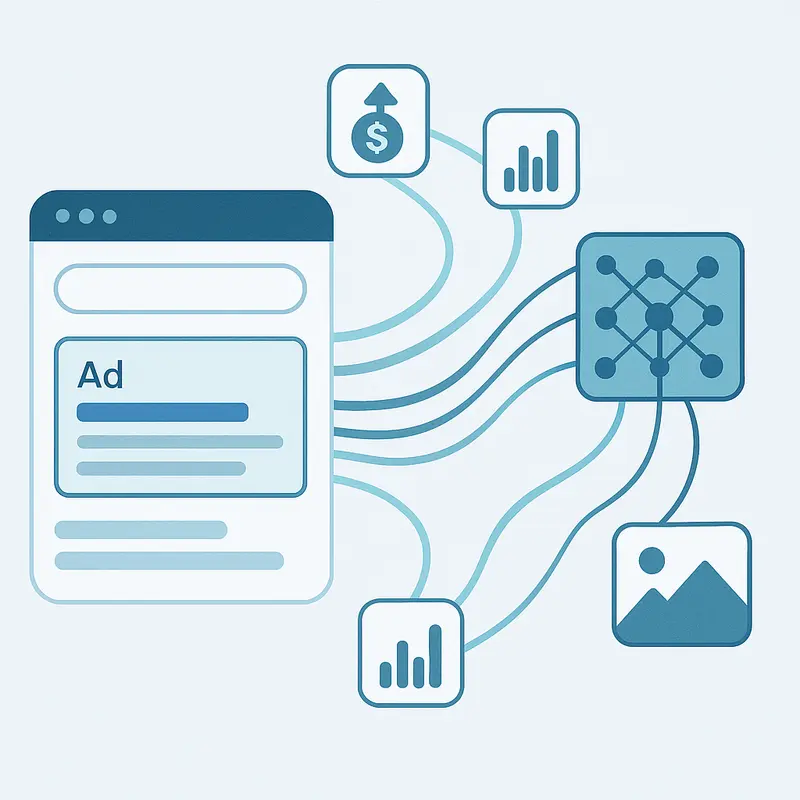
AI PPC Services are no longer a futuristic concept — they are the engine driving the next wave of paid advertising performance. From automated bidding and dynamic audience segmentation to creative generation and real-time attribution, AI is enabling advertisers to scale efficiency while extracting deeper insights from campaign data. If you’re evaluating when to hire PPC expert resources or invest in AI tooling, understanding the practical implications and the implementation roadmap is critical.
This long-form guide explores how AI will change the PPC services industry across technology, operations, measurement, and talent. You’ll find actionable frameworks, realistic use cases, a comparative table of traditional versus AI-powered PPC, and recommended next steps for agencies and in-house teams to capture AI-driven value.
The current state of PPC: where we stand
Pay-per-click advertising today sits at an inflection point. Platforms such as Google Ads and Microsoft Advertising have steadily introduced automation features—smart bidding, responsive search ads, and Performance Max—that offload manual optimization tasks to platform algorithms. Many advertisers have adopted these features to varying degrees, but adoption alone doesn’t guarantee better outcomes. The winners are organizations that combine platform automation with data strategy, creative testing, and human oversight.
Market demand remains robust. Global digital ad spend continues to grow year-over-year, and advertisers are allocating a larger share of their budgets to programmatic and search channels. As budgets scale, manual processes become bottlenecks; AI promises to reduce friction by automating repetitive tasks while surfacing high-value signals.
Core AI technologies powering next-gen PPC
AI in PPC comprises several distinct technologies that work together to optimize performance. Understanding these building blocks helps teams choose which capabilities to adopt first and how to integrate them with existing workflows.
Machine Learning for bidding and performance optimization
Machine learning models analyze historical clicks, conversions, device, time, and contextual features to make bid predictions. Unlike rule-based automation, ML continuously updates its parameters as new data arrives, enabling adaptive bidding that responds to market shifts in near real time.
Natural Language Processing (NLP) for creative and keyword understanding
NLP helps systems parse user intent, generate ad copy, and group keywords by semantic similarity. This improves ad relevance and allows advertisers to scale responsive creative strategies across large account structures.
Computer Vision and creative analysis
Computer vision techniques evaluate imagery to detect elements that correlate with stronger engagement—colors, faces, layouts—helping teams optimize visual creative for display and social placements.
Key AI-driven PPC capabilities and practical use cases
AI introduces a variety of capabilities that change how PPC is planned, executed, and measured. Below are the top areas where AI is already making an impact and how to operationalize them.
Automated bidding and budget allocation
AI-enabled bidding replaces manual bid adjustments with algorithmic models that optimize for specified goals (e.g., CPA, ROAS, maximize conversions). Instead of testing dozens of bid rules, teams define business objectives and constraints, while ML models select bids across auctions to meet targets.
Operational tip: Start by testing automated bidding on a subset of campaigns with consistent conversion signals. Monitor for bid creep and ensure conversion tracking is clean before expanding automation.
Audience discovery and micro-segmentation
AI uncovers micro-segments by analyzing behavioral and contextual signals that humans can’t easily spot. These micro-segments allow for hyper-personalized messaging that increases relevance and conversion rates.
Practical use: Combine platform audience signals with first-party data through a clean data pipeline, then apply ML-based clustering to find high-value segments your manual analysis misses.
Dynamic creative generation and personalization
Generative AI and template-driven systems can produce ad copy variations, headlines, and even display creatives that are tailored to audience segments and landing pages. This capability dramatically increases test throughput while preserving message relevance.
Actionable advice: Use generative copy as a rapid ideation tool, then A/B test top-performing variants against human-crafted control ads to validate lift.
Real-time attribution and incremental lift measurement
AI models can evaluate multi-touch attribution and estimate incremental lift from campaigns by accounting for overlapping exposures, seasonality, and external factors. These probabilistic models offer more nuanced insights than last-click metrics.
Implementation note: Pair probabilistic attribution with controlled experiments (holdouts) when evaluating transformational media strategy changes to validate model outputs.
Measuring impact: metrics, experiments, and data strategy
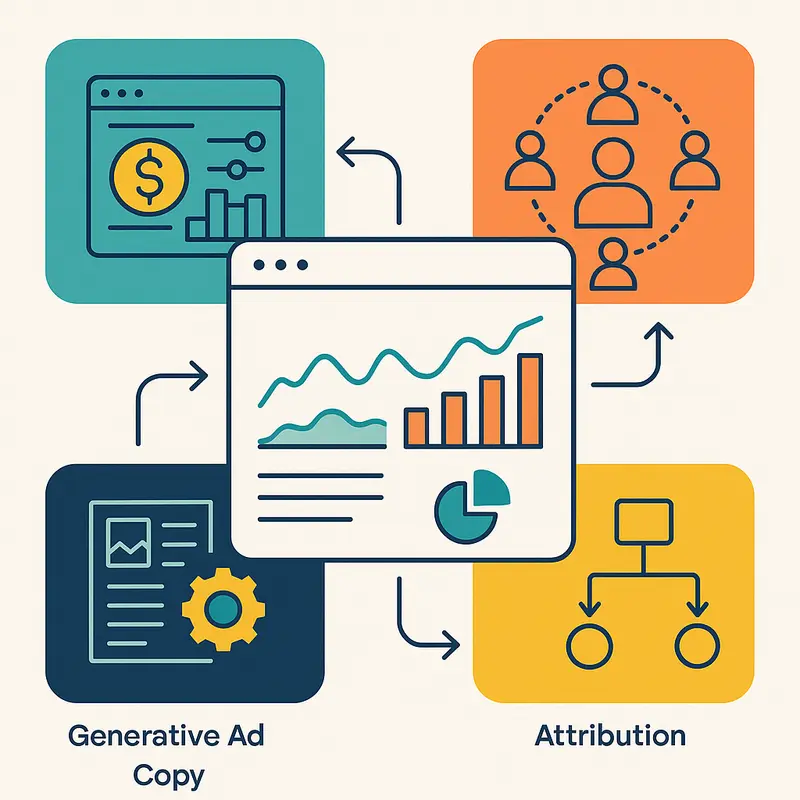
Accurate measurement is the backbone of AI-powered PPC. Models are only as good as the data they consume. Shifts to AI-driven bidding and personalization require a disciplined measurement strategy to avoid optimization on noisy or biased signals.
Essential data hygiene steps
- Ensure conversion tracking is consistent across platforms and matches business outcomes.
- Resolve identity and attribution gaps using first-party data and probabilistic matching.
- Establish data pipelines that deliver timely, de-duplicated event data to your models.
Experimentation frameworks
Controlled experiments (A/B tests and holdout groups) are essential to validate AI optimizations. Experiments test hypotheses such as “Will AI bidding improve ROI vs manual bidding?” or “Does generative creative actually increase conversions for micro-segments?”
Best practice: Run statistically powered experiments and measure both short-term conversion metrics and longer-term customer value signals.
Key metrics to track
- Cost per acquisition (CPA) and return on ad spend (ROAS)
- Incremental lift and lifetime value (LTV) impact
- Conversion rate and quality of traffic (engagement metrics)
- Model stability metrics (prediction drift, calibration)
Perspective: Organizations that treat measurement as a strategic capability—not merely a reporting plug-in—extract far greater value from AI-driven PPC.
Operational changes and evolving team roles
The rise of AI in PPC will shift how agencies and in-house teams are structured. Routine tasks like manual bid changes and keyword-level reporting will decline, while strategic roles expand around data, experimentation, and creative optimization.
The new mix of roles
- AI Strategist / Performance Scientist: Designs ML-driven strategies, selects models, and oversees their deployment.
- Creative Technologist: Bridges creative production with dynamic templates and generative copy solutions.
- Data Engineer / Analyst: Ensures data quality, real-time pipelines, and model inputs are robust.
- PPC Specialist (higher-level): Focuses on strategy, hypothesis design, and cross-channel orchestration rather than manual optimizations.
Hiring and skill development: when to hire PPC expert
As automation covers tactical work, the demand increases for professionals who can interpret model outputs, design experiments, and align paid media with broader business goals. If your team lacks experience in model validation, data pipelines, and cross-channel analytics, it’s time to hire a PPC expert or augment with specialists who bring these capabilities.
Where agencies can add immediate value: consult on governance, implement model monitoring, design audience strategies informed by first-party data, and manage creative experimentation frameworks.
Implementation roadmap: how agencies and brands should adopt AI PPC services
Adopting AI is a journey, not a flip of a switch. The roadmap below helps teams prioritize actions, manage risk, and deliver measurable improvements early.
Phase 1 — Quick wins (0–3 months)
- Validate and clean conversion tracking; remove duplicate events.
- Test platform automation on low-risk campaigns (e.g., max conversions on search campaigns with stable conversion rates).
- Standardize naming conventions and account structure to support automated rules and creative templates.
Phase 2 — Scale and integrate (3–12 months)
- Integrate first-party CRM signals with ad platforms or data clean rooms.
- Deploy ML-based bidding across campaigns where conversion signal quality is sufficient.
- Implement creative generation workflows with A/B testing controls.
Phase 3 — Optimize and govern (12+ months)
- Build internal model governance, monitoring for drift, and audit trails for decisions.
- Adopt advanced attribution and incremental lift measurement using holdouts and probabilistic models.
- Continuously retrain models and expand micro-segmentation strategies into personalization across channels.
Cost, ROI, and comparative outcomes
One common question: what is the expected ROI of adopting AI in PPC? While results vary by industry and data maturity, AI can materially reduce wasted spend and increase conversion rates when implemented responsibly. Below is a general comparison to help stakeholders weigh costs and benefits.
| Dimension | Traditional PPC | AI-powered PPC |
|---|---|---|
| Bid optimization | Manual rules, time-consuming adjustments | Algorithmic bidding with continuous learning |
| Creative testing | Limited variants due to production cost | Rapid multivariate testing with generative assistance |
| Audience targeting | Broad segments and manual list management | Micro-segmentation and lookalike models |
| Measurement | Last-click attribution, basic reporting | Probabilistic attribution and lift modeling |
| Time-to-insight | Days to weeks | Near real-time insights and alerts |
Cost considerations include platform learning budgets, investment in data infrastructure, and potential third-party AI tools or consulting. Often the fastest path to value is a hybrid approach: combine native platform automation with custom data integrations and human oversight from specialists—either in-house or via agencies and staff augmentation.
Risks, ethics, and governance
AI improves performance, but it also introduces new risks that require governance. Left unchecked, models can perpetuate biases, optimize for unintended traffic, or make opaque decisions that clash with brand safety or compliance requirements.
Bias and fairness
Models trained on historical data may replicate past biases—for example, optimizing away certain demographic segments that are valuable long-term. Establish fairness checks and incorporate human review into critical decisions.
Transparency and explainability
Stakeholders require explanations for why a model made specific bid or audience decisions. Maintain model logs, feature importance reports, and a change management process for model updates.
Privacy and data protection
First-party data is the most valuable asset for AI PPC, but it must be handled carefully to comply with privacy laws (e.g., GDPR, CCPA). Use hashed identifiers, consent management, and, where applicable, privacy-preserving computation techniques.
Reminder: Model governance is not optional. Establishing clear policies for monitoring, incident response, and ethical review is essential to maintain performance without compromising brand trust.
Case study examples and industry trends
Real-world adopters demonstrate concrete benefits. Early adopters in retail and financial services report improved efficiency as AI takes over granular optimization tasks, enabling teams to focus on strategy and creative differentiation.
Industry trends to watch:
- Convergence of search and social algorithms—platforms will increasingly optimize across placements.
- Wider adoption of Creative Management Platforms (CMPs) integrated with generative AI for scalable personalization.
- Greater reliance on first-party data and clean-room analytics to measure cross-platform impact.
For organizations that need assistance integrating AI into paid programs, partnering with teams that combine data engineering, paid media expertise, and creative operations accelerates time-to-value. Consider engaging an AI partner for strategy and implementation — for example, working with teams that provide AI and machine learning solutions alongside paid marketing specialists.
Checklist: Ready to adopt AI PPC services?
Use this checklist to assess readiness before expanding AI across your paid channels:
- Are your conversion events clean, de-duplicated, and aligned with business outcomes?
- Do you have access to first-party customer data and consent to use it for ad personalization?
- Have you run controlled tests to validate platform automation on a subset of campaigns?
- Do you have internal or external expertise to monitor model performance and intervene when needed?
- Is there a plan for creative scale and experimentation using generative tools?
Key Takeaways
Summary:
- AI PPC Services shift the focus from manual execution to strategy, data quality, and creative experimentation.
- Start with clean measurement, pilot automation on stable campaigns, and expand with a governance-first approach.
- Teams should evolve: hire or upskill to include data engineers, performance scientists, and creative technologists rather than only traditional PPC operators.
- Hybrid models—combining platform automation with custom AI models and human oversight—deliver the most reliable results.
- If you need help accelerating adoption or want to hire PPC expert talent for AI-driven programs, consider augmenting your team with experienced partners.
Conclusion — Next steps and call to action
AI will not replace good strategy; it will amplify it. Organizations that combine disciplined measurement, first-party data, and a roadmap for model governance will unlock substantial performance gains. If your team is evaluating the technology and talent needed to scale AI-powered campaigns, you don’t have to navigate the transition alone.
ePlanetSoft offers integrated services across AI, paid marketing, and staff augmentation to help brands and agencies adopt AI PPC Services responsibly and efficiently. Whether you need strategic consulting, custom model development, or to hire a PPC expert with AI experience, we can help you design and execute the right roadmap. Connect with our paid media specialists for a tailored assessment and pilot plan, or explore our paid marketing services to accelerate your AI adoption.
Ready to start?
Reach out to evaluate a pilot that proves value in 60–90 days and builds a foundation for long-term AI-driven growth.
- No commitment required
- Detailed technical roadmap
- Customized to your infrastructure
By submitting this form, you agree to our privacy policy. · 4,000+ businesses served · 24hr response · 98% satisfaction