Enterprise AI & Automation Agency | Eplanet Soft
How to Build an MVP in 30 Days: A Step-by-Step Guide
Learn how to build MVP fast with a proven 30-day roadmap for startup MVP development. Practical steps, tech choices, and growth-ready testing—start building today.

Key takeaways
- Set a 30-day timeline with clear weekly milestones to force high-impact decisions and measurable learning.
- Prioritize the smallest set of features that test your riskiest assumptions—use MoSCoW or RICE to decide what’s in scope.
- Use prototypes and pre-sales experiments to validate demand before heavy engineering investment.
- Choose a pragmatic tech stack (managed services, serverless, modern JS frameworks) to accelerate development.
- Instrument the MVP with analytics and run targeted growth tests to validate channels and pricing.
Bringing a product idea to market quickly is the competitive advantage that separates founders who learn fast from those who waste months building features users don’t want. If you want to build MVP fast and validate real demand, a focused, 30-day plan gives you the structure to move from idea to usable product without overengineering. This MVP development guide walks you through the exact sprint-by-sprint actions, prioritization techniques, and tooling choices to build an MVP in 30 days—even when your team is small and resources are limited.
Startups face a brutal combination of time pressure and uncertainty. You need to demonstrate traction, convince early customers, and iterate based on real feedback rather than assumptions. The persuasive case for a tightly scoped, rapid MVP is not just anecdotal: industry research repeatedly shows that startups fail when they build the wrong product or spend too long before validating product-market fit. In this article we’ll show how to avoid that trap by structuring your efforts into a measurable, 30-day sequence that forces learning and reduces wasted effort.
Throughout this piece you’ll find concrete templates, a day-by-day table, and practical examples from real-world startups that shipped fast. We’ll also cover how to prioritize features using actionable frameworks, how to choose a pragmatic technology stack, and how to use analytics and lightweight growth tactics to validate demand. Whether you’re a solo founder, a small team, or planning to hire dedicated talent, this guide gives you the playbook to build an MVP quickly and defensibly.
Below is a complete roadmap and a set of step-by-step minimum viable product steps you can adapt to your context. Expect to see example user stories, sprint plans, recommended tools, and tips for turning early feedback into rapid iterations. By the end you’ll have both the operational plan and the strategic rationale to execute a high-velocity MVP build—from idea to validated prototype—in just 30 days.
Why Build an MVP in 30 Days?
Speed isn’t an end in itself: it’s a learning mechanism. Building an MVP quickly forces you to codify assumptions, prioritize ruthlessly, and confront reality with measurable outcomes. A 30-day horizon is short enough to maintain urgency and long enough to produce something meaningful that users can experience. For startups seeking investment or early customers, demonstrating a working MVP within a single month signals discipline and execution capability—two qualities investors and early adopters value highly.
Another practical reason to adopt a 30-day sprint is cost control. The longer you spend in development before testing your core hypothesis, the higher the risk you’ll be forced to rework or abandon features. Lean startup principles recommend validating the riskiest assumptions first—customer demand, pricing sensitivity, and the product’s core utility. A compressed timeline channels resources into building the smallest product that can test those assumptions, which reduces burn and accelerates decisive pivots if needed.
Real-world data supports this approach. According to Statista, many businesses fail within the first five years—often because they didn’t test demand early. Similarly, research from industry analysts shows that businesses practicing rapid experimentation learn faster and reduce the cost of failure. That’s why startup accelerators and successful product teams emphasize short, measurable cycles: you don’t want to spend six months building something you could have validated in one week.
Finally, building an MVP fast fosters a culture of clarity: fewer features, sharper user journeys, and a greater focus on customer conversations. This culture is crucial beyond the initial 30 days—it shapes how you collect data, iterate, and prioritize future roadmaps. Whether you plan to iterate into a full product or pursue a pivot, the discipline of a 30-day MVP sets up repeatable processes that speed future releases and facilitate smoother scaling.
Day-by-Day 30-Day Roadmap: What to Do Each Week
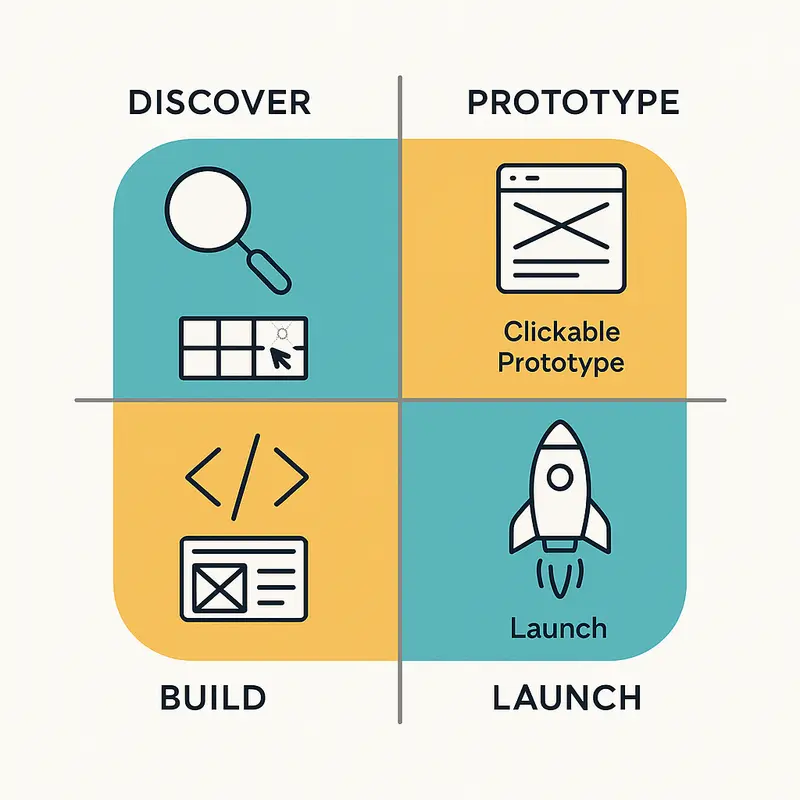
Breaking 30 days into weekly goals helps structure work, clarify deliverables, and manage stakeholder expectations. Below is a practical, battle-tested roadmap organized into four weekly sprints: Discover & Validate, Define & Prototype, Build & Integrate, Test & Launch. Each week has focused outcomes and typical tasks so your team knows what success looks like at each checkpoint.
| Week | Days | Objective | Core Activities | Deliverable |
|---|---|---|---|---|
| Week 1 | 1-7 | Discovery & Validation | Problem interviews, competitive analysis, define riskiest assumption | Validated problem statement, 3 user personas |
| Week 2 | 8-14 | Define & Prototype | Prioritize features, produce clickable prototype, usability testing | Clickable prototype & prioritized backlog (MoSCoW) |
| Week 3 | 15-21 | Build Core MVP | Implement core flows, integrate 3rd-party services, QA | Working MVP (alpha) with analytics |
| Week 4 | 22-30 | Test, Launch & Learn | Beta launch, collect metrics, iterate, and plan next steps | Public beta, validated metrics dashboard |
Note how the roadmap forces you to put a measurement at the end of each week. Week 1 should end with evidence that the problem exists and people will talk about it—surveys, interview quotes, or pre-signups. Week 2 is about user experience: a prototype that can be put in front of users for quick feedback. Week 3 is the development sprint focused only on core flows—don’t build admin panels or secondary features yet. Week 4 is all about validating hypotheses—if your KPIs aren’t trending, you either iterate quickly or pivot.
Week 1: How to Run Rapid Customer Discovery
Customer discovery is not a one-off—it's a method. In the first week, conduct 10–20 short interviews focused not on your idea but on the prospect’s pain, workflows, and current solutions. Use lightweight tools like Google Forms, Typeform, or a quick landing page to capture interest. If you can secure 10–20 meaningful conversations, you'll likely learn whether the problem is pervasive or niche. Keep interviews 15–20 minutes and ask open-ended questions—don’t pitch yet.
To structure interviews, use a hypothesis format: "We believe [target user] has problem [X] and currently handles it with [Y]." Each validated datum moves you closer to a problem worth solving. If you hear similar pain repeatedly, quantify it—ask how much time or money the problem costs them. Those quantifiable metrics become powerful validation signals for investors or partners later.
Week 2: Prototyping Tools and Tactics
Week 2 is where design cadence meets speed. Produce a clickable prototype using tools such as Figma, Adobe XD, or Sketch. Focus on three to five core screens representing the primary conversion flow (e.g., onboarding -> primary action -> result). Recruit 5–10 testers for moderated sessions; watching someone attempt the core task reveals far more than survey responses. Capture qualitative notes and two-to-three prioritized design changes to implement in week 3.
Defining Scope: Prioritization & User Stories
Deciding what to build is the most consequential step when you aim to build an MVP in 30 days. Prioritization frameworks like MoSCoW (Must have, Should have, Could have, Won't have) or RICE (Reach, Impact, Confidence, Effort) are indispensable. Use MoSCoW to create a minimal release plan—every "Must have" should directly test a core hypothesis. For example, if your hypothesis is that users will pay $X/month to save time on Y, the product must allow users to complete Y and measure time saved.
Write user stories for the must-have flows with acceptance criteria that are testable. A good user story structure: "As a [persona], I want to [action] so that [benefit]." Attach acceptance criteria such as success rates, performance targets, and what counts as a validated hypothesis. For a marketplace MVP, user stories might include buyer signup, listing creation, and the first transaction flow—without advanced search filters or seller analytics in the first release.
Effective prioritization also embraces constraints: eliminate features that are "nice to have" but not central to the value proposition. Use examples from existing startups: when Airbnb started, the MVP was a simple listing and booking flow; payment sophistication came later. That single-minded focus allowed them to validate demand for short-term room rentals before building a full platform. The lesson is clear: every feature should be traceable back to a hypothesis about user behavior.
How to Create Testable Acceptance Criteria
Acceptance criteria should be quantitative where possible. Instead of "user can sign up," state "80% of test users can complete signup in fewer than 90 seconds with no errors." Quantitative criteria permit clearer go/no-go decisions at each milestone. They also enable product analytics to automatically flag regressions or conversion issues after launch. Keep acceptance tests automated where possible—this reduces QA time during a compressed schedule.
De-risking Assumptions with Experiments
Convert key assumptions into experiments. If you assume users will pay for premium features, set up a landing page with pricing and a "Pre-order" button. Measure click-through and conversion rates before coding payments. This approach, sometimes called "pretotyping," saves weeks of engineering by validating the revenue model without building the actual billing flows.
Lean Design & Rapid Prototyping
Design in an MVP context is about communication and conversion, not micro-interactions or perfect aesthetics. The minimum design objective is to communicate the value proposition clearly and guide the user to the core action. Use a design system with reusable components and a small palette to maintain consistency while moving fast. Tools like Figma support component libraries and real-time collaboration, enabling designers and developers to iterate simultaneously.
Prototype fidelity should match the question you need to answer. Low-fidelity wireframes are great for validating navigation and concept; mid-fidelity clickable prototypes are essential for usability testing; high-fidelity UI only becomes necessary if brand experience is itself a core differentiator. For example, a fintech MVP testing whether users choose option A vs. B benefits from a realistic, secure-feeling UI; a productivity tool may be validated with simpler visuals to test workflows first.
When you prototype quickly, set up a feedback loop: prototype -> test with 5–10 users -> implement top 3 changes -> retest. This loop should be compressed into days. Pair design reviews with quantitative metrics—heatmaps, completion rates, and time-on-task—to guide objective decisions. Remember, the goal is not to please every stakeholder with a polished look but to create an experience that reliably elicits the behavior that validates your hypothesis.
Design Handoffs That Don’t Slow You Down
To avoid handoff delays, use design tokens and export-ready assets, and maintain a short component library. Clear documentation of states (error, success, loading) prevents rework. Tools like Zeplin or Figma’s inspect mode reduce guesswork for developers. If your team is remote, keep a shared board with prioritized tasks and a single source of truth for design decisions to avoid repeated clarifications.
Accessibility and Core UX Checks
Even in a rapid build, basic accessibility checks pay dividends. Ensure proper color contrast, keyboard navigation for critical flows, and clear error feedback. These are low-effort, high-impact items that prevent losing early users due to avoidable friction. Accessibility considerations also demonstrate product maturity to early investors or enterprise partners.
Rapid Development Strategies & Tech Stack Choices
To build MVP fast, choose technologies that maximize developer productivity and minimize setup time. Use managed backend services (BaaS) like Firebase, Auth0 for authentication, and Stripe for payments to avoid building boilerplate infrastructure. Frameworks like React (web), React Native (mobile), or Next.js (SSR + API routes) let you reuse components and speed up iteration. If your team includes specialists, align the stack with existing expertise to prevent ramp-up delays; if you're hiring, consider partnering with an external team to accelerate development.
For many startups the right balance is a modern JavaScript stack for rapid front-end iteration, plus a serverless backend to avoid maintaining infrastructure. For example, build a single-page app (SPA) with React and host APIs as serverless functions on platforms like Vercel or AWS Lambda. This pattern reduces DevOps overhead and lets teams concentrate on product logic. If your MVP needs real-time features, managed services like Pusher or PubNub provide reliable websockets without heavy infrastructure work.
Consider off-the-shelf platforms for specific product categories—e-commerce startups can use custom e-commerce solutions to expedite checkout flows, while marketplaces might start with a combination of no-code tools and manual processes before automating. The pragmatic approach is to automate only what scales; in early stages, manual interventions (e.g., manually approving listings) are acceptable if they speed learning and reduce engineering time.
When to Outsource vs. Build In-House
If your core differentiator is proprietary AI, you’ll want to control engineering in-house or hire AI engineers with relevant expertise. But if the MVP is primarily a UX wrapper around existing APIs, consider working with a specialized agency or hiring contract developers to reduce time-to-market. Platforms like ePlanetSoft’s staff augmentation can help you hire dedicated team members quickly while preserving product direction from founding teams.
Security and Compliance in a Short Build
Even with a fast timeline, don’t ignore basic security. Use HTTPS, secure authentication flows, and encrypted storage for sensitive data. If you plan to process payments, use PCI-compliant payment processors like Stripe to offload risk. For regulated industries (healthcare, finance), consult legal and compliance experts early—non-compliance can derail launches and waste the initial momentum you build in 30 days.
Testing, Analytics, and Early Growth Hacking
Testing is not an afterthought: it's a critical part of rapid product development. Instrument your MVP with analytics from day one. Track funnel metrics such as visit-to-signup and signup-to-conversion rates. Use event-based analytics tools like Mixpanel or Google Analytics 4 to measure behaviors, and set up dashboards that show the metrics that matter. If you can’t instrument everything, prioritize the core funnel events that map directly to your hypothesis.
A/B testing in a 30-day timeline must be targeted and limited to high-impact elements: headline, CTA, onboarding steps. Use simple experiments and split traffic to measure differences quickly. Growth tactics for early traction often include targeted outreach, partnerships, content seeding, and paid ads with tiny budgets to validate channels. For instance, run a $100 paid campaign to test a landing page conversion before building the feature that the landing page promises.
Measure qualitative feedback alongside quantitative metrics. Use short surveys, in-app feedback prompts, and follow-up interviews with early users. Prioritize fixes that move metric dials—if a single UI change improves conversion by 10%, it’s worth shipping. Keep a tightly managed bug-triage board and avoid scope creep: fix critical bugs that block the core flow and defer cosmetic issues until after the beta milestone.
“42% of startups fail because there is no market need for their product.” — CB Insights (this highlights why rapid validation is crucial)
Growth is also a product function. Integrate simple referral mechanics, ask for testimonials, and make it easy for early adopters to invite others. Track CAC and LTV even with coarse estimates—these numbers are essential once you start spending marketing dollars. For targeted acquisition, consider small test channels like niche communities or LinkedIn outreach for B2B, or influencer seeding for consumer apps. If you have limited marketing bandwidth, consult experts in demand generation or paid marketing to run quick tests and interpret results.
Case Studies and Real-World Examples

Examining how other startups executed rapid MVPs provides practical lessons. Airbnb famously launched with a simple site showing images of the rooms and a checkout flow; they validated the demand before building host dashboards. Dropbox began with a simple explainer video demonstrating the product concept, which validated interest and collected emails before significant engineering effort. These examples show that your MVP can be an offering you control manually or a marketing experiment that validates demand before coding.
Another instructive example is the startup that built an MVP for a scheduling app. Instead of immediately coding an algorithm, they used Google Calendar, Zapier, and a simple landing page to manually coordinate appointments. Early customers paid for the service, validating willingness to pay and helping the founders learn about edge cases. Once they had repeatable demand, they invested in automating scheduling flows and integrating a calendar API.
Case studies like these emphasize two ideas: first, the MVP often includes manual processes behind the scenes; second, the objective is learning, not shipping perfect features. Document what you learned with metrics and customer quotes that justify the next investment. If investors ask to see traction, you can present conversion rates, retention numbers, and qualitative feedback—evidence that your single-minded focus produced measurable outcomes rather than feature lists.
Example: SaaS MVP Timeline
Consider a SaaS analytics startup that used a 30-day plan to launch an MVP: Week 1—problem interviews and a landing page with early signup; Week 2—clickable prototype tested with industry peers; Week 3—backend integration using prebuilt analytics services; Week 4—public beta with 50 invited users and a conversion funnel. Within 60 days they had paying customers and iterated to add subscription billing based on real usage patterns. This timeline demonstrates how a tight plan produces both product and business learning quickly.
Preparing for Post-MVP: Growth, Funding, and Scaling
Once your 30-day launch yields initial data, the next steps depend on what you discovered. If you validated the core hypothesis (users engage and are willing to pay or convert), prioritize scaling the validated channels and automating manual processes that were used in the MVP. Use the data you collected to refine pricing, messaging, and retention tactics. If the metrics were weak, analyze why—was the value proposition unclear, was the onboarding too long, or did you target the wrong audience? That analysis will guide either iteration or pivot.
When seeking funding, present the story of hypothesis, experiment, result, and next steps. Investors prefer founders who demonstrate rapid learning cycles with coherent metrics. Provide key metrics such as conversion rate, churn, ARPU (average revenue per user), CAC (customer acquisition cost), and early retention cohorts. These figures show that your MVP was more than a prototype—it was a disciplined experiment that produced evidence and a repeatable acquisition plan.
For scaling technically, prepare a roadmap that replaces temporary workarounds with reliable systems. Move from manual processes to automated workflows, harden security and compliance, and ensure your architecture can scale cost-effectively (use database optimizations, CDNs, and caching where necessary). If you need to grow your engineering team, consider hiring specialists such as React developers or Node.js engineers to build sustainable systems aligned to your stack.
Conclusion: From 30-Day MVP to Product-Market Fit
Building an MVP in 30 days is an ambitious but achievable goal if you combine ruthless prioritization, pragmatic technology choices, and relentless focus on learning. The 30-day structure forces tradeoffs that clarify what matters: validating customer demand is more important than adding shiny features. By following a repeatable roadmap—discovery, prototyping, focused development, and rapid testing—you’ll collect the signals you need to make informed decisions about iteration, scaling, or pivoting.
Remember the guiding principle: every feature must map to a hypothesis. If you can measure the hypothesis within your MVP, you have succeeded in building something that reduces uncertainty and creates options. For teams looking to accelerate execution, partnering with experienced development teams and growth specialists can compress timelines further and mitigate common pitfalls. If you’d like expert help to implement this roadmap, consult our services for UI/UX, backend development, and targeted growth strategies—our teams specialize in rapid, data-driven product builds.
Frequently Asked Questions
How to Build an MVP in 30 Days.
How can I build an MVP fast without a technical co-founder?
You can build an MVP fast by using no-code/low-code tools, hiring contractors, or partnering with a development firm. Focus on validating the core hypothesis with landing pages, prototypes, and manual processes before investing in custom engineering.
What are the most important metrics to track during a 30-day MVP?
Track conversion (visit-to-signup), activation (users completing the core action), retention (day 7 or 14), and early revenue indicators or pre-orders. These metrics map directly to whether your product delivers measurable value to users.
Is it better to prototype or to build a coded MVP first?
Prototype first to validate UX and concept with minimal investment; use clickable prototypes to iterate quickly. Build a coded MVP when you have evidence that users will engage and the main flows are validated.
What tech stack is recommended to build an MVP in 30 days?
A pragmatic stack includes a front-end framework like React or Next.js, serverless APIs or a managed backend (e.g., Firebase), Auth0 for authentication, Stripe for payments, and analytics tools like Mixpanel or Google Analytics. Prioritize managed services to reduce infrastructure work.
How do I prioritize features for a startup MVP?
Use frameworks like MoSCoW or RICE to decide what’s essential to test your core hypothesis. Prioritize features that deliver the primary value proposition and defer secondary functionality until after validation.
When should I consider hiring external help for MVP development?
Hire external help when your team lacks critical skills, timelines are tight, or you need to scale development quickly. Agencies and specialist contractors can accelerate delivery while you focus on customer discovery and product-market fit.
Ready to start?
Take the 30-day challenge: define your riskiest assumption, reserve two weeks for customer discovery and prototypes, and execute the sprint plan above. If you want tactical help—from design handoffs to hiring engineering talent—reach out and let’s turn your idea into a validated product fast. Contact us to discuss accelerating your MVP development.
- No commitment required
- Detailed technical roadmap
- Customized to your infrastructure
By submitting this form, you agree to our privacy policy. · 4,000+ businesses served · 24hr response · 98% satisfaction