Enterprise AI & Automation Agency | Eplanet Soft
Why a Website Is Not Enough Anymore for Business Growth
A website alone no longer guarantees leads or growth. Learn why a digital presence strategy beats 'set-and-forget' sites, with tactics to turn traffic into customers.

Note: This article explores why a website not enough is now a common business challenge, and what leaders must do to build a modern digital presence strategy.
Introduction: The Problem with Saying a Website Is Enough
For many business owners the logic used to be simple: build a professional website, wait for visitors, and the phone starts ringing. That assumption worked in earlier internet eras when fewer companies had well-built sites and the web was less saturated. Today, however, the phrase "website not enough" has become a blunt reality for organizations of every size. A business website not generating leads is one of the leading complaints executives bring to marketing teams and external agencies when they re-evaluate digital performance.
The shift is not merely anecdotal. Consumer behavior has evolved — people expect personalized experiences, instant answers, social proof, and cross-channel interactions. Search engines and ad platforms reward integrated signal sets, including engagement metrics and conversion funnels, not just a static page. Without a holistic digital presence strategy, even well-designed websites underperform; they become brochures rather than working revenue-generating systems.
In this detailed guide we will unpack why website is not enough in 2026, illustrate common business website problems, and show practical replacements for the "website-only" mindset. We'll compare website vs marketing system approaches, provide real-world examples and data that explain why website fails to convert, and offer an actionable roadmap to turn online presence for business into measurable revenue growth.
What follows includes specific tactics — from improving conversion paths to integrating marketing automation and analytics — as well as internal resources you can leverage. If your business is asking "why website fails" or "why website is not enough," read on for a comprehensive strategy to create a website-plus that actually drives results.
1. Why a Website Alone Falls Short: Behavioral, Technical, and Competitive Forces
At a behavioral level, modern buyers do not discover and convert through a single touchpoint. Instead, they traverse multiple micro-moments: researching on search engines, reading reviews on social channels, comparing specs on marketplaces, and checking social proof. This omnichannel journey means a standalone website without supporting channels, targeted content, or retargeting will rarely capture attention when buyers are ready to act. According to Statista, a high portion of purchase journeys involve multiple research sources, making single-channel reliance risky.
Technically, a bare website often lacks the systems to convert. Conversion requires clarity in messaging, frictionless forms, fast page loads, and trust signals. Many businesses launch beautiful sites but neglect tracking, A/B testing, or integration with a CRM. Without these, businesses can’t measure lead quality, optimize user funnels, or follow up quickly — dramatically lowering conversion rates. A study from HubSpot highlights that companies using integrated inbound strategies convert and nurture leads far more efficiently than those relying on static sites alone.
Finally, competition has raised the bar. Your competitors are not just other websites — they are content hubs, social channels, app experiences, and ad systems that capture attention earlier in the funnel. If your digital presence for business is limited to a website without complementary marketing — such as SEO, paid media, email nurturing, or social amplification — you cede the discovery and credibility stages. That gap is why many businesses face the complaint that their "business website not generating leads." It’s often not that the site is bad; it’s that the ecosystem around it is missing.
H3: Real-world Example — How a Retailer Lost Traffic with a Standalone Site
Consider a mid-sized retailer that launched a modern e-commerce website but invested nothing in post-launch marketing. Month one saw a burst of organic interest, but traffic flattened. Conversion rates plateaued at 0.7% — below the industry average — because the site lacked product videos, user reviews, and an email flow that re-engaged cart abandoners. After adding paid social campaigns, on-site product reviews, and automated email sequences, conversion rate jumped to 2.3% within three months. This pattern mirrors market research showing that experience layers (reviews, personalization, retargeting) materially boost conversions.
H3: H3 Subsection — Key Technical Gaps a Website-Only Approach Misses
Technical gaps that prevent a site from converting typically include missing analytics (no event tracking), slow server response times, inadequate mobile optimization, and no integrations with CRM or marketing automation. Without these, teams can't segment leads, measure attribution, or iterate on design changes. Addressing these technical gaps transforms a site from static presence to optimization-ready asset.
H3: H3 Subsection — The Psychological Element: Trust and Social Proof
Trust signals like testimonials, case studies, and third-party certifications shorten the decision cycle. A website without social proof or poor content that doesn't match search intent will not rank or convert well. Incorporating reviews, usage statistics, and logos of known clients creates credibility that supports conversion metrics.
2. Website vs Marketing System: A Side-by-Side Comparison
Understanding the difference between a website and a marketing system is crucial for executives deciding where to allocate budget. A website is a destination; a marketing system is a coordinated set of channels, tools, and processes that attract, qualify, convert, and retain customers. Where a website answers "what we do," a marketing system answers "who should care, when, and how to follow up." In short, a marketing system operationalizes growth.
To make this concrete, consider the marketing system elements: search engine optimization (SEO), content marketing, paid advertising, email/marketing automation, CRO (conversion-rate-optimization), analytics, CRM integration, and social media. Each element contributes to funnel performance and, when orchestrated, amplifies results beyond what the website could achieve alone. For example, SEO improves organic discovery, while paid ads deliver immediate demand, and automation ensures no lead goes cold. The interplay creates compounding gains that a static website cannot generate alone.
Below is a comparison table that highlights the core differences and KPIs you should monitor when deciding whether to treat your site as a stand-alone asset or part of a broader system.
| Dimension | Website (Stand-alone) | Marketing System (Integrated) | Key KPI |
|---|---|---|---|
| Discovery | Passive; relies on direct, organic visits | Active; SEO, paid, social, partnerships | Traffic volume & source diversity |
| Conversion | One-off forms, limited testing | Optimized funnels, A/B testing, personalization | Conversion Rate (CVR) |
| Nurture | Little to none | Email sequences, retargeting, CRM workflows | Lead to MQL/SQL velocity |
| Measurement | Basic analytics | Attribution, cohort analysis, LTV tracking | ROI and CAC |
| Scale | Limited | Repeatable, scalable growth engines | Revenue growth & retention |
H3: How Metrics Change When You Move From Website to System
When a business upgrades from a website to a marketing system, you'll typically see improvements across acquisition cost, conversion rate, and customer lifetime value. For instance, combining SEO with content that addresses purchase intent can reduce paid acquisition cost by improving quality score and organic visibility. Similarly, adding email sequences to onboarding increases retention and LTV. These measurable changes justify the investment into integrated marketing technology and disciplined testing.
H3: Example — B2B Software Company That Scaled with a System
A B2B SaaS vendor had a professional site but stalled at 5-8 inbound leads per month. By layering targeted content, gated whitepapers, automated lead scoring, and retargeting, the company grew qualified leads by 450% within a year and shortened sales cycles by 30%. They combined professional SEO services with conversion optimizations and a lead-nurture strategy — a textbook example of website-plus transformation.
3. Common Reasons a Business Website Fails to Convert
There are recurring, diagnosable reasons why a website fails: unclear value proposition, poor UX, lack of calls-to-action (CTAs), slow performance, and no follow-up mechanism. Often multiple failures co-exist, creating compounding slippage through the funnel. One of the most common client stories we hear is that the website looks good — but leads never convert because the homepage copy is vague and the CTA sends users to a long, friction-filled form. Fixing one element rarely solves the problem; a coordinated approach is required.
Clarity is a low-hanging fruit. Your website’s headline should communicate the primary benefit within three seconds — otherwise users bounce. Next is friction reduction: forms should have the fewest fields necessary for the next step; gated assets should offer immediate perceived value; checkout processes should minimize surprises. Many businesses still collect too much data up-front and lose prospects. A/B testing different form lengths, CTA colors, and value propositions is essential to discover what resonates with your audience.
Finally, follow-up matters. A submitted form without immediate, contextual follow-up is wasted opportunity. Lead routing to sales, a timely email confirmation, and an automated sequence with content tailored to the lead’s interest drastically increase the chance of conversion. Integrating your site with CRM and automation platforms ensures that the website is not an island and that every captured visitor can be nurtured into a paying customer.
H3: Audit Checklist — Quick Wins to Diagnose "Why Website Not Converting"
Use this checklist to quickly diagnose conversion leakage: (1) Does the homepage answer "what's in it for me" in the first fold? (2) Are there clear, visible CTAs on main pages? (3) Are forms mobile-friendly and short? (4) Is tracking implemented for events and goals? (5) Is there a fallback for low-intent traffic (e.g., content offers)? Each item often points to a rapid improvement opportunity when addressed.
H3: Data Point — Page Speed and Conversion Correlation
Page speed is not just a technical KPI; it's business-critical. Google’s research and industry analyses show that each one-second delay in mobile load time can impact conversions by up to 20%. That means a slow site directly translates into lost revenue, especially for e-commerce and lead-gen businesses. Prioritizing performance optimization is therefore not optional.
4. Building a Digital Presence Strategy: Beyond the Website
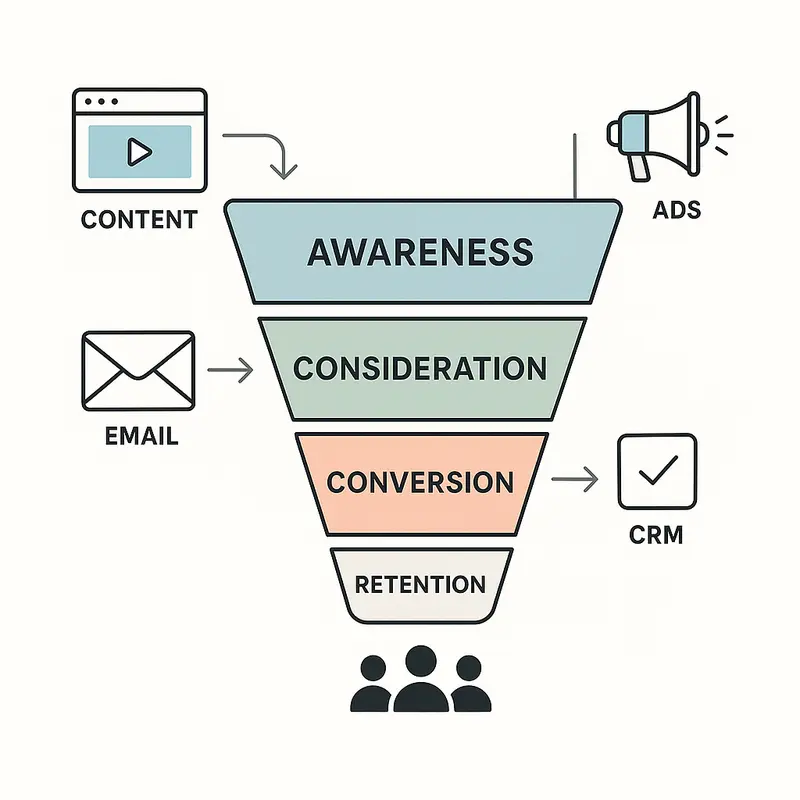
To remedy the gaps, businesses must move from a website-centric mindset to a digital presence strategy: a documented plan that coordinates content, search, social, paid, and automation around buyer stages. The strategy maps target personas to channels, content types, and conversion goals, and sets measurement frameworks to evaluate ROI. It turns the website from a static brochure into a central node in a multi-channel network that actively acquires and nurtures demand.
Start by defining customer personas and mapping their typical journeys. Identify the questions they ask at each stage and match content types: blog posts for awareness, detailed guides or webinars for consideration, and case studies and demos for decision. This mapping informs not only what you publish on the website, but also what you promote via social channels, how you set up retargeting pools, and which search keywords to pursue. Done correctly, the strategy ensures content serves both discovery and conversion functions.
Channels must be selected based on where your audience spends time and the expected ROI. For example, B2B buyers often respond well to LinkedIn content and long-form gated assets, while direct-to-consumer brands may prioritize Instagram and paid social. Complement these with a consistent social media marketing plan and targeted paid campaigns to amplify reach. Additionally, integrate analytics and reporting to measure campaign performance and iterate quickly.
H3: Tactical Steps for Creating a Digital Presence Strategy
Key tactical steps include: (1) persona development; (2) content audit to identify gaps; (3) channel selection and resource allocation; (4) conversion path design including lead magnets, CTAs, and nurture flows; (5) implementation of analytics and attribution; and (6) continuous testing and optimization. These steps create a playbook that aligns marketing, product, and sales teams around growth targets.
H3: Example — Service Business That Reinvented Presence
A regional services firm had steady organic traffic but low conversions due to generic messaging. By redesigning its online presence with persona-focused landing pages, local SEO, and a lead magnet that answered common buyer pain points, they saw a 60% increase in qualified leads within four months. They coupled the effort with better analytics — implemented via analytics and reporting — to attribute leads to specific content and channels, enabling smarter budget allocation.
5. Tactical Playbook: Turning Your Website into a Conversion and Revenue Engine
Execution is where strategy meets ROI. This tactical playbook covers immediate and medium-term actions to transform a business website into a lead machine. Immediate actions (0–30 days) include optimizing headlines, adding strong CTAs, implementing basic event tracking, and adding trust signals. Medium-term actions (30–90 days) focus on content creation, setting up email nurture flows, and launching targeted paid campaigns. Longer-term actions (90–180 days) involve personalization, advanced CRO, and building an audience through remarketing and community-building.
Prioritize by impact versus effort: low-effort, high-impact tasks like improving above-the-fold messaging, fixing mobile experience, and adding a short email follow-up should come first. Implement event tracking and tie it into your CRM so every conversion is measurable. Next, build content assets aligned to search intent and gated assets to capture leads. Use paid media as a funnel accelerator for high-value content, and route leads into automation sequences that qualify and nurture before sales outreach.
Finally, establish a testing cadence. A/B tests on landing pages, headlines, and forms should be run continuously. Track not just conversion rate but downstream metrics like SQL rate and revenue per lead. This ensures optimizations are tied to business outcomes rather than vanity metrics. If you lack internal resources, consider hiring a dedicated team or partner to run experiments and scale the work efficiently.
H3: Checklist — 10 Tactical Steps to Implement Immediately
- Clarify primary value proposition on homepage and top landing pages.
- Install and validate analytics and conversion tracking.
- Add prominent, contextual CTAs that map to buyer intent.
- Shorten forms; use progressive profiling in automation.
- Implement a welcome email and nurture sequence for leads.
- Fix mobile UX and speed issues.
- Add trust signals: client logos, testimonials, awards.
- Create 2–3 high-intent content assets and gate them.
- Launch a small paid campaign to test message-market fit.
- Set up weekly reporting and a monthly optimization sprint.
H3: Example — E-commerce Brand that Reduced CAC with CRO
An e-commerce brand reduced customer acquisition cost (CAC) by 28% after implementing a prioritized CRO program: simplifying checkout flow, adding product videos, and introducing dynamic retargeting. The company also used lookalike audiences developed from high-value customers to scale profitable acquisition, demonstrating how website improvements and marketing executions work in tandem.
6. Measurement, Attribution, and Continuous Improvement
Measurement is the backbone of a high-performing digital presence. A website without meaningful measurement is guesswork. Establish clear KPIs for each stage of the funnel (awareness, consideration, conversion, retention) and implement instrumentation to capture them. Common KPIs include new users, sessions by source, leads, conversion rates, MQLs, SQLs, CAC, and LTV. Without this visibility, diagnosing the "why website is not enough" problem becomes speculative rather than actionable.
Attribution matters because modern buyers touch multiple channels. Relying solely on last-click models skews insights and underfunds brand-building or upper-funnel activities. Implement multi-touch attribution or position-based models that give credit across the journey. Even with imperfect models, moving beyond last-click will reveal underappreciated channels that feed the funnel. Connect your site analytics to CRM data so you can measure revenue per channel and optimize for profit, not merely traffic.
Continuous improvement requires a structured testing process. Establish hypotheses, define success metrics, run experiments, and then iterate based on results. Maintain a test backlog and prioritize by expected impact and effort. This disciplined approach shifts your website from a static marketing asset to a living system that improves continuously. For many businesses, this step alone separates websites that stagnate from those that grow revenue year-over-year.
“Organizations that embed analytics and continuous experimentation into marketing see significantly higher growth and efficiency than those that treat the website as a static asset.” — industry research highlights the value of data-driven marketing.
H3: Tools and Integrations to Support Measurement
Key tools include analytics platforms (Google Analytics 4), tag managers, CRM systems, marketing automation (for example HubSpot or Marketo), A/B testing platforms (Optimizely, VWO), and data visualization tools. Integrating these systems ensures consistent data flows and actionable insights. For ePlanetSoft clients, we often combine web applications with analytics and reporting to create dashboards that align marketing and sales metrics in one place.
H3: Case Study — Attribution that Rebalanced Channel Spend
A mid-market company discovered through multi-touch attribution that content-driven email campaigns were generating higher-quality leads than the company's highest-spend paid search campaigns. By reallocating 20% of PPC budget to content and nurture, the company improved lead quality and reduced CAC, illustrating how measurement drives smarter investment.
7. Organizational Alignment: People, Processes, and Skills
Even the best strategy fails if the organization cannot execute. Align marketing, sales, product, and customer success around shared goals, SLAs, and processes. Define ownership for each funnel stage: who owns awareness, who qualifies leads, and how handoffs happen. Clear SLA commitments (e.g., sales responds to MQLs within X hours) ensure leads are not wasted. Processes should be documented and part of regular performance reviews to maintain discipline.
Skill gaps are common — you may need content strategists, CRO specialists, paid media experts, and data analysts. Many companies find it more efficient to hire a dedicated team or supplement with specialized contractors rather than hire every skill in-house immediately. Staff augmentation allows you to scale capabilities quickly while maintaining accountability. For tactical roles like SEO and CRO, partnering with agencies or hiring specialists often yields faster results than generalized marketing teams.
Finally, construct feedback loops. Use weekly sprints and monthly reviews to close the loop between hypotheses, experiments, and results. Celebrate wins and document lessons learned to build institutional knowledge. Over time, these processes convert ad-hoc website improvements into a repeatable playbook for growth.
H3: Internal Link — Design and Experience
When rethinking conversions, also consider visual and interaction design. Leverage expertise from a website designing agency or UI/UX design specialists to ensure your site communicates value instantly and reduces friction. Well-executed UX can be the difference between a visitor and a converted lead.
H3: Hiring Strategy — In-house vs External Partners
Decide which capabilities to build internally and which to outsource. Core brand and product messaging usually stay internal; execution-heavy specializations like paid media, analytics engineering, or rapid A/B testing can be more cost-effective through partners. Use a hybrid approach and maintain strong vendor governance to keep focus and quality high.
Key Takeaways

- A website not enough: Modern buyer journeys require multi-channel engagement, not a single destination.
- Website vs marketing system: Transform your site into a coordinated system that acquires, qualifies, converts, and retains.
- Common failures: Lack of clarity, poor UX, slow performance, and missing follow-up are frequent causes of low conversion.
- Actionable roadmap: Implement tracking, optimize CTAs, add nurture flows, and run continuous experiments.
- Organizational readiness: Align teams, invest in skills, and consider hiring or partnering to scale execution.
Conclusion: From Website to Revenue Engine — Your Next Steps
In today's digital landscape, simply launching a website is a starting point — not an outcome. If your business website not generating leads or not converting as expected, the problem is rarely isolated to design alone. It stems from missing orchestration: integrated channels, measurement, follow-up, and continuous optimization. By shifting from a website-only mindset to a digital presence strategy, you create a reliable engine for demand and revenue.
Begin with a pragmatic audit: clarify your primary conversions, instrument analytics, and implement low-effort, high-impact fixes like clear CTAs and faster load times. Next, build out the system: targeted content, paid amplification, nurture sequences, and attribution. Align your teams and fill skill gaps either through hiring or by partnering with specialists. If you need help implementing these changes, ePlanetSoft offers end-to-end support from strategy to execution — from professional SEO services and conversion rate optimization to custom platforms and analytics and reporting integration.
Turn your website from a static brochure into a measurable, scalable marketing system. Start with the audit today, prioritize the highest-impact actions, and iterate — because in a competitive digital economy, a website alone is no longer enough.
Image Prompts for AI Generation
Use the following detailed prompts to generate images for the blog:
- Featured/Hero Image Prompt: A modern business scene showing a multi-channel digital ecosystem — a central open laptop displaying a website, surrounded by floating icons for email, social media, search, analytics dashboard charts, and a marketing automation flow diagram; sleek, clean flat-vector style with blue and teal palette, subtle gradients, and professional corporate atmosphere, no text, high resolution, wide banner composition.
- Mid-Article Image Prompt: An illustrative infographic-style image of a conversion funnel, with labeled stages (awareness, consideration, conversion, retention), small icons for content, ads, email, and CRM connected by arrows; minimalist, modern tech illustration with muted accent colors, lots of white space, centered composition.
- Late-Article Image Prompt: A results/outcomes visualization showing a dashboard with rising KPIs (traffic, leads, conversion rate) on a desktop screen, team members reviewing the dashboard in the background, warm lighting, professional photographic-illustration hybrid style, corporate color accents, no text.
Further Reading and References
Frequently Asked Questions
Why a Website Is Not Enough Anymore for Business Growth.
Why is my website not generating leads despite having traffic?
High traffic without leads usually indicates a mismatch between visitor intent and site content, poor CTAs, or friction in conversion paths. Conduct an audit of messaging clarity, CTA placement, form length, and page speed; implement tracking to identify where visitors drop off and prioritize fixes that remove friction and match intent.
How do I know if my website needs a full redesign or just marketing improvements?
Start with analytics and user testing. If conversion issues stem from messaging, CTAs, or lack of follow-up, marketing improvements and CRO may suffice. If the site is technically outdated, not mobile-friendly, or fails accessibility standards, consider a redesign. Combine changes iteratively rather than defaulting to a full rebuild.
What is the difference between a website and a digital presence strategy?
A website is a single asset, while a digital presence strategy coordinates multiple channels and systems (SEO, paid, social, email, automation, CRM) to acquire and nurture customers. The strategy defines how the website fits into a broader funnel that drives measurable business outcomes.
Which metrics should I track to see if my website is converting properly?
Track a mix of acquisition and outcome metrics: sessions by channel, bounce rate, conversion rate per landing page, leads (MQLs/SQLs), CAC, and revenue per channel or campaign. For meaningful insights, integrate site analytics with CRM to connect leads to revenue.
How quickly can I expect results after moving from a website-only approach to a marketing system?
Some improvements, like clearer CTAs and faster page load times, can yield measurable uplift within weeks. More complex work — SEO, content authority, and advanced automation — may take 3–6 months to show substantial results. Plan a mixed cadence of quick wins and longer-term investments.
Ready to Grow Your Business?
Get a free consultation from our digital marketing and development experts. Let's discuss how we can help you achieve your goals.
- No commitment required
- Detailed technical roadmap
- Customized to your infrastructure
By submitting this form, you agree to our privacy policy. · 4,000+ businesses served · 24hr response · 98% satisfaction