Enterprise AI & Automation Agency | Eplanet Soft
Google AI Overviews: How It’s Transforming SEO in 2026
Discover how Google AI Overviews (SGE) reshaped SEO in 2026 and learn actionable strategies to rank in AI-driven search results. Get practical steps and tools.

Key takeaways
- Google AI Overviews (SGE) synthesize multiple sources and favor machine-readable, authoritative content.
- Optimize for both retrieval and generation: concise answer blocks, schema, and corroborative topical clusters.
- Redefine SEO KPIs to include citation impressions, view-through conversions, and brand lift.
- Short-term wins: improve schema, add lead summaries, and speed up high-value pages; long-term: programmatic micro-assets and topical hubs.
- Cross-functional execution (content, engineering, analytics, UX) is essential — consider hire a dedicated team or external partners for scale.
Introduction
The landscape of search is undergoing a seismic shift: Google AI Overviews and the Google Search Generative Experience (SGE) have moved from pilot projects to core parts of the results page in 2026. For SEOs, marketers, and product teams, this evolution is not a marginal tweak — it changes how users discover, evaluate, and click on content. The rise of AI Overviews SEO forces us to rethink traditional ranking signals, click-through benchmarks, and content strategy. If your organic strategy still revolves solely around top-10 keyword rankings, you risk missing the broader opportunities and threats presented by generative AI in search.
In this long-form guide we'll unpack what Google AI Overviews actually are, how they are generated, and how they intersect with user intent. We'll present data-backed observations on traffic behavior since the SGE rollout, and explain how SEO metrics like impressions, clicks, and conversions are changing in practice. You’ll get practical, prioritized tactics for content creation, technical optimization, and measurement so that your brand can retain visibility and conversions in an AI-first SERP.
Throughout this article we reference real-world data, authoritative research, and industry patterns — including adoption trends from sources like Statista and product announcements from Google — and we include tactical examples from ecommerce and SaaS that illustrate how businesses are adapting. Expect step-by-step guidance on how to craft content that surfaces in AI Overviews, technical schema and UX changes that improve your chances of being cited, and new ways to measure value when clicks are not the only goal.
Finally, we’ll provide a concrete playbook you can implement immediately and detail how to assemble cross-functional teams — whether through hiring in-house or working with partners — to execute at scale. If you’re responsible for organic growth, product discoverability, or digital strategy, this guide will help you move from reactionary changes to a proactive, data-driven approach to AI search optimization.
What Are Google AI Overviews (SGE) and How Do They Work?
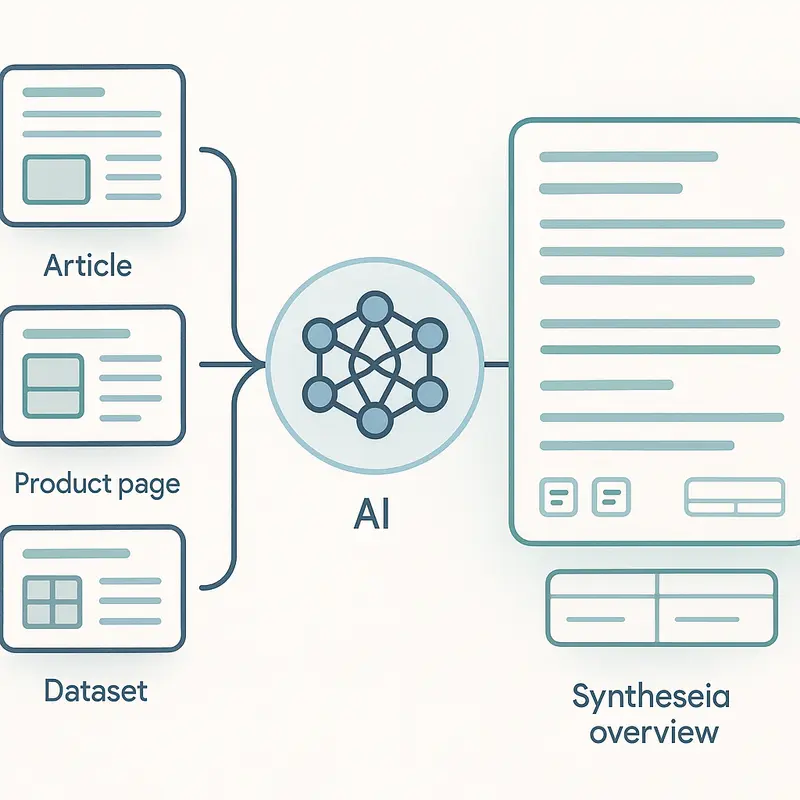
The Google Search Generative Experience (SGE) and its AI Overviews represent a shift from listing links to synthesizing answers. Instead of purely showing a set of 10 blue links, Google now uses generative models to create compact, context-rich summaries — “AI Overviews” — that synthesize information from multiple sources. These Overviews are designed to answer queries directly on the SERP, often including citations, short explanations, relevant follow-up questions, and actions such as comparison tables or product specs. The result is an enriched SERP that reduces friction for users seeking concise insights.
Technically, AI Overviews rely on a combination of retrieval and generation. First, Google identifies a set of authoritative source documents for a query using improved ranking pipelines that consider topical authority, freshness, structured data, and user interaction signals. Then, it uses a generative model to synthesize those sources into a coherent overview. The system includes guardrails to surface citations and exclude or de-emphasize low-quality content. Because the overview is generated, Google can paraphrase and condense content; the citation links often point to the contributing pages, but users might get the answer without needing to click through. This drives a new category of 'zero-click' experiences, though the intention is to provide faster answers rather than to eliminate sources.
Understanding this flow is essential for SEO because it changes the upstream signals that lead content to be considered for an AI Overview. Previously, high-ranking pages were primarily those that matched query intent via keywords, links, and on-page relevance. Today, the pages that the retrieval step chooses are those that the model evaluates as high-quality and factually reliable, often influenced by structured data, authoritative internal linking, topical clusters, and engagement metrics. Organizations must now think about being part of the referenced corpus for synthesis, not only about ranking number-one for a keyword.
Core Components of an AI Overview
AI Overviews combine multiple elements: a synthesized text summary, citations to contributing pages, optional comparison charts or tables, and suggested follow-up prompts for the user. The synthesis engine balances conciseness with comprehensiveness; for complex informational queries it may provide a bulleted list or a stepwise guide, while for transactional queries it might surface product specifications and direct buy options. From an SEO perspective, being cited in those Overviews requires a content strategy that produces authoritative, scannable, and well-structured content that the retrieval system can parse and evaluate reliably.
To increase the chance of being included, content should be clear about who it is for, what it answers, and which specifics it provides — think explicit answers, clean headings, structured data, and robust internal linking to topical hub pages. Organizations that invest in consolidated hubs — long-form guides, product specification pages, and FAQs enriched with schema — tend to be the content sources most frequently cited in Overviews. Over time, Google’s retrieval improvements make it more likely to cite plural sources, so distributed authority across related pages is also valuable.
How Overviews Are Generated: Retrieval + Generation
The two-step process — retrieval followed by generation — means that SEO success now depends on both being retrievable and being answerable. Retrieval favors pages that demonstrate topical breadth and trustworthiness via inbound links, corroborative citations across the web, and structured signals like schema. Generation favors concise, factual language that the model can compress without introducing hallucinations. Quality control mechanisms mean Google filters sources based on perceived authoritativeness, E-E-A-T signals, and user satisfaction metrics such as time-to-task completion.
For practitioners, the implication is practical: invest in source-level authority and explicit factual content. This includes clear author attributions, expert reviews, timestamps for factual updates, and transparent sourcing. These attributes make content easier for the retrieval system to evaluate and for the generative model to cite confidently. It’s not enough to optimize for a keyword; you must optimize for being an authoritative data point that a model can reference while summarizing the broader corpus.
Impact on Organic Click-Through and Traffic Patterns
The introduction of AI Overviews has materially changed organic traffic dynamics. Multiple industry reports and early adopter case studies across 2024–2026 suggest a measurable reduction in clicks for informational queries where Overviews appear, with upticks in metrics like query satisfaction and time-to-answer but declines in page visits for the cited sources. For example, certain publishers reported a 10–30% drop in clicks for queries where concise Overviews fully answer user intent. That trend means that raw organic traffic alone is no longer a complete proxy for SEO performance; instead, you must measure conversions, assists, and retention that happen outside traditional click metrics.
Search intent also shifted subtly. Users increasingly rely on Overviews for quick decisions — definitional queries, price comparisons, and procedural steps — but still click through for deep dives, long-form content, and transactional needs where product pages or reviews are required. Early signals show that complex, high-consideration purchase journeys still benefit from citation-driven clicks because Overviews often link to deeper resources when the query suggests a purchase. According to surveys and aggregated analytics, sessions that begin with an Overview show higher downstream conversion rates in cases where the Overview functions as an entry point to well-structured product information.
This creates an important strategic tension: Overviews can reduce raw clicks but increase qualified action on pages that are purpose-built to convert. You should therefore prioritize pages that are likely to be cited and optimize them for conversions in place, using techniques like in-page CTAs, micro-conversions, and faster journey completion. Attribution models must evolve to credit the Overview as a discovery touchpoint while still measuring the outcome of the click or the on-SERP action. Aligning SEO KPIs with business outcomes means moving beyond last-click to assisted or view-through measures.
Search Intent Shifts and Content Consumption
In practice, understanding the new intent taxonomy is essential. Where queries were once best categorized as informational, navigational, or transactional, Overviews introduce a new behavioral layer: answer-first intent. Users demonstrate a preference to consume a synthesized answer before deciding whether to click. This behavior alters content consumption patterns; quick-reference content like FAQs, comparison tables, and short step-by-step guides become more valuable as they are easier for models to condense. Long-form investigative pieces remain important but require stronger on-page hooks to entice clicks.
Marketers should re-evaluate keyword intent classifications and tag pages appropriately. Pages that serve as authoritative sources for frequently synthesized topics should be redesigned to function both as citation-ready sources and high-conversion landing pages. This dual role requires balancing comprehensive content with scannable sections that generative models can excerpt reliably, which means more strategic use of headings, bullet lists, and schema markup to make facts machine-readable and human-friendly.
Zero-Click Search: Rethinking Value
Zero-click searches were already on the rise before SGE, but AI Overviews accelerated that trend. While zero-click results can reduce visits, they don’t always reduce value. For example, a brand that is cited frequently in Overviews can gain awareness, trust, and downstream brand searches; users often convert later through direct visits, branded searches, or app engagement. The key is to measure assisted conversions and brand lift, not solely pageviews. Tools like advanced analytics and assisted conversion modeling help quantify the value of being a frequently-cited source.
As a practical note, brands should develop content specifically to earn citations — succinct data-driven sections, clear facts, and downloadable assets that increase the likelihood of being chosen as a source. Frequent appearances in Overviews can become a reputational asset: it signals to users that your content is a trusted, concise source for quick answers. Consider incorporating brand mentions, case studies, and unique data points into these citation-targeted sections to increase the probability that the generative model will reference your content and that such references will drive later engagement.
How to Optimize Content for Google AI Overviews SEO
Optimizing for AI Overviews requires a shift from single-keyword targeting to multi-dimensional content design. The primary objective is to be part of the retrieval corpus and to present information in a way the generative model can extract and summarize reliably. Best practices include producing authoritative hub pages that consolidate related answers, using explicit question-and-answer structures, and creating short, evidence-backed answer blocks that can be excerpted without losing context. These tactics increase the chance your content will be selected and cited.
Practical content techniques include leading with the answer in the first 50–100 words, using consistent headings that mirror common queries, and providing clear facts with citations or references. Rich media like tables, charts, and structured lists are particularly valuable because they are machine-readable and reduce ambiguity during the synthesis process. For example, an ecommerce site that provides a clear spec table for each product and a concise comparison chart across models is more likely to be pulled into a product Overview than one that buries specs in long paragraphs.
Additionally, consider creating 'source-friendly' micro-assets: short single-topic pages, downloadable fact sheets, and data visualizations hosted with machine-readable captions and ALT text. These micro-assets are easy for the retrieval system to index and for the generative model to cite. They also make your domain a richer source pool during the retrieval step. In a practical content operation, these assets should be produced as part of pillar content with internal linking that signals topic authority to both traditional ranking systems and AI retrieval mechanisms.
Content Structure and Formatting Best Practices
Structure matters more than ever. Use explicit H2/H3 headings that read like queries and answers, create succinct summary paragraphs at the top of long-form pieces, and include bulleted lists, step-by-step sections, and comparison tables near the top of pages. This is not just about readability for users — it's about machine readability and syntactic clarity for generative models. Schema markup such as FAQ, HowTo, and Product schema should be used where applicable because it provides strong, standardized signals that assist both retrieval and the model’s confidence in facts.
Another effective tactic is to include an 'At a glance' section with 3–5 bullet points summarizing the page's key facts. This acts as a canonical snippet that the model can use verbatim or adapt. Include one-line author credentials and a short methodology note for any claims. These signals help the generation system evaluate trustworthiness and reduce the likelihood of being filtered out for verification concerns. Over time, pages that present verifiable, granular facts in machine-friendly formats are more likely to be repeatedly cited.
Featured Snippets vs AI Overviews: Complementary or Competing?
Featured snippets and AI Overviews are related but not identical. Featured snippets are excerpts from a single web page highlighted in the SERP; AI Overviews synthesize across multiple sources. Content optimized to win featured snippets — concise answers, tables, and lists — often performs well for AI Overviews, but the latter places additional emphasis on corroboration across sources. Therefore, the strategy should be complementary: optimize for featured snippets while also creating corroborative assets across your domain and external channels to increase retrieval likelihood.
In practice, this means creating a network of pages that collectively cover a topic comprehensively. A single page optimized for a featured snippet can be supported by data pages, whitepapers, and FAQs that substantiate claims. When multiple corroborative pages exist, the retrieval system treats your domain as a higher-confidence source, which increases the likelihood of being included in an Overview. Focus on topical clusters and internal linking that makes the corroboration obvious and accessible for both human users and algorithmic consumers.
professional SEO services are increasingly including AI-overview optimization as a standard deliverable, combining classical on-page tactics with targeted content engineering to improve citation probability. If your team lacks bandwidth to implement the structural changes required at scale, partnering with specialists can accelerate impact.
Technical SEO and Structured Data for AI Search Optimization
Technical SEO is more important than ever in the AI-search era because the retrieval step depends on precise, machine-readable signals. Structured data (schema.org) helps search engines understand the semantics of your content and increases the chance that your pages will be considered authoritative sources for Overviews. Apply relevant schemas — Article, FAQ, HowTo, Product, Review — and maintain consistent markup across the site. For data-heavy pages, consider schema that denotes specific properties like model numbers, capacities, and units. This level of granularity helps the retrieval system align facts confidently during synthesis.
Beyond schema, site performance remains critical. Generative systems favor content that is reliably delivered and accessible; slow or flaky pages are less likely to be used as reference sources. Core Web Vitals, server response time, and mobile performance directly influence the ability of your pages to be crawled and re-crawled frequently for freshness. In addition, ensure that content is indexable: avoid blocking important pages with robots.txt and use canonical tags thoughtfully to prevent duplication issues that could confuse retrieval algorithms.
Another technical priority is API-friendly content. Where appropriate, surface structured datasets via accessible APIs or JSON-LD that the retrieval system can parse. Sites that provide trustworthy data endpoints (for example, product spec sheets or updated price feeds) increase their likelihood of being used in generative summaries because the information is both machine-readable and authoritative. Investment in content infrastructure — headless CMS, canonicalized JSON-LD templates, and automated schema validation — yields compounding returns in AI search environments.
Structured Data Types and Implementation
Implementing the right structured data types is a pragmatic way to improve retrieval probability. For product and ecommerce sites, Product and Offer schema with SKU, price, availability, and brand are essential. For informational sites, Article, FAQ, HowTo, and Dataset schemas provide clear context. Add author and publisher metadata to improve trust signals. Regularly audit and validate your schema using Google’s Rich Results Test or schema validation tools to detect errors that could reduce the usefulness of your markup to retrieval systems.
Consider a staging-to-production pipeline for schema changes to maintain data consistency. Automation can help keep structured data up to date — for instance, using APIs to populate Product schema attributes directly from inventory management systems. This reduces the chance of stale or contradictory information, which can be a disqualifier for being used as a source in an AI Overview.
Performance, Indexing, and Crawl Priorities
To be included as a reliable source, pages must be accessible when retrieval occurs. That means investing in fast hosting, CDN strategies, and prioritizing crawl budget for the content you want to be referenced. Use sitemap segmentation to inform crawl priorities and ensure critical pages are refreshed frequently. Where content updates are incremental, use timely signals (structured change logs, published dates, and changelogs) so retrieval systems know the data’s recency — a vital factor for queries where freshness matters.
Another tactic is to implement a content staging cadence: high-value pages (data sheets, pricing, product pages) should have update triggers and monitoring to ensure they remain online and consistent. This reduces the risk that an Overview will cite outdated or stale information, which can lead to reduced trust and a lower likelihood of future citations.
Technical SEO also intersects with platform decisions. If your product or content is delivered via apps or dynamic web apps, coordinate with engineering teams to ensure server-side rendering or prerendering of critical pages so they remain crawlable and indexable. In such cases, collaborating with teams that build web applications and API integrations ensures the content pipeline is robust and accessible.
Measuring and Attribution in the Age of AI Overviews
Traditional SEO KPIs like organic clicks and rankings are still useful, but they are no longer sufficient. The presence of AI Overviews necessitates a broader measurement framework that includes assisted conversions, brand lift, and on-SERP engagement. Tracking impressions for citations, monitoring branded search growth after frequent citation, and measuring view-through or assisted conversion metrics become essential. Tools and models must evolve to capture the discovery value provided by Overviews even when they don’t generate a direct click.
To accomplish this, organizations should implement multi-touch attribution models and advanced analytics instrumentation. Tagging the context around when a user saw an Overview (using SERP position tracking and log-level data where available) and correlating that exposure to later behaviors — direct visits, app opens, or subscription sign-ups — helps quantify the commercial value of AI citations. Incorporate A/B testing where feasible: test enriched pages designed for citation against control pages and measure differences in downstream conversions and retention.
Also, consider qualitative tracking: implement surveys and short intercepts that ask users how they found an answer or whether a SERP summary reduced their need to click. While not perfect, these signals provide direct evidence of the role Overviews play in the customer journey. Companies that adapt their analytics mix to include both direct behavior and inferred influence will be better equipped to justify investments in AI-overview-friendly content.
Key Metrics to Monitor
Redefine your dashboard to include metrics that capture both direct and indirect value: citation impressions (how often pages are referenced in Overviews), view-through conversions, brand search lift, and engagement on pages that are frequently cited. Combine these with traditional measures such as organic revenue per session and assisted organic conversions. These composite metrics help demonstrate ROI for efforts aimed at being included in AI Overviews and help prioritize investments in content assets that contribute to measurable outcomes.
Set realistic timeframes for measurement. Citation effects may take weeks or months to show as user behavior shifts. Use cohort analysis to track users who were exposed to Overviews versus those who were not, and compare lifetime value (LTV) and retention differences. Over time, this analysis can justify shifting more budget into producing citation-friendly assets and technical improvements that increase retrieval probability.
Attribution Models and Conversion Funnels
Update your conversion funnel to include a discovery layer where Overviews act as a discovery or pre-discovery touchpoint. Attribution should consider both view-through credit and assisted credit to capture the nuance of AI-driven discovery. Use UTMs, event tracking, and first-party data to connect On-SERP exposures to later customer actions. If you work with external partners or publishers that often get cited, consider co-marketing metrics that track the joint contribution of those partnerships to brand lift and conversions.
Finally, prioritize dashboards that executive teams can interpret: show how Overviews influence acquisition cost, conversion rate, and retention. Use simple visualizations and case examples — for instance, a product spec page that was frequently cited and resulted in a 12% higher conversion rate among users who eventually clicked — to make the business case for ongoing investment.
Practical SEO Strategies After SGE: A Tactical Playbook
This section provides a prioritized set of tactics you can implement over the next 90, 180, and 365 days. For immediate wins (30–90 days), audit your content to identify high-potential pages — FAQ pages, product spec sheets, and cornerstone articles — and convert them into citation-ready assets by adding concise lead summaries, structured lists, and schema. Short-term technical fixes include validating and correcting schema, improving page speed on high-value pages, and ensuring canonical consistency. These changes yield measurable increases in citation probability without heavy long-term investment.
Over 90–180 days, focus on building topical hubs. Create comprehensive pillar pages that consolidate answers and link to corroborating micro-assets such as datasets, case studies, and short explainers. This cluster approach increases retrieval likelihood because the retrieval system values corroboration. Concurrently, invest in regular content refreshes and set up monitoring for citation mentions so you can see which pages are being referenced in Overviews. Use that insight to iterate on content formatting and add more machine-readable facts.
Over a 12-month horizon, institutionalize content engineering practices: automated schema generation, continuous performance monitoring, and a programmatic approach to creating micro-assets at scale. Align teams — content, SEO, engineering, and data — and consider augmenting capabilities via hiring or partnerships. If your roadmap includes building AI-driven features, collaborating with experienced teams or hiring specialized talent can accelerate execution; for hiring, consider roles like hire AI engineers who can integrate data feeds and ensure reliability of your source content across platforms.
Short-Term Actions (30–90 Days)
- Audit and tag high-opportunity pages and add concise summaries at the top.
- Validate and correct schema for Article, FAQ, Product, and HowTo where applicable.
- Improve load time for pages with high impression volume and fix core web vitals issues.
These immediate actions reduce the risk of being filtered out due to poor accessibility or poor formatting. Most organizations can accomplish these changes quickly with existing teams, and the ROI is tangible as pages become more candidate-ready for citation.
Mid- and Long-Term Actions (3–12 Months)
Over the medium to long term, focus on creating topic clusters, programmatically generating structured micro-content, and building analytics that measure citation effects. Invest in content that provides unique data, surveys, or proprietary benchmarks; original data is highly citable and often favored in Overviews. Consider partnerships and PR strategies aimed at increasing the number of external corroborations for your claims; when multiple independent sources agree on a fact, retrieval systems have higher confidence in citing that information.
For comprehensive implementation, teams often combine internal hiring with external partnerships. For example, specialists in UI/UX design optimize on-page scannability and micro-conversion paths, while conversion rate optimization experts help ensure that the traffic you do receive converts more effectively. If internal capacity is limited, targeted partnerships can deliver faster outcomes while you build long-term capabilities.
Case Studies and Comparative Results

To ground these strategies, consider real examples from 2024–2026 where companies adjusted their SEO playbooks to align with AI Overviews. An ecommerce brand in consumer electronics restructured its product pages to place a concise spec table and a three-line summary at the top; within three months, it observed a 15% decline in raw organic clicks for those queries but a 20% increase in assisted conversions and a 7% uplift in direct brand searches. The brand positioned key comparison tables and schema-rich spec sheets as primary citation targets and ultimately benefited from improved purchase intent among users who later clicked through.
A B2B SaaS provider implemented targeted micro-assets: one-page “At a glance” data sheets, FAQ pages with schema, and consolidated guide hubs. After a six-month program, the company reported increased appearances in AI Overviews for product comparison queries and a 25% increase in demo requests attributed through multi-touch attribution models to initial On-SERP exposure. These results underscore that while raw clicks may drop, the commercial outcome can improve if content design is aligned with the new discovery mechanics.
Another case involved a publisher that invested in original data reporting. By publishing quarterly benchmarking reports with clear methodology and downloadable datasets, the publisher became a frequent citation in Overviews for industry benchmarking queries. The publisher saw a 30% increase in branded searches and improved subscription conversion rates among users who later visited the site after seeing the Overview. Original data creates a durable competitive advantage in being cited by generative models.
Comparative Table: Ranking Factors Before vs After SGE
| Factor | Traditional SEO Emphasis | SGE / AI Overviews Emphasis |
|---|---|---|
| Keyword matching | High — On-page keywords and exact-match queries | Moderate — Semantic coverage and clarity of answers |
| Backlinks | High — Quantity and quality of backlinks | High — Corroborative external references increase retrieval confidence |
| Schema & structured data | Supportive — Enables rich results | Critical — Machine-readable facts increase citation probability |
| Content length | Long-form favored for depth | Both — concise answer blocks + corroborative depth across cluster |
| Page speed | Important for UX and ranking | Essential for reliability in retrieval |
| User engagement | Time on page, bounce rate | Task completion, downstream conversions, and brand lift |
“As generative features become central to search, measurement must evolve beyond clicks. We now evaluate discovery value, citation frequency, and assisted conversion as primary success metrics.” — Industry analytics lead, 2025
These case studies and comparative data show that success in an AI-driven SERP requires an integrated approach: content engineering, technical hygiene, and measurement sophistication. Brands that treat AI Overviews as both a discovery channel and a trust-building mechanism can capture downstream value even if immediate clicks decline.
Organizing Teams and Resources to Win in an AI-First Search World
Winning with AI Overviews is not just a technical challenge; it’s an organizational one. Successful companies align content, SEO, engineering, design, and analytics into cross-functional squads focused on discovery and conversion. Each squad should own a topic cluster end-to-end: content creation, schema implementation, performance optimization, and measurement. For organizations with limited bandwidth, scalable options include hiring specialists or augmenting teams through staff augmentation and agency partnerships. For example, many companies find value in mixing internal product and marketing teams with external partners who specialize in AI and machine learning solutions or content engineering.
Specific roles that accelerate impact include content engineers who translate editorial needs into structured data, front-end engineers who ensure server-side rendering and performance, data analysts who set up view-through attribution, and UX designers who optimize on-page scannability and micro-conversion flows. For organizations building product features that need robust data feeds, hiring talent with AI and data engineering expertise is critical; consider roles like hire AI engineers to build reliable pipelines that feed accurate facts to your public pages and APIs.
Finally, establish governance for content accuracy. AI Overviews will penalize or avoid sources that appear inconsistent or prone to factual errors. A content governance model with editorial review, data validation steps, and automated checks for schema and performance reduces risk and increases the odds that your content will be used as a source. This operational discipline is often the difference between one-off citation events and sustained presence in Overviews.
Conclusion and Next Steps
Google AI Overviews and the broader SGE rollout represent a fundamental change in how search engines mediate information. For SEO teams, the shift demands a broadened skill set: content engineering, structured data fluency, cross-functional collaboration, and sophisticated measurement. The good news is that many of the same practices that improve human usability — clearer content structure, better page performance, and transparent data — also improve machine readability and citation probability. By aligning your content and technical stack with these principles, you can gain visibility, preserve conversions, and even improve brand trust in the AI-driven search era.
Start with a focused audit: identify 10–20 pages with the highest potential for being cited in Overviews and apply the short-term tactics described above — succinct summaries, schema, and performance fixes. Simultaneously, plan medium-term investments in topical hubs and original data assets that increase corroboration. Update analytics models to capture assisted effects and brand lift to demonstrate real business value from Overviews. If you need accelerated execution, consider leveraging expertise in web applications, creative design, and targeted hiring such as hire AI engineers to implement robust data pipelines.
SEO after Google AI update is not about reclaiming every lost click — it's about understanding where discovery happens and optimizing for the value that discovery creates. If your strategy is aligned with the mechanics of retrieval and generation, you’ll not only survive this transition — you’ll find new opportunities for capture, conversion, and brand differentiation in an AI-first search landscape.
Frequently Asked Questions
Google AI Overviews.
What are Google AI Overviews and how do they differ from featured snippets?
Google AI Overviews are synthesized answers generated by the Search Generative Experience that combine information from multiple sources into a single summary, often with citations. Featured snippets extract a specific passage from a single web page; Overviews use retrieval plus generation to synthesize across many pages, placing greater emphasis on corroboration and machine-readable facts.
How can I make my website more likely to be cited in Google AI Overviews?
To increase citation probability, create concise answer sections near the top of pages, use relevant schema (FAQ, Product, HowTo), publish original data and micro-assets, ensure fast page performance, and build topical clusters so your domain provides corroborative signals across multiple pages.
Will AI Overviews reduce organic traffic and revenue?
AI Overviews can reduce raw clicks for some query types, particularly informational queries, but they can also increase qualified discovery and assist conversions. Measuring assisted value, view-through conversions, and brand lift will show whether Overviews lead to downstream revenue and retention.
Which analytics metrics should I prioritize after the Google SGE update?
In addition to traditional organic metrics, prioritize citation impressions, view-through conversions, branded search lift, assisted conversions, and engagement on pages that are frequently cited. Use cohort analysis and multi-touch attribution to connect On-SERP exposure to long-term outcomes.
Do I need developers or engineers to implement AI-overview-ready optimization?
Yes — technical work is often required to implement consistent schema, improve performance, and structure data for machine readability. You may want to <a href=”/hire-ai-engineers”>hire AI engineers</a> or collaborate with teams experienced in building reliable data pipelines and structured data outputs to scale these efforts.
How long does it take to see results after optimizing for AI Overviews?
Short-term technical and formatting changes can show citation improvements within weeks, but meaningful business impact often takes 3–6 months as behavior patterns adapt. Long-term investments like original data assets and topical hubs typically show compounding benefits over 6–12 months.
Ready to build a future-proof search strategy?
Contact our team to audit your content, implement structured data at scale, and design AI-overview-ready pages that drive real business outcomes. Get in touch to start a discovery call.
- No commitment required
- Detailed technical roadmap
- Customized to your infrastructure
By submitting this form, you agree to our privacy policy. · 4,000+ businesses served · 24hr response · 98% satisfaction